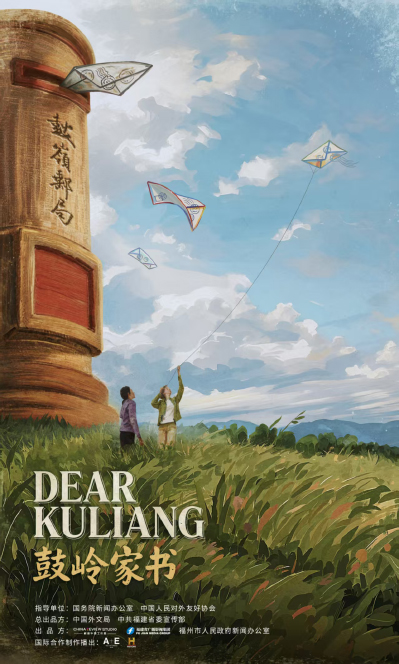
To the east of Fuzhou, capital of Fujian Province in southeast China, stands a verdant mountain known as Kuliang. In the mid-19th century, many international guests settled in the city. Kuliang rose to fame as a beloved summer retreat, attracting expatriates who had made Fuzhou their home. For nearly a century, foreign and local residents lived together in harmony, and Kuliang blossomed into a unique international community where Eastern and Western cultures intertwined.
A history brought to life
Mary Carleton was one of the expatriates. In 1887, after graduating from the College of Medicine at Syracuse University in the United States, under the Methodist Episcopal Church, she arrived in China, where she worked in a hospital in Kuliang, later built a clinic, and adopted a Chinese daughter.
More than a century later, Carleton’s descendant Holly Bradsher, a U.S. high school student, learned of this chapter of history from her grandmother. Deeply moved by it, she decided to travel across the ocean to China to trace the footsteps of her great-great grandaunt. Along the way, she formed a friendship with a Chinese girl, Zhou Tianyi, and together they explored Kuliang, visiting places that still bear the many cherished memories of friendship between China and the U.S.
The 50-minute China-U.S. co-produced documentary Dear Kuliang tells exactly such stories. It not only revives touching stories of Carleton and other figures connected to old Kuliang, but also captures the journey of contemporary Chinese and American youth as they meet, come to understand one another, lend mutual support and build a deep and heartfelt friendship.
With filming beginning in July 2023, the documentary was released in China on SETV (Southeast Television) on November 10 and was also broadcast on the History Channel in the U.S.
“The production took nearly two years and was filmed at multiple locations across China and the U.S.,” Chen Fang, general producer of Dear Kuliang, told Beijing Review.
Dear Kuliang celebrated its U.S screening, held at Loyola Marymount University and the Consulate General of China in Los Angeles, during the Capture the Moments of Friendship: a Cinematic Record of China-U.S. Relations event that took place in Los Angeles on November 7. The event was one of the highlights of the 21st Chinese American Film Festival (CAFF) and the Chinese American Television Festival. The screenings attracted local university students and faculty, film industry professionals and representatives from cultural and friendship organizations.
Founded in 2005, the annual festivals are held in Los Angeles every November. The Los Angeles County Office has designated November as “Chinese American Film Festival and Chinese American Television Festival Month.”
During the festivals, a series of panels convened, bringing together professionals from China and the U.S. to exchange insights and explore avenues for collaboration.
Friendship across the Pacific
Among the many guests participating in the screening, Andrew Morgan, an acclaimed filmmaker with four Academy Awards to his name, is a pioneering figure and advocate for Sino-U.S. co-productions in film and television. He has been actively involved in the production of Chinese-themed projects such as The Way of the Dragon (a 1972 film directed by and starred in by Bruce Lee), Enter the Dragon (a 1973 martial arts film directed by Robert Clouse and also starring Lee) and The Warlords (a 2007 historical action film directed by Peter Chan).
His personal experience of engagement with China represents a microcosm of the broader friendship between the two countries. After the screening, he told Chen that he had a deep connection with Lee. Following Lee’s passing, he personally accompanied Lee’s wife and two children on their return to the U.S. and assisted in arranging the funeral services in Seattle.
Morgan was also exceedingly generous in his praise for this documentary: “From what I have seen, it is an excellent documentary. It highlights a period of Sino-American relations prior to the founding of People’s Republic of China that many Americans are unfamiliar with, and in that regard, it is especially valuable.”
The friendship between the young Chinese and American protagonists in the documentary left a deep impression on him. He stated that it is very important to strengthen the connections and exchanges between young people in China and the U.S.
“When you start to connect the younger generations in both countries and show the similarities in lifestyle, then they start to feel that they have more in common, and that will overcome a lot of the current political difficulties and misinformation being spread by certain factions here in the West. It helps young people on both sides of the Pacific to realize that, honestly, under the skin, we are all the same, so I hope there will be more documentaries and you continue to bring them to the CAFF,” he told participants at the screening.
Also present at the event were other figures who, like Morgan, have been deeply involved in Sino-U.S. film collaboration and industry exchanges, and Bob Underwood, head of the International Committee of the Writers Guild of America West.
“Every story that shows the relationship between people in China and the U.S. helps improve the bilateral relationships. And Dear Kuliang tells an especially touching story,” he said to Chen.
Underwood himself had visited China many times, but before his first trip, his impression of the country was very one-dimensional. “Americans tend to think all Chinese people are the same—just ‘Chinese,’ nothing more. It was only after coming to the field that I realized how rich and diverse the geography, landscapes and local cultures truly are. Every time I go some place new in China, I am really taken in by what a fresh, new experience it is,” he said.
He also admitted that many American teenagers’ understanding of China is no different from what his used to be. With this in mind, he hopes that Chinese and American teenagers can begin engaging with one another as early as possible. “I believe the earlier young people are encouraged to connect with one another, the better—before misconceptions about others can take root,” he added. –The Daily Mail-Beijing Review news exchange item