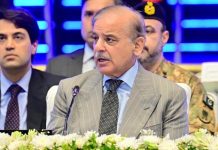

ISLAMABAD: The 11th National Finance Commission (NFC) meeting in Islamabad concluded on Thursday with a decision to form six to seven working groups to advance discussions on fiscal matters.
The maiden NFC meeting, chaired by Finance Minister Muhammad Aurangzeb, was attended by the chief ministers of Sindh and Khyber Pakhtunkhwa, who participated in their capacity as provincial finance ministers, while Punjab and Balochistan were represented by their respective finance ministers.
Adviser to KP CM on Finance, Muzzammil Aslam, also joined the meeting alongside the CM Afridi. Federal Board of Revenue (FBR) Chairman Rashid Langrial was also in attendance, along with private members from all four provinces.
Sources said that the next sitting of the NFC is expected to take place on January 8 or 15.
The sources said that working groups will examine key financial issues, including a dedicated group for the former FATA region, which will look into how the merged districts can be fully integrated into the federal fiscal framework.
After the meeting, Sindh Chief Minister Murad Ali Shah briefly spoke to the media and said: “It has been decided that groups will be formed which will take financial matters ahead.”
Speaking to the media, Muzzammil Aslam termed the meeting as constructive. “The proposal is to form separate groups that will settle different matters,” he said, adding that six to seven groups will be formed, and above them, there will be an umbrella group.
He confirmed that one of the groups would specifically address the fiscal incorporation of the former FATA districts. “There is a working group on [ex] FATA to decide how it should be included in the financial structure,” he said.
He went on to say that the meeting took place in a positive environment. No one was pressured [during the meeting] and everyone’s views were heard.”
Muzzammil also clarified that no proposal was discussed regarding a reduction in the provinces’ share under the NFC Award.
Meanwhile, speaking during the 11th NFC session, FinMin Aurangzed described the inaugural meeting as an important moment of constitutional responsibility and mutual cooperation, adding that the NFC forum was established under Article 150 of the Constitution. He noted that the 10th NFC Award ended on 21 July 2025.
Aurangzeb emphasised that the federal government was committed to convening the 11th NFC’s opening session without delay. “The prime minister personally took a deep interest in ensuring this meeting was held as early as possible,” he said.
He explained that the session had previously been postponed due to the devastating floods in Punjab, Khyber Pakhtunkhwa and Sindh. Addressing speculation surrounding the NFC, he said: “The solution to concerns and ambiguities lies in sincere and transparent dialogue.”
Aurangzeb further said: “We are here with open minds and without bias. Our first priority is to listen to one another. The federal government is here to hear the provinces’ position.”
He expressed hope that the provinces would move forward with a spirit of constructive cooperation, praising them for signing the National Fiscal Pact, which he described as evidence of our shared commitment and ability to work together in the national interest.
Aurangzeb acknowledged provincial cooperation in achieving mandatory surpluses and implementing the IMF programme. Recalling national challenges, he said: “This year the country faced extraordinary threats from India and severe floods, yet we stood united as a strong federation.”
“This is the spirit we wish to preserve throughout the process of the 11th NFC Award,” he added.
‘Revisiting the NFC Award’
Minister for Planning Ahsan Iqbal has proposed a revision in both vertical and horizontal distribution of resource formula among the Centre and provinces, The News reported on Thursday.
A working paper titled “Revisiting the NFC Award” has been shared by the Ministry of Planning with Prime Minister Shehbaz Sharif, proposing two scenarios for vertical distribution of resources among the Centre and provinces.
Under scenario one, upfront deductions for national priorities have been proposed as before distribution, 2.5% of the divisible pool is allocated for critical matters (such as the war on terror, water security, Civil Armed Forces (CAF) and grants to AJK & GB are also allocated from the divisible pool before distribution.
The remaining pool is then shared with the existing proportion of 57.5% and 42.5% between the provinces and the federal government, respectively. From FY2027 onward, this mechanism would slightly ease the federal fiscal space.
Under Scenario II, the expenditures for BISP and HEC are charged upfront from the divisible pool. The remaining revenues are then distributed as 57.5% to the provinces and 42.5% to the federal government. By FY2030, the federal resources are about 11-12% higher than under the baseline.
It is imperative to rationalise the vertical distribution of resources under the NFC framework. A recalibrated formula, one that recognizes constitutional provinces alongside AJK, GB, ICT, and NMDs, will create a more balanced, equitable, and sustainable fiscal arrangement, strengthen federal capacity to meet national obligations and support the long-term stability of Pakistan’s fiscal federalism.
Overall, higher expenditures relative to revenues resulted in a persistently higher federal fiscal deficit, which remained within the range of 5 to 8.4 per cent for over a decade. This is not merely cyclical but structural, which fuels debt accumulation and undermines fiscal sustainability. This, in turn, has significantly increased the debt servicing cost, which is consuming a significant portion of federal revenues and squeezing the government’s fiscal space for priority areas, thus leading to repeated and often severe adjustments to bridge the revenue-expenditure gap.
For horizontal distribution within the provinces, the working paper states that population dominates with an 82% weight, while poverty, revenue generation and inverse population density carry only marginal significance. This report has proposed three alternative options to move away from this population-heavy approach.
In Option 1, the weight for population is reduced to 78%, with modest increases for other factors such as inverse population density, fertility and forest cover.
In Option 2, the distribution becomes more balanced, as population weight falls to 68%, while reasonable weights are assigned to revenue generation (10%), inverse fertility rate (2%) and forest cover (2%).
In Option 3, the distribution would even alter, as population weight falls to 60%, while high weights are assigned to revenue generation (20%), inverse fertility rate (5%), and forest cover (5%). This transition to a further broader approach reflects the intent to recognise fiscal effort, social outcomes and ecological contributions alongside population. In all three scenarios, the share of Punjab reduced from the existing 51.74% to 47.26% under scenario 1, 44.73% under scenario 2 and 41.89% in the third scenario under the federal divisible pool.
The share of Sindh remained at 25.55% under the existing NFC and would be standing at 25.05% in scenario-1, 25.55% in scenario-2 and 25.09% in scenario-3.
The share of KP stood at 14.62% under the existing NFC and under scenario-1, it will remain at 17.12%, 16.95% under scenario-2 and 15.67% under scenario-3.
Balochistan’s share in the existing NFC stood at 9.09% and it would be standing at 9.75% under scenario 1, 11.5% under scenario 2 and 12.02% under scenario 3.
The share of ICT will be standing at 0.83% under scenario-1, 1.26% under scenario-2 and 5.33% under scenario-3.
It states that the current NFC arrangement, while historic in expanding provincial fiscal space and strengthening autonomy, has created structural imbalances which threaten the sustainability of Pakistan’s fiscal federalism.
Despite receiving 57.5% of divisible pool transfers, provincial revenues remain stagnant at around 1% of GDP, with weak performance in services taxation, agriculture income tax, and property taxation. –Agencies