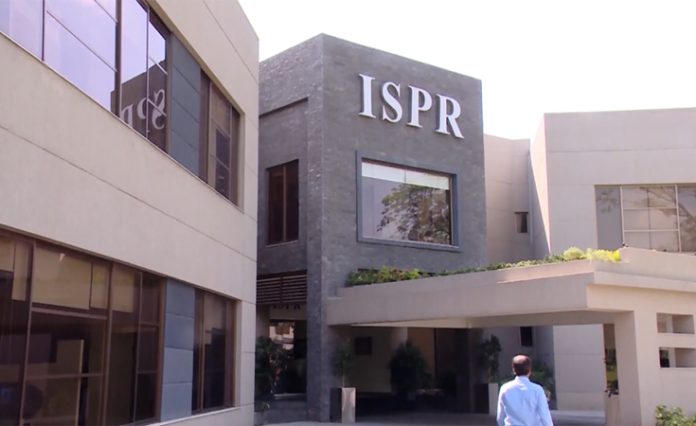
Inter-Services Public Relations (ISPR) Director General Lt Gen Ahmed Sharif Chaudhry said that Pakistan was “preparing for the future war” as the country marked the first anniversary of Marka-e-Haq, while asserting that the country had not underestimated New Delhi but “placed them [India] where they are.”
ISPR DG made the remarks while addressing a press conference along with Rear Admiral Shifaat Ali Khan and Air Vice Marshal Tariq Ghazi.
Marka-e-Haq (battle of truth) refers to the 19-day military conflict with India, spanning from April 22 to May 10, 2025.
On May 6-7 last year, India launched an unprovoked attack on Pakistan, following an attack on tourists in the Indian Illegally Occupied Jammu and Kashmir’s Pahalgam town.
Pakistan, during the 87-hour conflict, downed eight Indian fighter jets, including French-made Rafale, and dozens of drones. The war between the two nuclear-armed nations ended on May 10 with a ceasefire agreement brokered by the US.
The more than 80-hour war eventually stopped on May 10 after intervention from the United States.
“We welcome you to ISPR on this happy day,” Lt Gen Chaudhry said at the outset of the press conference.
He noted that Pakistan’s military had defeated an enemy “five times larger than itself,” and further described India as a “terrorist state”.
“Today, we are not going to dwell a lot on what happened … We are going to spend more time from May 2025 to May 2026,” he said, adding that they would put in front of the nation “10 strategic consequences” of the conflict.
‘Strategic consequences’
First of the strategic consequences is, the ISPR DG said, the Indian narrative of painting Pakistan as a source of terrorism stood buried forever.
“International community, as a consequence of Marka-e-Haq, came to know and now fully understand that Pakistan, as alleged by Indians over a period of time, is not a perpetrator but a victim of Indian sponsored terrorism,” he noted.
Lt Gen Chaudhry noted that India attempted to portray, without evidence, that Pakistan had perpetrated terrorism in India. “It had been one year since the Pahalgam incident, yet the questions that Pakistan had asked remain unanswered,” he said.
“How come an FIR was registered within 15 minutes of the incident… Where is the evidence? The whole world, including sensible Indians, is asking who is behind the attack. Nobody buys this… You are the biggest terrorist. Nobody listens to them, nobody believes them,” he added.
Moving on to the second consequence, he said that Marka-e-Haq consolidated Pakistan as the net security stabiliser in the region, “as per the vision of the founding father, and the vision was ‘peace within and without”.
He said that Marka-e-Haq showed who was controlling and dominating the escalation, adding that India escalated the conflict based on a “lie and fabricated drama” and how maturely Pakistan and its armed forces handled that. “The biggest ambassador of stability in the region was Pakistan and its leadership,” he added.
Referring to the third strategic consequence, Lt Gen Chaudhry said it was related to “our eastern neighbour,” saying it was the “politicisation of Indian military leadership and militarisation of Indian political leadership.”
“You heard their air chief marshal a few months after Marka-e-Haq saying ‘I got to know today that even we downed some planes’ […] That is politicisation of the military leadership … Why are you trying to make jokers out of your admirals, generals and marshals? Don’t do that.”
On the other hand, he said: “We have placed the facts as they are.”
Furthermore, he criticised the Indian politicians for appearing like “war mongers” and giving statements based on hatred. The DG ISPR noted that the politicisation of the military and militarisation of politics was “dangerous”.
Meanwhile, Chaudhry said that the fourth strategic consequence was the global acknowledgement of Indian efforts to externalise its internal problems and internalise its external problems while using terrorism as a “state tool”.
He pointed out that India’s internal problems included the repression of minorities and Kashmiris. “This comes from a false sense of entitlement and this hubristic attitude.”
“You do not want to resolve your internal problems, and you externalise them by levelling allegations that Pakistan was behind terrorism in the neighbouring country… You need to address them politically and internally,” he added.
He pointed out that Kashmir is not India’s internal problem, but an internationally recognised dispute. “It’s not your internal problem for you to make demographic changes there … you cannot do that.”
He further said that “they [Indians] were even behind terrorism in their own country and would then accuse others”.
Moving on to the fifth strategic consequence, the ISPR DG said, Marka-e-Haq exposed the “true face of the Indian media and its discredited information operations”.
He criticised the Indian authorities for “shutting down Pakistani media and social media” during Marka-e-Haq and this practice was still ongoing. “It cannot solve the problem… There is only one advice to India, which is to speak the truth.”
“That’s what Pakistan did… The only thing that can survive in today’s information domain is truth. Tell people the truth. But somehow the Indians think they can work their way around lies. It doesn’t work anymore,” he added.
Chaudhry said that the sixth consequence was the “transformed character of warfare”, noting that this covered multi-domain operations, non-contact warfare, synergy, proxies and information.
He explained that warfare was not limited to borders anymore, adding that it is fought on land, in the sea, in the air, in cyberspace, and it is cognitive as well.
“By God blessing, Pakistan’s armed forces were prepared to fight against India during Marka-e-Haq in all those domains. We were prepared back then, and we are prepared today as well,” he added.
Furthermore, Lt Gen Chaudhry said that the seventh consequence was Pakistan’s proven potential and the resilience to combat multifaceted challenges. “That is another very important consequence that the nation has gone through… in simple words, it is the belief in ourselves,” he said.
Coming to the next, the ISPR DG said, the eighth was the loud and clear establishment of deterrence, reaffirmation of the fact that there is no space for war between two geographically contiguous nuclear states.
“Anyone who thinks there is space for war between two nuclear neighbours is crazy. That is madness. Only a madman can think about. You want to do it, then there should be no doubt about our resolve,” he added.
He added that the ninth consequence was the recognition of Pakistan as a “geopolitically significant and responsible middle power” at the global stage. “The politico-military leadership, politico-military diplomacy and respect are the strategic consequences of Marka-e-Haq,” he added.
He said that the last, but most important consequence, was the unshakeable synergy between the people, the government and the armed forces, “which we call the Bunyan-um-Marsoos effect”.
‘Pakistan preparing for future war’
Responding to questions during a press conference, Lt Gen Chaudhry said India wrongly believed that higher defence spending and technological superiority would guarantee victory.
He questioned India’s “sense of self-entitlement”, saying New Delhi had no right to determine the future of people in the region.
“Their assessment of Pakistan is absolutely wrong,” he said, adding that India had made a huge strategic miscalculation. The military spokesperson also rejected claims of any divide between the armed forces and the public.
“There is nobody who has the power to come between the people and the armed forces. We are together,” he said.
“If you want to add one difference, that is belief within every child in Pakistan; that martyrdom is a reward and not to be afraid of,” Lt Gen Chaudhry said.
Lt Gen Chaudhry said: “Pakistan Army is not an army for the elites, it is an army for the poor”. He further said Pakistan was preparing for the future war.
“We are not underestimating them… we place them [India] where they are, but we also know who we are,” he added.
‘Pak-Saudi ties deep, multidimensional’
Speaking about Pakistan and Saudi Arabia ties, Lt Gen Chaudhry said that Islamabad and Riyadh share deep and multidimensional relations, while reaffirming Islamabad’s commitment to the kingdom’s security.
Replying to a question, the ISPR DG said Pakistan values its longstanding ties with Saudi Arabia and considers any threat to the kingdom a matter of concern for Pakistan as well.
“Pakistan and Saudi Arabia’s relations are very deep and multidimensional. Any threat to Saudi Arabia is also a threat to us,” he added.
In September last year, Pakistan and Saudi Arabia signed a “Strategic Mutual Defence Agreement” in Riyadh, pledging that any attack on either nation would be treated as an act of aggression against both.
Last month, Pakistan sent fighter jets and other military forces to Saudi Arabia to boost security under a defence pact between the two countries, the Saudi defence ministry said in a statement.
‘Dialogue is politicians’ responsibility’
The chief military spokesperson, while responding to a question on internal politics, said that political dialogue is the responsibility of political parties, stressing that they must engage with each other to resolve issues.
He said the military is not a stakeholder in Pakistan’s political affairs and does not represent any particular sect, creed, language or political ideology.
“We are not a stakeholder in the politics of Pakistan, nor do we represent any specific creed, sect, language or political ideology,” Lt Gen Chaudhry said.
He added: “We come from the people of Pakistan and the people of Pakistan come from us.”
Encouraging political reconciliation, he said: “We say resolve your issues through dialogue. Who stops them? It is none of our business.”
‘Afghanistan not a rational player’
The ISPR DG highlighted Islamabad’s role in facilitating US-Iran talks aimed at ending the Middle East war, describing Pakistan as a “rational state”, while contrasting it with Afghanistan’s conduct.
Afghanistan does not act as a rational player or function like a state, he added.
Lt Gen Chaudhry questioned whether any rational actor makes terrorism the main source of a country’s income or denies its communities the right to equal development and expression.
The ISPR further said Operation Ghazab lil-Haq in Afghanistan is ongoing, adding it is linked to actions of the Afghan Taliban regime and not directed against Afghanistan or its people.
He said Pakistan’s operation is part of the national counter-terrorism response, noting a decline in incidents and an increase in militant fatalities.
‘Historic conflict’
Addressing the presser, Rear Admiral Ali described Marka-e-Haq as a “historic and memorable” conflict, saying India had long projected itself as a major naval power with a large defence budget and blue-water navy ambitions.
He questioned why the Indian Navy failed to confront Pakistan directly during the conflict.
He said India attempted to deploy naval vessels in the northern Arabian Sea to target Pakistan’s naval assets and disrupt maritime trade.
However, he added that the Pakistan Navy’s strategy ensured ports, installations and sea routes remained fully operational.
Rear Admiral Ali recalled that the Pakistan Navy and PAF were prepared to target India’s aircraft carrier Vikrant.
‘8-0’
Speaking for his part, Deputy Chief of Air Staff Projects Air Vice Marshal Tariq Ghazi provided a brief rundown of the Marka-e-Haq to refresh the memories, resolving the mocking of the “adversary” for changing the storyline as “they are trying to understand what has happened”.
“PAF chief Zaheer Ahmad Sidhu spearheaded the formulation and later led its execution of PAF’s operational response,” he said.
Air Vice Marshal Ghazi said that eight Indian aircraft were shot down during Operation Bunyan-um-Marsoos.
Giving details, he said that four Rafale jets, one Su-30, one MiG-29, one Mirage 2000 and one “expensive” multi-role unmanned aerial system had been shot down.
Speaking of the operation, he noted that the air force had to immediately maintain “defence and strong posture” alongside the highest level of alert with full spectrum monitoring that included the enemy’s communication.
“We adopted a strong air defence posture to thwart any hostile adventure through combat air patrols, scrambles, and eyes on the sky all the time,” he said, adding that the PAF, for the first time in warfare, integrated and operationalised its multi-domain assets.
“When we witnessed that the IAF [Indian Air Force] made aggressive deployment, which included deployment of key assets and offensive weapons systems all across the country and concealed its key assets,” he said, but added that the PAF was monitoring each and every move. –Agencies