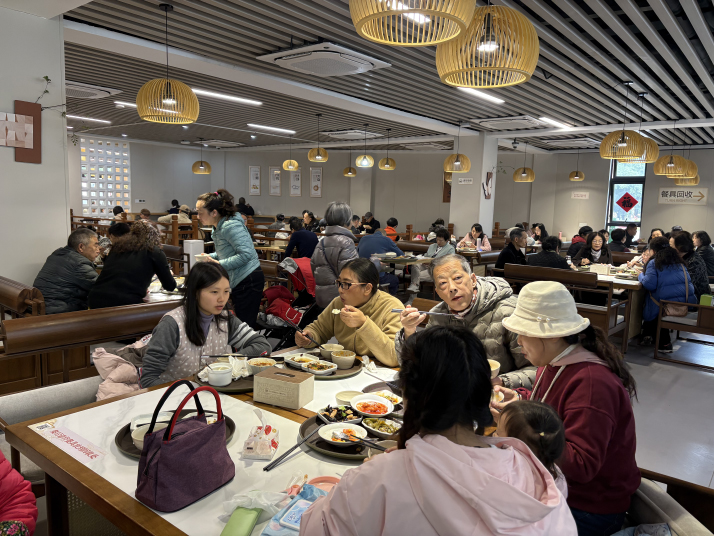
Recently, museums across China have begun operating cafeterias, and “grabbing a bite at the museum” has become a trend among young people. Whether it’s having a 22-yuan ($3) meal with a combination of meat and vegetables at the Liaoning Provincial Museum in Shenyang, ordering a bowl of beef noodles at the Hubei Provincial Museum in Wuhan, or savoring authentic shaomai (steamed dumplings with a savory meat filling) at the Inner Mongolia Museum in Hohhot, visitors today are no longer satisfied with just “seeing artifacts.” They now consider the canteens must-visit destination in museums.
Filling the gap
The rise of this trend is inherently linked to the nature of museum visitation. Large collections necessitate several hours of touring, with visitors often building up quite an appetite.
“Being able to have a hot meal inside the museum addresses a real public need,” Wu Liyun, a professor of tourism at the China Academy of Culture and Tourism at Beijing International Studies University, told Xinhua News Agency. She highlighted that establishing cafeterias within museums solves the fundamental issue of dining for patrons spending a lot of time exploring the exhibits.
Affordability is also cited as a major driver of this popularity. Zhao Xiaofeng, head of the Cultural and Creative Product Development Department of the Inner Mongolia Museum, told Xinhua that reasonable pricing appeals strongly to younger audiences. For instance, the Sichuan Museum features Sichuan home-style dishes starting at 3 yuan ($0.4), capping meat dishes at 12 yuan ($1.7), while the Anhui Provincial Museum provides set meals (two meats and two vegetables) for under 30 yuan ($4.3).
Museum dining has transcended mere sustenance; it is now a vehicle for cultural immersion, perfectly aligning with the younger generations’ appetite for novelty and shareable experiences.
Ancient artifacts are being ingeniously transformed into edible art. Visitors are thrilled to discover they can “consume” cultural artifacts after viewing them, as relics dating back millennia are recast as cakes, coffee, noodles and braised eggs.
The Yinxu Museum in Anyang, Henan Province, exemplifies this creativity at its Zixiang Restaurant with the remarkable Oracle Bone Script Noodles. Each strand is printed with black squid ink to feature auspicious phrases like “Great Fortune and Success” or “Good Health and Peace” written in the ancient script. This turns every bite into an interactive, textual puzzle, driving weekend and holiday sales to an impressive 500 to 600 servings daily. Named after the nearby Yinxu Ruins, a UNESCO World Heritage Site, the Yinxu Museum is dedicated to the Shang Dynasty (1600-1046 B.C.), safeguarding over 4,000 artifacts from the Bronze Age, including bronze, pottery, jade vessels and oracle bone inscriptions.
The Hubei Provincial Museum serves Bianzhong (Chime Bell) Beef Noodles, distinguished by a braised egg molded and steamed to resemble the museum’s iconic ancient chime bells.
The Liaoning Provincial Museum, offers Pomegranate Vase Mousse Cake. Based on the glazed Pomegranate Vase from the Yongzheng (1678-1735) era in the Qing Dynasty (1644-1911), this dessert has a rich, light texture and mirrors the historic ceramic piece in appearance.

Up close and public
The opening of cafeterias within museums is not only a response to public demand but also comes from a deep consideration for the museums’ own sustainable development. It is an example of the innovative transformation of cultural venues. Public leisure choices are increasingly diverse, with shopping malls, coffee shops and cinemas all competing for public attention. Museums relying solely on exhibits are finding it increasingly difficult to retain audiences.
The exploration of the cafeteria model is an attempt by museums to get closer to the public, ensuring that museums become “cultural spaces” integrated into daily life, rather than just “attractions.”
Zhong Ling, Vice President of the Sichuan Museum, told Xinhua that affordable dining options encourage more people to visit, extending the average stay by one and a half to two and a half hours. This gives visitors time to explore more exhibition halls and participate in cultural activities, deepening their understanding of the museum’s exhibits and culture. For instance, some cafeteria areas are supplemented with tearooms, and reading bars, allowing visitors to enjoy tea, read books or participate in intangible cultural heritage workshops and free lectures after a meal, creating a complete chain of “visiting exhibition, dining, leisure and socializing.”
In addition to traditional tourists, the canteens attract numerous local residents who might not have initially planned to view the exhibits. These new demographics, potentially visiting just for a meal, might end up browsing the exhibitions, thus becoming a new audience base for the museum. For instance, popular dishes like the Chime Bell Beef Noodles at the Hubei Provincial Museum have not only boosted canteen consumption but have also prompted many people to visit the exhibition halls to learn about the history of the related relics.
However, the popularity of museum canteens has led to a surge in visitor numbers, which in turn presents challenges to the museum’s daily management: Not only do canteen queues cause congestion potentially within the venue, disrupting visitor flow; the increased number of visitors also puts greater pressure on relic protection and hygiene maintenance.
In response to these issues, museums nationwide have introduced countermeasures. The Inner Mongolia Museum promotes online reservations for its canteen to reduce on-site queuing congestion during peak hours. The Sichuan Museum flexibly adds temporary tables and chairs in the outdoor garden area based on visitor flow, while increasing sanitation staff to maintain cleanliness.
There are also concerns that the “hustle and bustle” of a restaurant setting will undermine the museum’s required tranquility and dignity, leading to a commercialized and superficial cultural experience. Countering this view, Wu suggests that museum cafeterias can serve as attractions, drawing in individuals who might otherwise bypass a museum visit, thus increasing cultural accessibility. Her key recommendation is that museums establish rational layouts for dining and exhibition zones to avoid any interference between the two. –The Daily Mail-Beijing Review news exchange item