
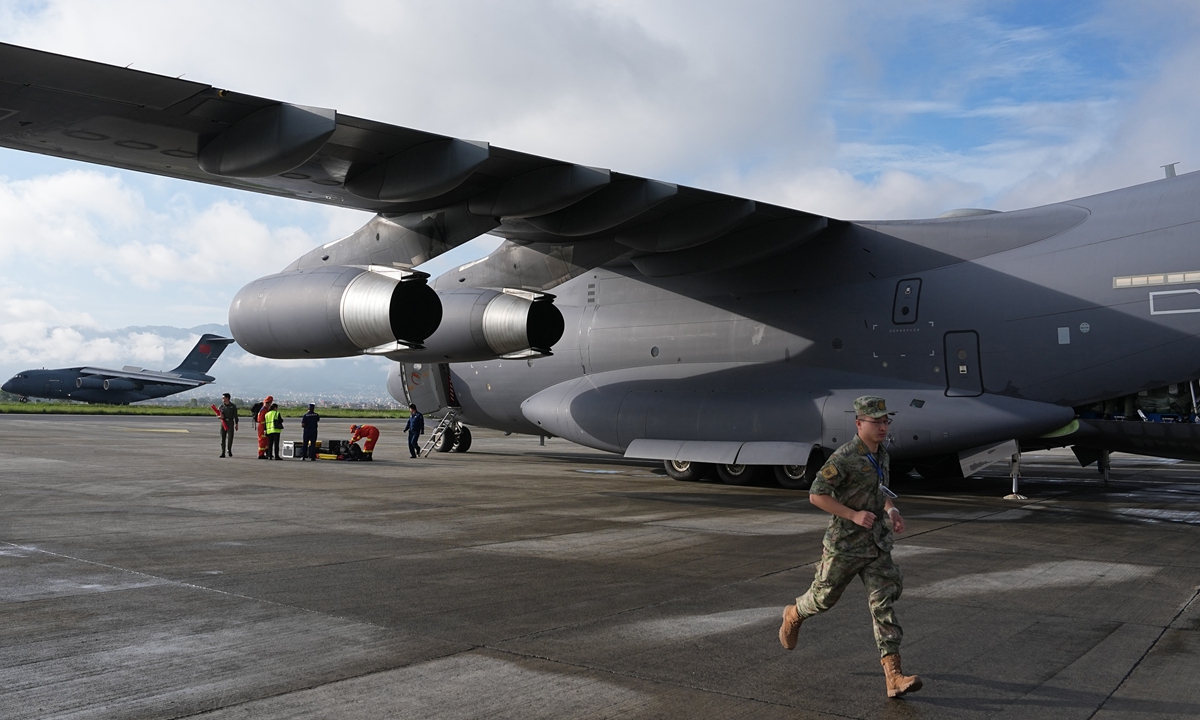
BEIJING: As rescue teams pushed toward the devastated Gyirong Port by land, water and air, and Chinese military transport aircraft ferried emergency supplies to Nepal, authorities in Southwest China’s Xizang Autonomous Region continued to reveal details about the deadly August 26 mudslide in Nepal that has left at least 16 dead and 546 missing in China.
At a press conference held by the Information Office of the People’s Government of the Xizang Autonomous Region on Sunday, officials outlined the formidable difficulties confronting rescuers, and presented a scientific assessment tracing the disaster to the collapse of a high-altitude glacier in Nepal. Participants at the press conference first observed a moment of silence for those who lost their lives in the disaster.
According to the press conference, some 2,141 rescue personnel have been mobilized, including members of the PLA, the People’s Armed Police Force, the China Search and Rescue Team, border defense units, police and engineering and rescue enterprise China Anneng, while 269 vehicles and 3,922 sets of rescue equipment were dispatched to the disaster-hit area.
Rescue teams are advancing toward the core disaster zone from three directions – over land, along waterways and from the air, an official said at the press conference.
Local authorities have relocated 499 residents from five villages in risk-prone areas of Gyirong Township and Sale Township, while more than 57,000 pieces or sets of relief materials, including cotton coats and tents, have been allocated. Meanwhile, 555 domestic tourists were also transferred from Gyirong Township.
The authorities have identified 261 foreign nationals from 23 countries as unaccounted for, including 104 Nepalis, 49 Indians, 15 Britons and 18 Americans. The countries’ embassies and consulates in China have been notified.
Following persistent searches, on-site inspections and cross-checking of information, no foreign tourists are currently stranded in Gyirong county, officials said.
However, tracing those unaccounted for remains extremely difficult. The mudslide struck suddenly with enormous destructive force, extensively damaging infrastructure and personnel registration records in the affected area, an official said.
The terrain has made the rescue operation equally challenging. The disaster zone is marked by high mountains, deep valleys and fast-flowing rivers, while complex and rapidly changing air currents constrain aerial operations. Numerous glaciers and glacial lakes in the surrounding area pose further risks.
In particular, a barrier lake formed on the Purepu Tsangpo upstream of Gyirong Port has threatened the safety of rescuers. The disaster also severely damaged national highway G216 leading to the port and cut off electricity and communications, leaving rescue conditions far more difficult than those encountered in conventional geological disasters, officials said. –The Daily Mail-Global Times news exchange item