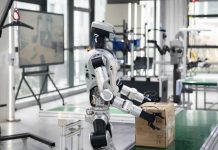

BEIJING: Humanoid robots broke a half-marathon record held by a human runner during a sports event in Beijing on Sunday, highlighting the unpredictable potential of their capabilities.
“Flash”, a robot developed by Chinese smartphone maker Honor, won the 2026 Beijing E-Town Half Marathon and Humanoid Robot Half Marathon, taking 50 minutes and 26 seconds to finish the 21-kilometer race on Sunday morning.
The previous human record was 57 minutes and 20 seconds, which was set by Uganda’s Jacob Kiplimo in March in Lisbon, Portugal.
The performance was a significant step forward from last year’s inaugural race, during which the winning robot finished in 2 hours, 40 minutes and 42 seconds, and, among the nearly 20 participating teams, only six robots completed the race.
This year, more than 100 teams took to the track. The range of participating teams expanded from five provinces last year to 13 provinces this year, and the event also attracted five international teams, with a new record set for the race completion rate.
The top three finishers, including the champion, runner-up and second runner-up, were all humanoid robots produced by Honor, a newcomer to the field, which has transitioned from manufacturing mobile phones “in just one year”, Du Xiaodi, the company’s engineer and coach of the champion robot, said after the event.
The company has not yet ventured into product sales and is still addressing challenges in the research and development of independent electric motors, he added.
Other competitors in the event included branded robots from companies such as Unitree and Noetix.
One of the most amusing scenes of last year’s event was human engineers running after robots while holding their computers.
But this year, more than 40 percent of the teams competed autonomously, with their robots relying entirely on sensors, cameras and other devices to perceive their surroundings in real time, and independently completing a series of complex tasks such as localization, mapping, path planning and dynamic obstacle avoidance.
Notably, the track this year was more challenging than last year’s, with additional curves, slopes and uphill and downhill sections added to put the robots’ adaptive capabilities to a tougher test.
The top three robots all autonomously navigated through scenic areas, including a milu deer park and a tree-lined avenue in E-Town, which is also known as Beijing Economic-Technological Development Area. –The Daily Mail-China Daily news exchange item