
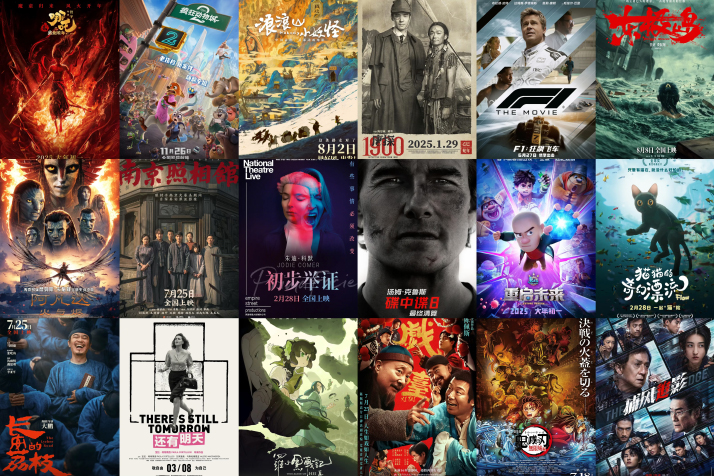
From a distance, 2025 had all the markings of a blockbuster year for Chinese cinema. It opened with the runaway success of Ne Zha: Demon Child Conquers the Sea (Ne Zha 2), which now sits at No.5 on the world’s all-time box-office chart, just behind Titanic; and it closed with another bang with Disney’s Zootopia 2, which is now the highest-grossing imported film in Chinese box office history.
The figures matched the upbeat mood. After a lukewarm 2024, in which takings fell 23 percent from 2023 to 42.5 billion yuan ($6 billion), data released by the Chinese Film Administration put 2025’s total box-office revenue at 51.8 billion yuan ($7.4 billion), up roughly 22 percent year on year.
A closer look at the chart tells a more nuanced story. According to Chinese ticketing platform Maoyan, Ne Zha 2 alone accounted for nearly a third of the year’s box office, with a staggering gross of 15.4 billion yuan ($2.2 billion). At the same time, the number of domestic films earning between 100 million yuan ($14 million) and 1 billion yuan ($140 million)—often the mark of a solid performer—fell by about 40 percent.
This, however, could be a good thing, as movies that broke through in 2025 suggest a shift away from star power and marketing gimmicks toward ratings, reviews and word-of-mouth fame.
“We are in the midst of a deep structural shift,” Rao Shuguang, Secretary General of the China Film Critics Association, told domestic media. “People are less willing to watch movies in cinemas, which makes it all the more important to produce more quality films with strong cinematic appeal—ones that encourage viewers to return to the habit of watching movies on the big screen.”
In the end, it comes down to two things: a distinctive viewing experience and a story that resonates, he said.
All about animation
Last year, that appetite for spectacle and resonance found its clearest outlet in one medium: animation, which emerged as the biggest force at the Chinese box office. With takings topping 25 billion yuan ($3.6 billion), animation made up almost half of the year’s domestic ticket sales.
Out in front, undeniably, was Ne Zha 2, the second installment in the Ne Zha franchise, which follows a rebellious demon child as he learns to master his unruly powers and slowly grows into the hero the world needs. Building on the first movie’s themes of identity and self-determination, the sequel widens its lens to depict a cosmic battle that questions the very order separating gods from demons.
Audiences have lauded the film’s visual splendor—an achievement that owes less to any single studio’s flair than to an industry-wide barn-raising. Over five years, more than 4,000 animators from 138 companies across China contributed to the production. “It was like the Olympics of the animation industry,” one participating artist told newspaper People’s Daily.
Yet its appeal lies not just in scale and spectacle, but in the way it threads ancient myths into a recognizably modern story. Many viewers, for instance, found themselves sympathizing with Shen Gongbao, the first film’s main villain, recast in the sequel as a tragic figure desperate to shed his lowly origins and earn a place among the gods. “The character embodies the lives of small-town kids who study and work hard for upward mobility, only to discover that effort does not guarantee reward,” read one comment with 28,000 likes on Chinese review platform Douban.
That story of the would-be striver became the centerpiece of another 2D animated film released last summer, Nobody. While Ne Zha 2 remains, at heart, a hero’s tale, Nobody follows a ragtag band of nameless demons who masquerade as the legendary quartet from Journey to the West and embark on their own pilgrimage.
This shift of perspective has struck a deep emotional chord with viewers, who see themselves in the underdogs—scrambling for a foothold in an increasingly competitive market, looking for meaning in meaningless work and sacrificing personal needs to conform to social expectations.
Yet they also see something else—the small victories of hanging on, of choosing kindness, for all of life’s disappointments. “It’s not necessarily a happy film,” Simon Abrams, a New York-based film critic and a long-time observer of global cinema, told Beijing Review. “But it carries a hopeful message—one that celebrates the simple act of trying, even if you have to fake it at first, which I think resonates with a lot of people.”
This broad appeal has translated into ticket sales: With takings of more than 1.7 billion yuan ($240 million), Nobody is now the highest-grossing 2D animation in Chinese box-office history.
For years, the industry favored computer-generated 3D spectacles; 2025, however, brought a renewed appetite for hand-drawn 2D animation, fueled not only by Nobody but also by The Legend of Hei II, which tells the story of how a cat elf named Xiaohei and his master try to avert a war between humans and spirits.
Unlike most other Chinese animated hits to break out in recent years, The Legend of Hei II was a much smaller undertaking. In 2011, when Chinese animator MTJJ (Mu Tou) first created Xiaohei in a web series, it was essentially a one-man project.
Yet its modest scale proved an asset. The long production cycle, coupled with its careful craftsmanship and well-developed story, fostered a breed of die-hard devotees and a slow but steady buildup of word of mouth. With a stellar 9.5 out of 10 rating for the web series, an 8.0 for the first feature film and an 8.7 for the second film, The Legend of Hei franchise now ranks among Douban’s highest-rated Chinese animations.
“For independent animators like me, it’s a light on the horizon,” Si Yu, a 30-year-old animator who has just started her own studio in Chengdu, Sichuan Province, told Beijing Review. “In an industry built for speed and scale, it’s proof that a small project can still break through—one sketch at a time.”
Margins of history
If animation was one storyline running throughout the year, historical drama was another.
Over the past few years, the genre has been one of the Chinese box office’s most dependable engines. Between 2020 and 2022, war epics—The Eight Hundred, The Battle at Lake Changjin and The Battle at Lake Changjin II—claimed the annual top spot in succession, underscoring a steady appetite for grand historical narratives delivered through massive set pieces, swarms of extras and digital armies stretching to the horizon.
Last year, however, the genre’s vantage point shifted, as Chinese filmmakers turned to less-told, often more varied narratives—stories lived by ordinary people who were swept up in events they could neither choose nor control.
One film that took this approach to a near-absurd extreme was The Lychee Road, a comedy-drama set in the Tang Dynasty (618-907). Drawing on a famous line by Tang-era poet Du Mu, it centers on Li Shande, a low-ranking official, who was tricked into the seemingly impossible task of transporting fresh lychees over 2,000 km to the imperial court as a birthday gift for the emperor’s favorite concubine.
For all its period trappings and comedic touch, the story was essentially a biting satire of modern corporate culture—one that mirrors today’s young workers’ grind under impossible performance indicators, toxic bosses and heavy mortgages.
Another period comedy-drama that performed strongly in theaters was Detective Chinatown 1900, the fourth entry in the Detective Chinatown franchise. Grossing 3.6 billion yuan ($519 million), it was the third highest-grossing film at last year’s Chinese box office. Unlike earlier entries set in the modern international metropolises of Bangkok, New York and Tokyo, respectively, the film is set in San Francisco’s Chinatown in the 1900s, against the backdrop of the Chinese Exclusion Act of 1882.
“The 1900s offer a stark contrast between an America already strikingly advanced and a crisis-ridden China under the faltering Qing Dynasty (1644-1911), and that opens a space for us to zoom in on how Chinese immigrants lived under the shadow of xenophobia,” Dai Mo, one of the film’s directors, told China Newsweek magazine. “It’s a less-told history, but it’s worth telling.”
Another film that writes from the margins of history is Dead to Rights, which follows a group of civilians who take shelter in a photo studio during the Nanjing Massacre, a six-week spree of mass murder and mass rape committed by Japanese invaders following their capture of the then Chinese capital on December 13, 1937. What begins as a struggle to stay alive slowly evolves into a larger mission: smuggling photographs out of the city to expose the atrocities of the Japanese army.
“These average people were not born heroes, yet they still chose to step forward in a time of crisis,” Shen Ao, the film’s director, told 1905.com, a professional Chinese film portal. “In their awakening, we catch a glimpse of the countless ordinary lives that lived through that history.”

A wider slate
In 2025, 106 international films were screened in China, the highest tally in five years and up from 78 the year before.
After months of middling takings, with daily ticket sales hovering in the 20-30-million-yuan ($2.8-4.3-million) range, the release of Zootopia 2 last November jolted that number to above 100 million yuan. As of press time, the film had surpassed 4 billion yuan ($560 million) in revenue in China, almost equating to the combined haul of every other Hollywood release in the country in 2025, according to Maoyan.
Online, young Chinese have been churning out AI-generated selfies with Judy and Nick, the film’s two protagonists, at the cinema, and using the pair as a springboard to talk about mental wellbeing and intimate relationships. Many saw themselves in Judy’s constant need for reassurance; others recognized Nick’s instinct to pull away.
“It demonstrates Chinese moviegoers’ continuing interest in films that resonate, regardless of origin, and the potential of import films to play an important role in the renewed growth of China’s theatrical industry in general,” Rance Pow, chief executive of Artisan Gateway, a film and cinema advisory firm, told newspaper The Guardian.
The success of Zootopia 2, however, is not merely a tale of cultural export; it is also a case study in how Chinese and international markets have converged to sustain a franchise. Over the past decade, that has meant forging partnerships with local brands such as Miniso and Luckin Coffee, and launching the world’s only Zootopia-themed park at Shanghai Disneyland.
“This shows, on the one hand, that China still needs Hollywood’s supply,” Zhao Ming, a Beijing-based cinema manager, told Beijing Review. “But it also shows how much Hollywood needs China—a vast market with unbounded potential and a sustained willingness to engage with the world.”
That greater openness showed up in the year’s import mix, which included not only spectacle-heavy tentpoles such as Avatar: Fire and Ash and F1: The Movie, but also smaller titles like There’s Still Tomorrow and Prima Facie.

The year that has just begun looks set to bring an even more diverse slate—and audiences are already debating which title might be the next breakout hit. Strong contenders include Scare Out, a spy thriller directed by Zhang Yimou; Blades of the Guardians, a martial-arts picture from Hong Kong filmmaker Yuan Woo-ping; Odyssey directed by Christopher Nolan; and franchise stalwarts such as Dune 3 and Toy Story 5.
There may, however, never be a second Ne Zha 2. “People like success stories, but it isn’t realistic to have a $2.2-billion hit every year,” Abrams said. “And that’s a good thing, as it leaves room for a broader spread of films—and a fuller range of stories.”
After all, Ne Zha 2 may be the industry’s hero, but it’s the quieter tales of ordinary strivers that give the box office a fuller picture. –The Daily Mail-Beijing Review news exchange item