During the Milano Cortina 2026 Olympic Winter Games, held in Italy from February 6 to 22, a video of Chinese freestyle skier Gu Ailing (Eileen Gu) fielding questions from the media went viral across global social media platforms.
After Gu took silver in the women’s freeski slopestyle on February 9 and again in the big air event on February 16, she was asked whether she viewed her two silver medals as “two golds lost.” The 22-year-old responded with a laugh, offering a thoughtful perspective on her career achievements.
“I’m the most decorated female freeskier in history. I think that’s an answer in and of itself,” Gu said. “Winning a medal at the Olympics is a life-changing experience for every athlete. Doing it five times is exponentially harder, because every medal is equally hard for me… so I think that is more than good enough.”
She went on to win the gold in the freeski halfpipe event on February 22.
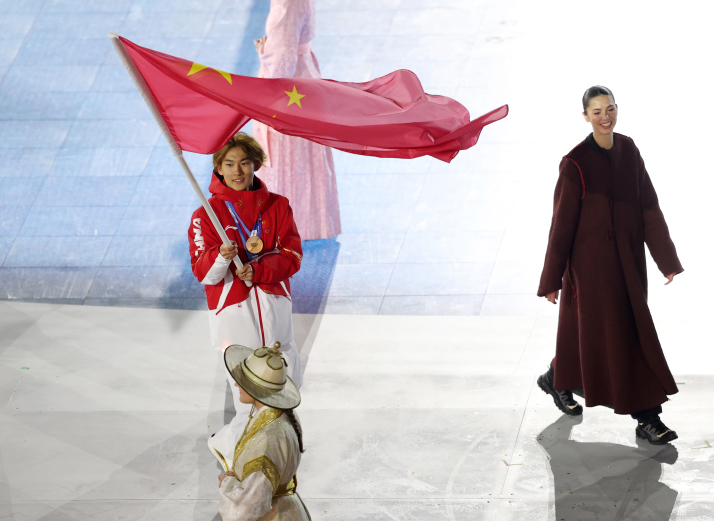
This spirit—striving to be the best version of oneself and achieving what has never been done before—is exactly what Chinese Olympians have always embraced and followed. At the Milano Cortina 2026 Winter Olympics, the Chinese delegation delivered its best result at an overseas Winter Games, collecting five gold, four silver and six bronze medals. Standout moments came in freestyle skiing, snowboarding and speed skating.

Games highlights
China sent 126 athletes to Milano Cortina, competing across seven sports and 91 events, the largest delegation and most extensive event participation in an overseas Winter Games.
Su Yiming pocketed China’s first gold medal at this year’s Games in the men’s snowboard slopestyle on his 22nd birthday on February 18, days after claiming bronze in the big air event. Four years ago at the Beijing Winter Olympics, he won gold in big air and silver in slopestyle.
“At 17, I was still a kid. I didn’t have many expectations or responsibilities,” he said. “This time, I carry much more responsibility. It’s an honor to represent China and Chinese snowboarding on this stage.”
“I’ve already experienced what success feels like,” he added. “This time, it’s about becoming better than who I was yesterday. I’ve become more mature and more stable. I want to keep improving and contribute more to this sport.”
Following Su’s triumph, Xu Mengtao soared to the top of the podium in the women’s aerials on the same day, scoring 112.90 points, adding another gold to China’s remarkable campaign. This was her fifth Winter Games.
China dominated the final rounds of the event, with three skiers entering the super final and Shao Qi securing the bronze with 101.90 points. “I am really satisfied with today’s performance, and I think Chinese aerial skiers showed tremendous strength today,” Shao said.
In speed skating, Ning Zhongyan captured three medals, including a historic gold in the men’s 1500m with a new Olympic record. Days earlier, Ning’s bronze in the 1000m marked China’s first Olympic medal in that event—a leap forward from his fifth-place finish in Beijing four years ago.
Since the men’s 1500m speed skating event was introduced at the first Winter Olympics in 1924, all 26 gold medals over 102 years had been claimed by athletes from Europe and North America. “The 1500m in speed skating is like the 400m or 800m in athletics,” Ning reflected after his race. “As an Asian athlete, defeating the Europeans and North Americans in this event was incredibly tough.”
The men’s speed skating team pursuit delivered the country’s debut medal in the event. In ski jumping, bobsleigh and luge—sports historically on the margins of China’s winter program—national records tumbled repeatedly, reflecting the country’s widening imprint on the Games.

Home away from home
While athletic triumphs unfolded across competition venues, another kind of connection was taking shape away from the ice and snow. When the Olympic flame was gently extinguished on February 22, the China House in Milan also bid farewell to the world after a warm and memorable gathering.
The China House is a comprehensive platform established by the Chinese Olympic Committee to support its delegation at major international games. Throughout its 19 days of operation, it served not only as a steadfast pillar of support for Team China but also as a cultural window, radiating warmth and openness to the world.
Visitors to the China House could explore three thoughtfully curated spaces: a cultural exhibition zone, an intangible cultural heritage experience zone and a sports interaction zone. The design drew inspiration from both the Milano Cortina Games’ visual identity and traditional Chinese New Year motifs—a timely tribute, as the festival, the most important holiday in Chinese culture, was celebrated on February 17 during the Olympic period.
In the cultural exhibition zone, 67 artifact sets from the collection of the China Sports Museum were on display, showcasing traditional Chinese sports such as equestrian, martial arts, Go, Chinese chess and cuju (ancient Chinese soccer). In celebration of the Year of the Horse on the Chinese lunisolar calendar in 2026, a special selection of sports artifacts featuring horse-related themes was also exhibited.
Complementing the cultural and heritage displays, the sports interaction zone offered a glimpse into the future. Here, visitors engaged with domestically made intelligent robots and AI-powered fitness equipment, experiencing firsthand the exciting possibilities of technology-driven sport.
Meanwhile, the intangible cultural heritage zone drew crowds of eager visitors, who lined up to experience the charm of traditional Chinese culture—the sweetness of sugar sculpture the delicacy of papercutting, and the auspicious symbolism of knot-tying.
Yu Jianyong, Director of the Sports Equipment Center of the General Administration of Sport of China, said that this was the fourth appearance of the China House at a Winter Olympics. Preliminary figures show the number of visitors far exceeded that of the previous three editions, with most coming from overseas, including Olympic officials, figures from the sports world and athlete representatives from various countries and regions.
Yu added sport is no longer only about winning medals; it has also become a platform for cultural exchange, business cooperation and people-to-people ties, and described the China House as an example of that broader role.
Italian visitor Daniele told Xinhua News Agency he had never been to China, but after visiting the China House, he now hopes to travel to there one day.


Winter sports heat
Back in China, the winter sports heat sparked by the Winter Games swept across the nation. From indoor ski slopes in warmer southern cities to newly opened ice rinks up north, millions of Chinese embraced the thrill of winter sports, inspired by the performances of their Olympians on the global stage.
According to data released by China’s General Administration of Sport, during the 2024-25 ice and snow season, 292 million Chinese residents participated in ice and snow sports—a participation rate of 20.61 percent. That figure represents an increase of approximately 27.44 million people compared to the previous season.
The boom can be traced back to Beijing 2022, which ignited a lasting national passion for winter sports. The 2025 China Ice and Snow Economy Development Report shows that from 2016 to 2024, the size of China’s ice and snow industry surged from 364.7 billion yuan ($53 billion) to 980 billion yuan ($142 billion). It is expected to surpass 1 trillion yuan ($145.6 billion) this winter season, underscoring how Olympic momentum has translated into lasting economic and social impact.
Cai Ziqi, a ski coach from Harbin in northeast China’s Heilongjiang Province, has witnessed the post-Olympic boom firsthand. “Since Beijing 2022, there’s been a clear increase in young people taking up skiing,” she told Beijing Review. “Most are beginners, but their passion to learn is impressive. Many opt for professional coaching—not just to pick up technique, but also for safety.”
The appeal of ice and snow sports has now found its way into schools and communities across the country. In Changsha, central China’s Hunan Province, for instance, schools are bringing winter sports into PE classes. Meanwhile, authorities in Gansu Province in northwest China have launched a Youth Winter Sports initiative, hosting over 100 public events and setting up specialized programs to get more communities involved in ice and snow activities. –The Daily Mail-Beijing Review News exchange item