Shortly before 7 p.m. on December 19, 2025, people began filing into a lecture hall at the Beijing campus of China Europe International Business School in the capital’s northwestern suburbs. Tickets were oversold by more than 100; extra chairs had to be added at the back as latecomers continued to arrive.
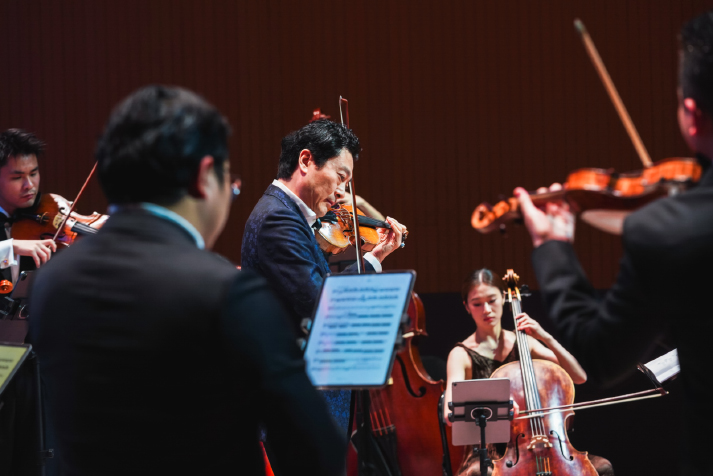
The gathering was not for a talk on management or finance, but for a string concert performed by Lu Siqing, one of China’s most celebrated violinists, alongside an ensemble of 11 young Chinese musicians from Major Performing Arts Group (MPAG), a Chinese classical music agency.
The crossover extended beyond the venue and the lineup to the music itself. Built around the cycle of seasons, the program interwove Antonio Vivaldi’s The Four Seasons, a work first published in 1725 and now one of the most frequently performed works in the classical repertoire, with The Four Seasons of China, which reimagines the familiar theme through a Chinese musical vocabulary.
In keeping with its theme, the event also marked the beginning of a new life cycle for the piece. Over the past year, The Four Seasons of China has travelled across the country, appearing at major music festivals since its premiere in December 2024. In February, it will make its European debut, with Lu leading the ensemble on a tour through Hungary, Bulgaria, Italy, Austria, Germany and Spain.
What unfolded over the evening thereby suggested something larger than a single performance. It offered a glimpse into how Chinese classical music is trying to tackle two pressing challenges: how to speak to the world in a shared musical language, and how to ensure that a younger generation of artists has the opportunity to do so.
The missing piece
For Liu Yisheng, founder of the MPAG and producer of The Four Seasons of China, the project was created to address a longstanding gap in classical music.
Few motifs in classical music are as enduring as the seasons. From Vivaldi’s 300-year-old violin concertos to Pyotr Ilyich Tchaikovsky’s 12-part piano suite, Joseph Haydn’s oratorio inspired by an 18th-century epic poem and The Four Seasons of Buenos Aires—Astor Piazolla’s tango twist on the theme—composers across centuries and continents have drawn on the cycles of nature for creative experimentation. Yet one voice has long been missing from this rich lineage: the musical traditions of China.
“Chinese people have a unique way of understanding nature, one that is rooted in centuries of agricultural traditions and a philosophy that sees humans and nature as inseparable,” Liu told Beijing Review. “But this perspective is very much underrepresented in orchestral music, especially in large-scale compositions.”
China’s musical tradition is not short of seasonal imagery. Pieces performed on traditional Chinese instruments, like Sunny Spring and Winter Snow, Three Variations on the Plum Blossom and Lotus Flowers Emerging From Water, have long offered their own unique interpretation of natural wonders. What has been missing, Liu argued, is scale: These works are short pieces, not large-form compositions capable of sustaining an orchestral narrative.
In 2024, the task of bridging this gap was entrusted to Wen Ziyang, a composer from Chengdu, Sichuan Province, born in 1998. Known for fusing traditional Chinese elements with Western classical music, Wen’s works include He Ge, a chamber piece featuring the clarinet, accordion and sheng, a Chinese wind instrument, Beethoven in China, which intertwines Ludwig van Beethoven’s motifs with a Chinese folk song, and The Golden Mask, which brings to life the ancient world of Sanxingdui, a Bronze Age culture that once existed in the southwestern Chinese province of Sichuan.
Instead of following the Western division of the year, The Four Seasons of China is structured around China’s lunisolar calendar and its 24 solar terms. The 24 solar terms are a traditional Chinese system dividing the year into 24 periods based on the sun’s movement.
Unlike the familiar Western structure that opens with spring and ends with winter, Wen’s composition circles back to spring in its final section, thereby closing on a jubilant note—an arrangement that embodies the Chinese view of time as a cyclical renewal rather than a linear progression.
To evoke a distinctly Chinese experience of the seasons, Wen wove a rich array of regional musical elements into the composition. For the chapter on spring, he introduced snippets of chundiao, or spring ballad, a genre of folk music commonly produced in the eastern Chinese provinces of Jiangsu and Zhejiang, while Tibetan folk melodies were incorporated into the autumn chapter to capture the joyful spirit of the harvest.
“The Chinese view of the seasons is deeply poetic and romantic,” Wen told Beijing Review. “My goal is to convey its spirit through music.”
In tune with tomorrow
The work not only creates a space for dialogue across cultures but also evokes a sense of continuity by showcasing how music endures as a living tradition, passed from one generation to the next.
For Wen, the project was about blending the traditional and the contemporary, the collective and the deeply personal. The summer chapter, for example, opens with a scene from Shichahai, a historical area in downtown Beijing, where he brought in a Peking opera interlude, as well as Jingyun Dagu, a form of Chinese opera where stories are sung in a Beijing dialect accompanied by a drum.
“Having lived in Beijing for almost a decade, these sounds have come to shape my memory of the city,” Wen said. “In a way, The Four Seasons of China is about my own life.”
“While the 24 solar terms may serve as an inspiration, Wen’s piece is more about his own understanding of nature and music,” Lu told Beijing Review. “Unlike Vivaldi’s The Four Seasons, which offers a more literal portrayal of natural landscapes, Wen’s piece centers on the broader theme of celebration—of being thankful for the gifts that life bestows.”
This spirit of gratitude mirrors Lu’s own musical journey. Starting to practice the violin at 4, he entered the Central Conservatory of Music’s elementary school at 8 and was later hand-picked by British violinist Yehudi Menuhin to study at his music school in the United Kingdom. At 17, Lu became the first Asian violinist to win the prestigious International Paganini Violin Competition. He then refined his craft at the Juilliard School in the United States and went on to become a leading figure in the world of classical music.
Despite his many titles and achievements, the word that came up most in Lu’s interview was “lucky.” “I’ve been incredibly lucky to receive so much support early in my career,” he said. “Now, I want to use whatever resources I have to help the next generation of musicians by giving them a little push and making their journey a little easier.”
The Four Seasons of China, Lu observed, is a perfect example of how young artists should be supported. “As musicians, we have a dual responsibility: to preserve the great works of the past and to help new pieces find an audience,” he said, noting that less than 10 percent of all compositions in music history are regularly performed, while the rest remain largely unheard. “Projects like this give young musicians the opportunity to let their work be heard—both within China and beyond,” Lu added.
“The piece is like a vessel into which Wen pours his own memories of the seasons, and we, too, bring our own,” He Shucong, principal violinist of the group, told Beijing Review. “We have all participated in creating the work, and this is where the power of music lies—to bridge time and space and bring people together.”
For Wen, He and other young musicians who are just beginning their career journeys, the concert on December 19 is a prelude to many more remarkable chapters that are yet to be written.
For Lu, it will be a moment where life comes full circle. More than 20 years ago, he returned to China after studying and performing abroad. Now, as he reflects on the upcoming European tour, he describes it as “going back out to sea”—this time bringing a Chinese work to the birthplace of Western classical music.
“While Western classical music boasts a vast repertoire developed over centuries, we are still a relatively young sector,” Lu remarked. “That said, our own musical traditions are incredibly rich and diverse. There’s much to learn from others, but also much to discover from within.” –The Daily Mail-Beijing Review news exchange item