Eighty years ago in April, judges and prosecutors from 11 countries came together in Tokyo, Japan, to bring to justice Japanese officials responsible for war crimes and other atrocities during World War II. From 1946 to 1948, the International Military Tribunal for the Far East, also known as the Tokyo Trial, convened more than 800 court sessions, examined over 4,300 pieces of evidence and produced a judgment exceeding 1,200 pages.
On April 29, at a commemorative event in Nanjing, Jiangsu Province, marking the 80th anniversary of the opening of the tribunal, a set of archival materials was added to the collection of the Memorial Hall of the Victims in Nanjing Massacre by Japanese Invaders.
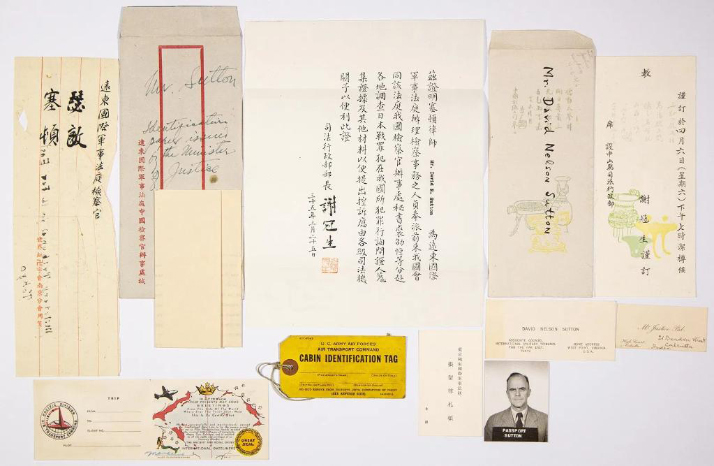
The donation includes 18 items once belonging to David Nelson Sutton, an associate prosecutor at the trial. Among them are six original diaries kept between 1946 and 1948, investigative reports, partial court records, and documents related to wartime activities of the Japanese military in China. The materials were acquired at an overseas auction by Chinese collector Zou Dehuai.
“The documents provide a rare, process-level record of how evidence was gathered for the Tokyo Trial, particularly in relation to Japanese military actions in China and the events in Nanjing in 1937-38,” Zou told Beijing Review. “While the tribunal itself has been extensively studied, the day-to-day investigative work that underpinned its proceedings is less frequently documented in such direct form.”
Opening the archive
Sutton arrived in China in March 1946 as part of a team from the International Prosecution Section of the tribunal. Over the following months, he traveled across several cities, including Shanghai, Beiping (now Beijing), Chongqing and Nanjing, gathering evidence related to alleged war crimes.
His work focused in part on the Nanjing Massacre, one of the most barbaric episodes of World War II. In the six weeks following the Japanese troops’ capture of Nanjing, the then Chinese capital, on December 13, 1937, they slaughtered more than 300,000 Chinese civilians and unarmed soldiers. Establishing the scale and nature of the violence required extensive testimonial and documentary evidence.
The six diaries in the newly donated archive document this process in detail.
“Unlike formal reports prepared for submission, Sutton’s diaries functioned as working records. They trace his movements, note investigative leads, and record interactions with witnesses and institutions,” Zou said, adding that the personal records show how a prosecutor worked step by step to trace wartime atrocities—how he found witnesses, how he listened to survivors, and how those accounts were eventually turned into courtroom evidence.
Zou named an example: In one entry, Sutton records a visit to the banks of the Yangtze River, where witness accounts described large-scale killings carried out with machine guns. In another, he notes the examination of burial records maintained by local charitable organizations, which documented the disposal of bodies in the aftermath of mass violence.
His notes reflect not only what was said by witnesses, but the process of verification and corroboration. The materials also shed light on the preparation of witnesses for the Tokyo Trial.
In June 1946, Sutton returned to Nanjing to identify individuals who could testify in court. His notes describe meetings with potential witnesses and coordination with others already known to the prosecution.
Among those referenced are Robert Wilson, an American surgeon who treated victims during the events in Nanjing, and Xu Chuanyin, a Chinese witness. Both would later contribute to the body of testimony presented before the tribunal.
According to the records, Sutton and several witnesses traveled together from China to Tokyo, bringing with them documentary evidence, including materials from the U.S. Embassy in Nanjing. These would become part of the prosecution’s case.
The Tokyo Trial concluded in 1948, resulting in convictions for a number of senior Japanese officials. Nevertheless, its legacy remains subject to debate, including criticisms that it represented “victor’s justice.”
Zou refutes such characterizations, contending that they run counter to the evidentiary record. “The verdict is documented. The evidence is documented. The history is documented,” he said. “Yet there are still claims that it was fabricated. That is not ignorance—it is deliberate distortion.”
Against such claims, he places emphasis on primary materials. “Empty arguments are not enough,” he said. “What carries weight is the archive itself.”

Combatting silence
For Zou, the decision to collect and eventually donate such materials is tied to that conviction. He described Sutton’s diaries as filling a notable gap. Sutton left behind tens of thousands of pages of documents related to the Tokyo Trial, now dispersed across institutions including the University of Richmond and the University of Virginia in the U.S. Yet the six personal diaries had long been absent from the known archive.
“They were the missing piece—the part that reflects his personal perspective and his state of mind,” Zou said. “That absence remained until these materials surfaced.”
After acquiring the archive in late 2025 and receiving it in China in early 2026, Zou began sorting the documents. He later decided to donate them to the Memorial Hall of the Victims in Nanjing Massacre by Japanese Invaders. “I believe these materials should be seen—not only in China, but by the world,” he said.
In institutional terms, the transfer ensures preservation and access. For researchers, the archive offers a set of primary materials that can be read alongside official tribunal records and other collections.
“The first-hand diaries give history a different texture,” Zou said. “Official records show the final legal language. Personal documents show the process.”
He cited one example: references in the diaries to discussions of biological warfare evidence in 1946, including meetings in Chongqing with Chinese experts. These investigative steps, Zou noted, are largely absent from formal trial records.
Eighty years after the Tokyo Trial began, Zou sees renewed urgency in preserving and revisiting its documentation. “We revisit it now because reality does not allow us to forget,” he said.
He pointed to attempts of some right-wing factions in Japan to downplay, deny or even glorify the country’s history of wartime aggression, including the revision of textbooks and shifting public awareness among younger generations.
“Historical revisionism thrives on ambiguity,” he said. Having been born in the 1990s, Zou sees his role in practical terms: “I want to, in my own way, build a bridge between this historical period and the young people. I hope that the younger generation like me will not forget history. History transcends mere numbers or abstract conclusions; it is those specific individuals. The memory of wars should not only be displayed in the static cases of memorial halls, but should also become the reason for everyone to cherish peace in their hearts.” –The Daily Mail-Beijing Review News exchange item