By Hina Kiyani
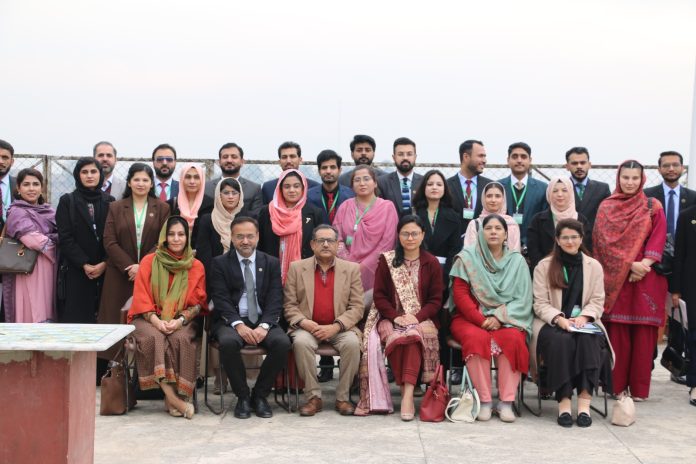
ISLAMABAD: Probationers of the 53rd Common Training Programme (CTP) of the Civil Services Academy on Wednesday visited the Sustainable Development Policy Institute (SDPI) as part of their orientation to independent policy research institutions, engaging in wide-ranging discussions on governance, sustainable development, economy, technology, and demography.
Welcoming the participants, Dr Abid Qaiyum Suleri, SDPI Executive Director, underlined the role of think tanks as independent policy critique bodies that work with governments but not for them. He described SDPI as a shadow government that provides objective analysis and evidence-based solutions, stressing that the appetite for independent governance and informed policy advice is increasing within the public sector, said a press release.
“SDPI does not accept government endowment or funding, a distinction that is essential to maintain credibility and independence,” he said, adding that policies are neither inherently good nor bad, but their success depends on how widely they benefit stakeholders. He called upon the young civil servants to expand the circle of beneficiaries through their expanded services and inclusive policymaking.
Addressing demography and governance, Dr Shafqat Munir, SDPI Deputy Executive Director, emphasized that demographic trends underpin governance, policy choices and service delivery. He cautioned that Pakistan’s demographic transition could yield a dividend or a disaster depending on policy responses.
He also called for accelerated fertility decline through family planning and women’s education, investing in quality human capital, enabling women’s economic participation, creating productive jobs in SMEs, agribusiness and the green economy, and strengthening institutions through data-driven planning and inter-sectoral coordination.
“Demographic change is neither destiny nor doom but a force multiplier shaped by policy and institutional capacity. If systems perform, productivity and growth accelerate; if they fail, frustration accumulates and history shows demography does not forgive policy failure rather it amplifies it,” he warned.
On agriculture and land use, Dr Kashif Majeed Salik, Research Fellow and Climate Change Expert at SDPI, highlighted challenges of land fragmentation, climate stress and low productivity. He stressed the need for precision and climate-smart agriculture, market-oriented farming models and land reforms to protect farmers, who what he said are the most vulnerable actors in the value chain.
Dr Khalid Waleed, Research Fellow and energy economy expert at SDPI, traced the global evolution of sustainable development from the 1972 Limits to Growth report to the 1987 Brundtland Report, which defines development that meets present needs without compromising future generations, a guiding principle of SDPI since its establishment in 1992.
He also shared a critical assessment of Pakistan’s energy sector, pointing to fragmented planning and the need for reforms, including tariff rationalization, market competition and early retirement of inefficient coal plants.
Engineer Ahad Nazir, Head of Center for Private Sector Engagement at SDPI, discussed artificial intelligence and governance, warning that AI has emerged as a strategic state capability with implications for energy demand, infrastructure, data protection and accountability. He called for integrated and agile policymaking, noting that technology is advancing faster than law in Pakistan.
Zainab Naeem, Associate Research Fellow and Head of Circularity at SDPI, spoke on the circular economy, noting that many circular practices are already embedded in Pakistan’s economy, particularly in textiles. She discussed emerging challenges such as the EU’s Carbon Border Adjustment Mechanism (CBAM) and SDPI’s work on Pakistan’s National Circular Economy Policy and locally developed climate solutions.
Other speakers included: Dr Syed Kaleem Imam, who spoke on smart cities and urban governance; Dr Fareeha Armughan, who moderated interactive sessions and facilitated dialogue; Dr Irfan Ahmad Chatha on competition and anti-competitive practices; Qasim Shah on trade and WTO regimes; and Dr Razia Safdar on family planning and healthcare governance.
The visit concluded with an interactive question-answer session and a vote of thanks by Haya Qadri, a probationer of the 53rd CTP, who appreciated SDPI’s role in exposing young civil servants to independent, evidence-based policy discourse critical for effective public service.