
For 28-year-old Fu Yinuo, Tengtou is not only where he lives and works—it is the place where he grew up and which shaped who he is.
In 2016, at the age of 18, Fu left the village after being admitted to Southwest Jiaotong University in Chengdu, Sichuan Province, where he majored in environmental engineering. His journey later took him to Hong Kong Polytechnic University for a master’s degree in urban planning and sustainable development. Along the way, he interned in Shanghai and worked in a district of Ningbo City in Zhejiang, accumulating years of experience in some of China’s most dynamic cities.
With his academic background and professional exposure, Fu had no shortage of options.
Yet he chose to return to Tengtou, where he now serves as an assistant to the secretary of the village branch of the Communist Party of China.
“What drew me back most strongly was emotional attachment,” Fu said. “It’s a bond with the place where I grew up and a feeling that I wanted to do something meaningful for it.”
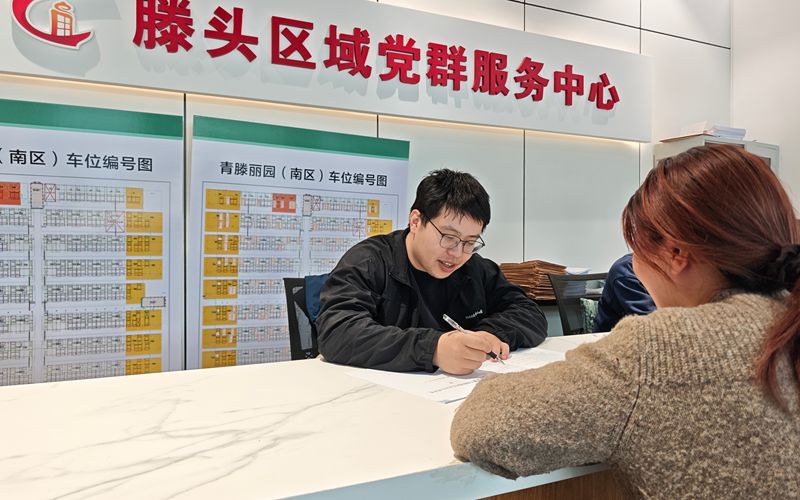
Fu Yinuo receives a villager at the Tengtou Party and Community Service Center, advising her on renovation issues related to community housing, on February 5 (COURTESY PHOTO)
Responding to China’s rural revitalization strategy, which aims to narrow the urban-rural gap and advance the comprehensive development of the rural economy, he hoped to bring his expertise and experience back to the grassroots and build a future in his hometown. His decision was met by understanding and support from his family.
Life after returning home feels noticeably different. Fu describes a slower, more balanced pace. Outside of work, he could spend more time with his family, and ties at home have grown stronger. The essentials of daily life, like shopping, logistics and transportation, are nearly as convenient as in the city, but without the crowds of rush-hour commuters. “It’s calmer, more composed,” he said. “Rural jobs may offer fewer opportunities than cities, but they are more stable, and that stability makes it easier to put down roots.”
Fu Dandan, also from Tengtou, did not begin to feel her emotional connection to the village until after she had left.
Before heading to Ningbo to attend university, she had never thought of her hometown as particularly special. That changed in 2010 during a visit to the Shanghai World Expo with her classmates. Amid the many national pavilions, she unexpectedly came across an exhibition dedicated to Tengtou—showcasing its development model of “using ecology to promote tourism, and tourism to sustain ecology.”
“It was genuinely shocking,” she recalled. “But what stayed with me most was hearing my classmates say, ‘Your village is amazing’.”
To Fu Dandan, the ecological consciousness of the Tengtou community is an instinct to cherish the land after emerging from a difficult period. In 1993, just three months after being recognized by the United Nations Environment Programme on its Global 500 Roll of Honor for Environmental Achievement, Tengtou established China’s first village-level Environmental Protection Committee. The committee instituted a mandatory pre-investment environmental review process for all proposed projects; any project failing to meet stringent environmental standards was rejected by unanimous decision. Over the years, the committee has declined more than 50 economically attractive investment proposals, cumulatively valued at approximately 400 million yuan ($57.65 million), solely on environmental grounds.
Outside recognition of her hometown filled Fu Dandan with pride and prompted her to look at it with new eyes, for the first time considering the idea of returning one day.
Later, as she entered the workforce, she found that realities, including high living costs and unstable housing, made city life increasingly difficult. Encouraged by her parents, she decided to return home. Now, she serves as deputy director at Tengtou’s External Communications Office and is responsible for editing and producing Tengtou Bulletin, the village’s local publication. Since returning, her perspective has grown clearer: Rural areas hold real potential and Tengtou, in particular, offers fertile ground for young people to work, innovate and start businesses.
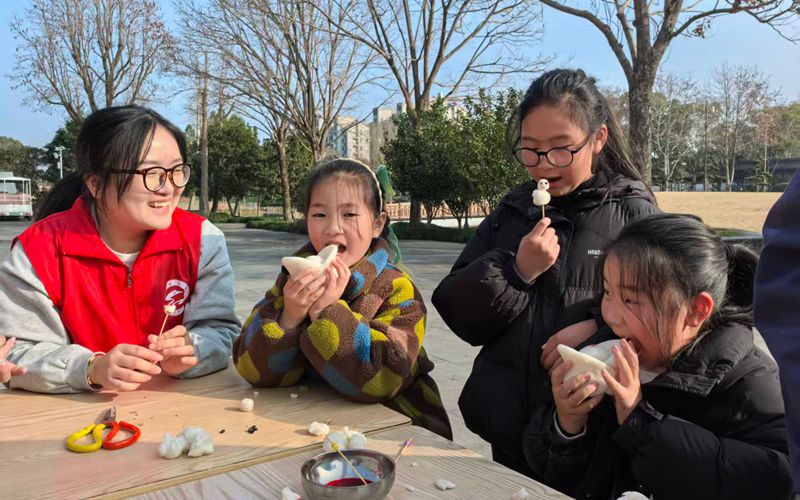
Fu Dandan (first left) volunteers at a traditional rice-cake-making experience event in Tengtou Village, Zhejiang Province, on February 3 (COURTESY PHOTO)
“Tengtou’s support for young people is not a recent development. As early as one or two decades ago, the village held annual forums for young entrepreneurs, providing space to share experiences, discuss challenges and seek support,” Fu Dandan told Beijing Review. “More recently, plans have been proposed to establish a Tengtou Entrepreneurs Association, offering a more structured platform for collaboration and growth. For young employees eager to improve their skills, the village and its enterprises actively encourage professional certification and training,” she continued.
Fu Dandan explained that Tengtou’s agricultural sector is shifting toward hi-tech, high-quality and high value-added production. At the same time, the village has invested in emerging industries such as new materials and ecological construction—fields that urgently need young professionals.
Entrepreneurship is vibrant. Leveraging its rich tourism resources, Tengtou has seen the emergence of specialty cafés, theme parks and cultural attractions, offering low-barrier entry points for young entrepreneurs. Local produce, such as rice cakes, fried snacks and peaches, are now sold through livestreaming and e-commerce platforms, many of which are directly operated and managed by young people.
“We need fresh ideas,” Fu Dandan said. “And we need more young people to bring those ideas to life.”
This view resonates with Fu Yinuo. In his eyes, today’s rural development no longer depends on traditional farmers alone, but on professionals who understand technology, industry and modern management. “For young people who are well-educated and committed to working in rural areas, the long-term prospects are very broad—if they’re willing to stay the course,” he said.
Looking ahead, Fu Yinuo hopes to apply his professional expertise to village planning and governance, helping make Tengtou more beautiful and more livable. He also wants to organize sporting events, cultural activities, free medical consultations, community visits and digital skills workshops—initiatives aimed at enriching both the material and spiritual lives of villagers. For him, the fulfillment derived from rural work also stems from direct commendation and enthusiastic feedback from local villagers.
“I’m willing to stay,” he said. “To start with small things, and through steady, everyday efforts, help the village grow into something even better.”
From leaving for the city to returning home, the choices made by Fu Yinuo and Fu Dandan point to the same conclusion: When industries are in place, communities are supportive and opportunities for growth exist, rural areas can become places where young people build not only careers, but meaningful lives. –The Daily Mail-Beijing Review news exchange item