BEIJING: Chinese President Xi Jinping on Wednesday raised a four-point proposal on building a new security architecture in the Middle East via upholding a vision of common, comprehensive, cooperative and sustainable security, the Xinhua News Agency reported.
In his talks with Egyptian President Abdel Fattah El-Sisi, Xi said China supports countries in the region in developing good-neighborly and friendly relations.
To promote common security in the region, Xi calls for unleashing internal drivers, advancing an integrated approach, cementing development foundation, and enhancing international coordination.
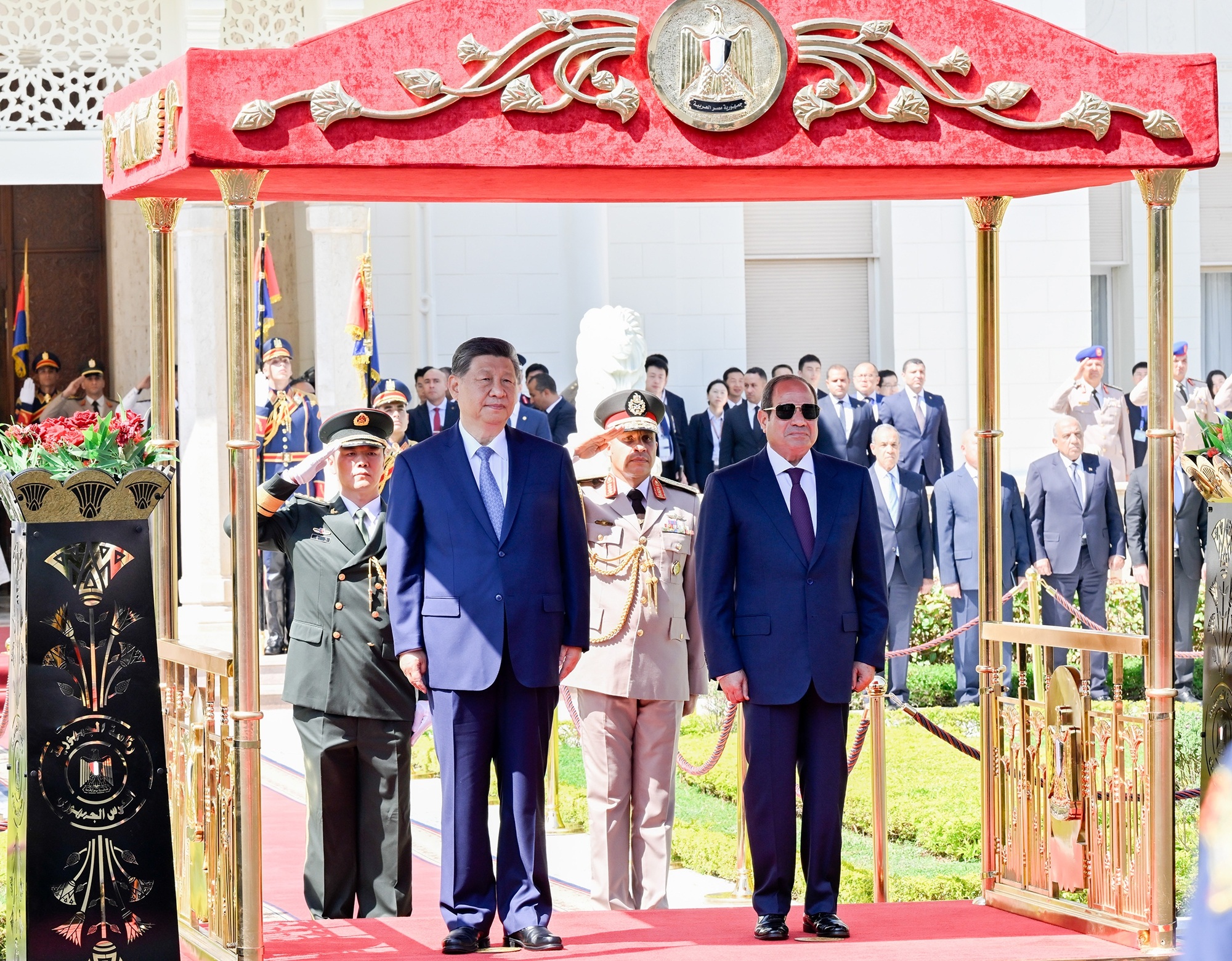
For his part, Sisi welcomed Xi’s historic state visit to Egypt on the occasion of the 70th anniversary of diplomatic ties between the two countries.
Sisi said that since the establishment of diplomatic relations, bilateral ties have developed in a sound and steady manner, and cooperation across various fields has yielded fruitful results. Egypt firmly adheres to the one-China principle and is committed to further advancing the Egypt-China comprehensive strategic partnership, Sisi added.
Chinese analysts said that Xi’s four-point proposal sends a clear message that Middle Eastern countries should pursue greater strategic autonomy in security affairs rather than rely excessively on external powers, and the people of the Middle East should be the masters of their own affairs. Stronger China-Egypt coordination could help explore a path for the Middle East to move from turbulence toward stability, they noted.
For decades, many regional countries depended heavily on outside powers for security protection and spent heavily on Western weapons, yet such dependence did not always translate into effective protection when their own security came under threat, Sun Degang, director of the Center for Middle Eastern Studies at Fudan University, told the Global Times.
More Middle Eastern countries are therefore reassessing their security strategies and seeking to rely more on themselves to safeguard sovereignty and national security. This reflects a growing determination to avoid becoming pawns or targets in major-power rivalry, and playing a greater role in shaping a regional security architecture that better serves their own interests, Sun said.
Liu Xinlu, vice president of Beijing Foreign Studies University, told the Global Times that China’s decision to put forward the proposal in Egypt itself underscores the country’s strategic importance. Egypt serves as an important anchor of regional stability, occupies a pivotal position in safeguarding Red Sea shipping, and remains a key mediator on the Palestinian-Israeli issue.
Stronger China-Egypt coordination is therefore helping explore a path for the Middle East to move from turbulence toward stability – one in which regional countries have a greater say over their own future, Liu said. “It will not be a short road, but if the direction is right, every step counts.”
Enhanced partnership
During Xi’s state visit to Egypt, the two countries released the joint statement on further deepening their comprehensive strategic partnership.
China and Egypt have forged a friendship featuring equality and mutual trust, friendship and mutual learning, solidarity and mutual support, as well as win-win cooperation, said the joint statement on Wednesday.
The two heads of state also agreed to strengthen coordination on global governance and safeguard the interests of developing countries and the Global South, said the joint statement, per Xinhua.
China and Egypt agreed to encourage Chinese companies to actively pursue cooperation on industry localization and support Egypt’s digital transformation and sustainable development, said the joint statement.
The emphasis on localization, digital transformation and sustainable development reflects how China-Egypt cooperation is evolving beyond traditional sectors and becoming more closely aligned with Egypt’s long-term modernization goals, Chinese analysts pointed out.
Li Weijian, a scholar from the Shanghai Institutes for International Studies and vice president of the Chinese Association for Middle Eastern Studies, told the Global Times on Wednesday that China and Egypt have long shared a high degree of consensus on development cooperation and governance, while Egypt has seen tangible benefits from sustained and pragmatic cooperation with China. This, he said, has laid a solid foundation for the long-term stability of bilateral ties.
Li noted that the significance of such cooperation has become even more pronounced amid renewed turbulence in the Middle East. While the region had experienced a wave of reconciliation after Saudi Arabia and Iran restored diplomatic ties, prolonged conflict between Israel and Hamas and continuing tensions surrounding Iran have again disrupted regional stability. Against this backdrop, he said, China and Egypt’s continued focus on development cooperation is particularly valuable.
Compared with a decade ago, countries across the Middle East have developed a stronger consensus on the importance of development, cooperation and modernization, Li said. In this sense, the Chinese President’s visit offers a model for the wider region, showing that even amid instability, development cooperation can remain an important force for sustaining regional stability and shaping the region’s future.
New co-op highlights
During the talks, Xi called on China and Egypt to create new highlights for cooperation in green energy, EVs, aerospace, digital economy and modern agricultural technology, Xinhua reported.
According to Xinhua, the two sides signed more than 20 cooperation documents in areas including the digital economy, science and technology, education and transportation.
Li noted that countries including Egypt, Saudi Arabia and the United Arab Emirates have rolled out national development visions, with infrastructure remaining a fundamental prerequisite for further industrial upgrading. At the same time, modernization is no longer simply about building roads and bridges. Green development, electric vehicles, artificial intelligence and the digital economy are increasingly shaping the next stage of growth, and Egypt has strong demand for cooperation in these emerging sectors.
The cooperation areas highlighted during Xi’s visit therefore correspond closely to Egypt’s development needs, while pointing to a broader shift in China-Egypt cooperation from traditional infrastructure toward a more diverse, technology-driven and future-oriented model, Li said. Given Egypt’s influence in both the Arab world and Africa, such cooperation could generate a broader demonstration effect across the Middle East and Africa and contribute to wider Global South cooperation. –The Daily Mail-Globals Times news exchange item