Compact, candid and constructive—such was the character of Chinese President Xi Jinping’s state visit to the United States on September 23-25. The 43-hour engagement defied the expectations of those who had braced for a contest of wills; what defined it instead was a succession of warm, cordial handshakes, setting a tone that steadied the world’s most consequential relationship. In that sense, the visit afforded a world short on certainty a rare measure of predictability.
Xi and U.S. President Donald Trump had a candid and in-depth exchange of views in a friendly atmosphere of mutual respect on strategic and overarching issues concerning China-U.S. relations and the broader global landscape, Chinese Foreign Minister Wang Yi, also a member of the Political Bureau of the Communist Party of China Central Committee, said while briefing reporters on Xi’s visit.
Since Trump began his second presidential term in early 2025, the two heads of state have maintained close exchanges, including three in-person meetings and five phone talks, and fostered a pattern of interaction marked by mutual respect and sincerity, Wang said, adding this has become the most valuable strategic asset in the China-U.S. relationship.
The strongest signal to the world is that the leaders of the world’s two most consequential major countries, though overtly competitive, can meet in harmony and in a good spirit, which is the headline achievement, American China expert Robert Lawrence Kuhn, Chairman of The Kuhn Foundation, told Xinhua News Agency.

Resetting the tone
The September state visit was Xi’s first to the U.S. in 11 years and, more remarkably, it came less than six months after Trump’s own state visit to China in May, when the two presidents agreed to build a constructive China-U.S. relationship of strategic stability.
Trump framed the occasion as a “state visit-plus,” personally greeting Xi at the Joint Base Andrews in the U.S. state of Maryland, where fighter jets flew over the airport in tribute, and a 21-gun salute was fired.
The latter is among the highest military honors accorded to a visiting head of state, but is rarely rendered at an airport. The arrangement has been described by U.S. media as a “rare” and “unusual” departure from protocol, as U.S. presidents typically receive visiting foreign leaders at the White House, rather than greet them at the airport.
Joint Base Andrews carries symbolic weight in China-U.S. diplomatic history. It was here that Richard Nixon in 1972 departed for Beijing on his historic trip that ended decades of estrangement and set normalization in motion. Seven years later, Deng Xiaoping’s special plane touched down at the same base for his landmark nine-day U.S. tour, the first official visit to the U.S. by a top Chinese leader after bilateral diplomatic ties were established in 1979.
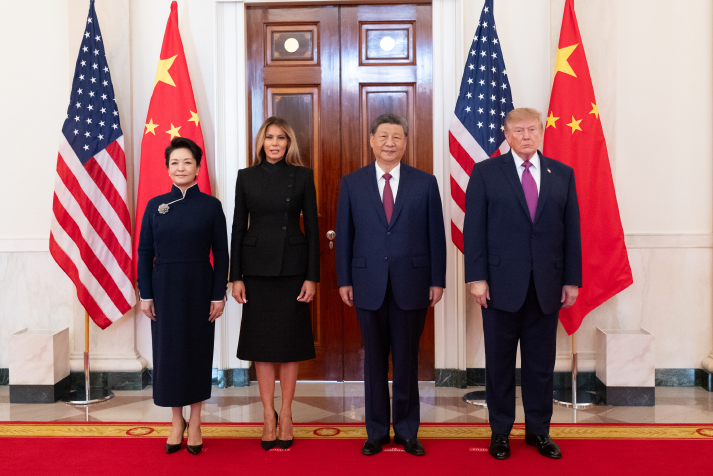
After receiving Xi in person at the airport on September 23, Trump hosted a grand welcome ceremony at the White House on September 24. Xi and his wife, Peng Liyuan, watched a demonstration by the U.S. Marine Corps in the company of the U.S. presidential couple.
The ceremony also featured a military review, with U.S. honor guards from different service branches performing traditional drills and playing instrumental music. Multiple combat aircraft flew over the White House in honor of the Chinese and U.S. presidents and their wives.
An important political outcome of the visit is that the two presidents further enriched the substance of the new vision of China-U.S. relations, agreeing to build a constructive China-U.S. relationship of strategic stability based on respect, fairness and reciprocity, Wang said.
Respect means respecting each other’s sovereignty and territorial integrity, respecting each country’s choice of social system and development path, and respecting the other side’s core interests and major concerns, Wang explained, adding fairness means pursuing mutually beneficial cooperation and handling differences through consultation, rejecting a zero-sum game in which one side’s gain comes at the expense of the other’s, and not seeking unilateral absolute advantage. Reciprocity means that the two countries are equal in sovereignty, that neither side stands above the other, that neither engages in hegemonic nor bullying behavior, that each side’s concerns are addressed on an equal basis, and that cooperation across different fields develops in a balanced manner, according to Wang.
“This state visit was a diplomatic milestone. Through extensive, face-to-face conversations between the two heads of state, the new vision of a constructive China-U.S. relationship of strategic stability has been further substantiated,” Wu Xinbo, Director of the Center for American Studies at Fudan University, told China Central Television.
Looking back over decades of shifting U.S. approaches toward China, American economist Richard Wolff told Beijing Review that Washington has “vacillated between policies of engagement and containment in response to China’s rapid growth.” Against the backdrop of mounting strains from overseas military overreach, the stakes are high for both sides to pursue mutual accommodation rather than drift toward confrontation, he added.

Yielding substantive outcomes
During their talks, the two presidents agreed to support each other as China will host the 2026 APEC Economic Leaders’ Meeting in November and the U.S. will host the Group of 20 (G20) Leaders’ Summit in December, expressing the intention to attend each other’s events.
On the topic of Iran, the heads of state agreed that Tehran should honor its commitment to not developing nuclear weapons. No country or institution can be allowed to impose tolls on international waterways, they said.
Ahead of Xi’s state visit, Chinese and U.S. economic and trade teams concluded their latest round of consultations in New York City and Washington, D.C. The two leaders acknowledged the positive role of the China-U.S. economic and trade consultation mechanism, and recognized the outcomes achieved by their respective economic and trade teams: The establishment and advancement of such mechanisms as a board of trade, a reciprocal tariff reduction arrangement on approximately $30 billion worth of goods imported from each other, and an extension of the suspension of certain tariff and non-tariff measures agreed to during the Kuala Lumpur consultations in October 2025.
During that two-day meeting in Malaysia, the two sides reached a joint arrangement addressing mutual trade concerns, including tariff suspensions and export control pauses, that provided a phased buffer for the then-tense bilateral economic relationship.
Xi and Trump also commended the results achieved so far in bilateral counter-narcotics law enforcement cooperation. The two sides have worked closely to jointly crack multiple cases involving new psychoactive substances and precursor chemicals, and arrest dozens of suspects in both countries.
As for AI, they agreed on the establishment of the China-U.S. AI Dialogue to exchange views on AI-related risks and benefits. A communication channel for AI-related incidents will also be established.

Simply framing this development through the lens of an “AI race” risks distorting the nature of technological rivalry. Edemilson Paraná, an associate professor of sociology at University College Dublin, Ireland, warned that such a race-centered narrative could feed a self-reinforcing technological security dilemma: Restrictive measures on one side spur efforts for self-reliance on the other, which in turn fuels calls for tougher safeguards (See pp.30-31).
“Instead of chasing a winner-takes-all outcome, China and the U.S. ought to manage competition while preserving cross-border scientific exchange, and make room for developing countries to shape their own AI development pathways,” he told Beijing Review.
In addition to these outcomes, the Chinese and U.S. militaries agreed to sign a memorandum of understanding as soon as possible on strengthening crisis communication and prevention.
Following the talks, the two presidential couples met again for a state dinner. Inside, red blossoms and linens decorated the room, a choice a White House press release said reflected the color’s longstanding cultural significance in China.
U.S. business communities, the biggest beneficiaries of stable bilateral ties, have voiced strong optimism about the visit’s far-reaching commercial impact. The state dinner has offered another glimpse of the breadth of economic ties between the two countries. Executives from major U.S. aviation, technology and financial firms were among the guests, including some who had accompanied Trump to Beijing in May, such as Nvidia CEO Jensen Huang and Tesla CEO Elon Musk.
Harley Seyedin, Chairman and President of the American Chamber of Commerce in South China (AmCham South China), cited survey evidence of sustained U.S. business confidence in the Chinese market. The chamber’s 2,300-plus member firms account for nearly 40 percent of total China-U.S. trade and investment volume and it has been conducting annual industry surveys for 23 years. According to its latest survey, over 45 percent of U.S. enterprises rank China as their top global reinvestment destination, around 76 percent plan to expand investment in China in 2026, and member companies have earmarked more than $13.4 billion for market layout and industrial expansion over the next three to five years.
Most U.S. companies continue to deliver robust, profitable operations in China, securing faster and higher investment returns than in most global markets, Seyedin told Beijing Review. Backed by China’s massive consumer base, ongoing service-oriented industrial upgrading, vibrant economic ecosystem and widespread corporate research and development centers, U.S. enterprises keep gaining unique and valuable commercial opportunities unavailable elsewhere, he added.
Michael Hart, President of the American Chamber of Commerce in China (AmCham China), which represents more than 800 member enterprises across finance, healthcare, advanced technology and AI, echoed the upbeat assessment. High-level presidential dialogues, he said, send crucial reassuring signals to global investors and help clear the way for U.S. companies to broaden their industrial and commercial footprint in China.
“Facing strong headwinds in the global economy and rising protectionism, the visit has restarted multiple economic and trade dialogue mechanisms and sent a clear signal to markets that decoupling and supply chain fragmentation serve nobody’s interests. A stable bilateral business climate not only enables U.S. firms to deepen their presence in China, but also facilitates Chinese enterprises operating in the U.S.,” Yuan Zheng, Deputy Director of the Institute of American Studies, Chinese Academy of Social Sciences, told newspaper People’s Daily.
Zhang Yansheng, senior consultant at the China Center for International Economic Exchanges, highlighted the practical value of renewed multi-tiered dialogue under head-of-state diplomacy. “China-U.S. economic and trade relations should follow the logic of expanding the list of areas for cooperation while shortening the list of frictional issues, and counteract geopolitical shocks with tangible deliverables,” he told Beijing Review.

Sustaining ties through the people
At the state dinner, both presidents looked back on the long history of exchange between the Chinese and American peoples, underscoring the importance of people-to-people ties.
Xi recalled how the two peoples stood shoulder to shoulder in the fight against Japanese militarist aggressors more than 80 years ago, and how Ping-Pong Diplomacy reopened the door to bilateral exchange more than half a century ago.
He also recounted the story of American Ronald Sakolsky, who supported Chinese desert control worker Yin Yuzhen’s tree-planting efforts more than 20 years ago, calling it a shining example of friendly exchange between the two peoples.
New steps are also being taken to carry the bilateral friendship forward.
During his visit, Xi announced that two pandas, Ping Ping and Fu Shuang, will soon arrive at Zoo Atlanta in Georgia to better connect with American communities. He also unveiled an expanded people-to-people initiative, inviting 100,000 young Americans to participate in exchange and study programs in China over the next five years.
“The hope of the China-U.S. relationship lies in our people, and its future lies with the young,” Xi said, highlighting the fundamental role of grassroots engagement in stabilizing major-country relations. The new plan builds on a previous 2023 proposal that aimed to host 50,000 American youth within five years, a target that has already been fulfilled ahead of schedule, demonstrating China’s consistent commitment to bilateral exchange.
China’s initiative “is very positive and significant, because I believe that those kinds of exchanges and students going back and forth are very, very important,” Kenneth Quinn, President Emeritus of the World Food Prize Foundation, told Xinhua News Agency.
Eric Hovagim, a U.S. filmmaker based in Shanghai, drew an evocative historical parallel. “In 1971, it took a ping-pong team… The tools might be changing, but the lessons are not. Governments can open the door to each other, and it’s our job to walk through it,” he told Beijing Review.
Beyond the bilateral gains, the visit carries far-reaching global implications. At a time when bloc-based rivalry and geopolitical fragmentation are gathering momentum, the two countries’ commitment to managing competition through dialogue sends a powerful signal to the rest of the world.
The greatest value of the visit does not lie in eliminating all differences at one stroke, but in establishing a framework for managing competition and averting conflict. It builds guardrails for bilateral ties and offers the volatile world a much-needed dose of reassurance, according to Wu.
Stabilized China-U.S. relations help mitigate risks for global supply chains, reinforce multilateral efforts on non-proliferation and emerging technology governance, and create more room for developing nations to pursue their development. In this sense, the handshakes in Washington, D.C. resonate well beyond the shores of the Pacific. –The Daily Mail-Beijing Review news exchange item