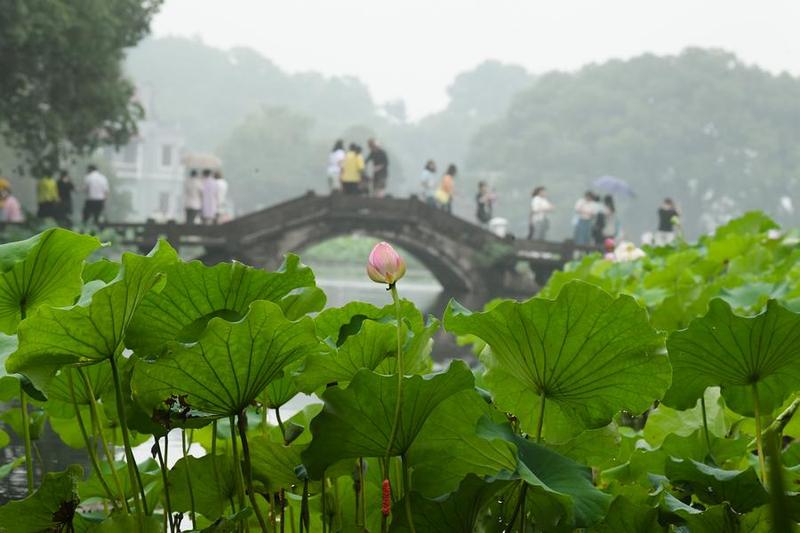
BEIJING: Every morning, boatwoman Chen Meifang steers her canopied wooden vessel across Hangzhou’s West Lake, guiding tourists past arched bridges, willow-lined banks and pagodas reflected in the still water.
For a thousand years, the lake has inspired poets and painters; for Chen, it is a living reminder of a decision that forever changed how people experience Hangzhou’s most beloved landmark.
In 2003, the fences surrounding the West Lake were torn down, and every park around it became free to enter — a move launched under the leadership of Xi Jinping, then Party secretary of Zhejiang province.
The policy turned the West Lake from a scenic enclave into a shared public space, allowing both residents and tourists to enjoy its beauty without barriers.
“Every part of this lake tells a story — of history, of change, of the people who live by it,” Chen said. “And we still feel that every day.”
The decision reflected a broader vision Xi was charting that year — the Double-Eight Strategy, a development blueprint that continues to define Zhejiang’s path two decades on.
The strategy identified eight of Zhejiang’s core strengths, including institutional advantages, geographical location and cluster-based industries, and laid out eight initiatives to leverage them, ranging from industrial upgrading and urban-rural integration to environmental protection and maritime development.
It also called for leveraging Zhejiang’s cultural and human resource strengths by invigorating the province through science, education and talent development, and by building Zhejiang into a province with a strong culture.
At the time, Zhejiang’s economy was entering a critical transition phase. Its GDP stood at 800.4 billion yuan ($113.2 billion) in 2002, ranking fourth among Chinese provincial-level regions, but faced challenges such as power and water shortages, as well as land supply constraints. The profits of industrial enterprises above a designated size across the province showed a slide in the past, according to local media reports.
From the challenges, Xi, who is now Chinese president and general secretary of the Communist Party of China Central Committee, saw an opening — to upgrade the province’s economic structure and transform its model of growth.
“The Double-Eight Strategy was a top-level design tailor-made for Zhejiang. It serves as the province’s overarching program, master strategy and guiding blueprint for advancing Zhejiang’s new phase of development,” said Guo Zhanheng, former deputy head of the policy research office of the CPC Zhejiang Provincial Committee. “It was not only a plan for prosperity, but also for balance — between city and countryside, between growth and ecology, between efficiency and fairness.” –The Daily Mail-China Daily news exchange item