
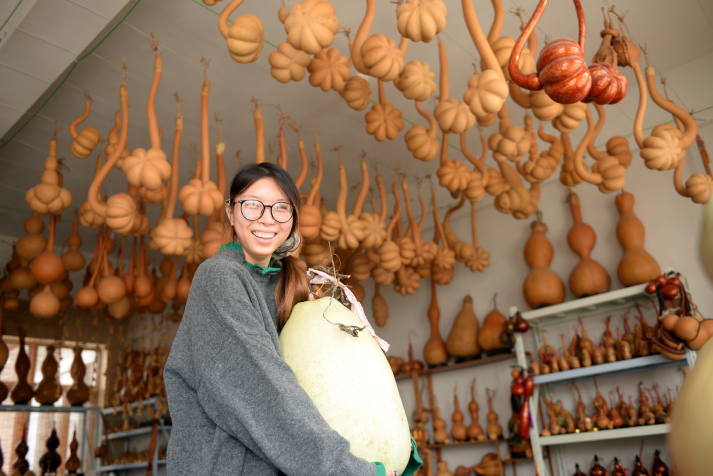
A video shot eight years ago planted a seed in Hao Xuekun’s mind—returning home to start a business. His hometown, Luzhuang Village in Liaocheng City of Shandong Province, is known for its abundant production of bottle gourds, a type of gourd that is either eaten while young or left to dry and made into ornaments, utensils or musical instruments. Luzhuang’s gourd production accounts for over 50 percent of the national total in both output and sales.
During the National Day holiday in October 2018, the then 19-year-old college student uploaded a short video documenting the village’s gourd fair online. The clip showed row upon row of gourd shops, bustling traders coming and going, and a variety of distinctive gourd types on display.
This casually posted video garnered over 200,000 views within 24 hours. Many viewers left comments asking about the prices of different gourd varieties. That single video directly facilitated more than a dozen online transactions and gave Hao a real sense of the market demand for the gourd.
The Chinese name for gourd, pronounced as hulu, sounds similar to “good fortune and prosperity,” making the good-looking vegetable a traditional favorite among Chinese consumers. Seeing this market potential, Hao made the decision to return to his hometown after graduating in 2021 to throw himself into the gourd industry.
He began growing gourd while using short videos to record their growth and share his farming experiences. By that time, his social media account had already attracted 120,000 followers, laying a solid foundation for his entrepreneurial journey.
Gourd artisans
Hao turned a room of his house into a livestreaming studio, filled with assorted specialty gourd for his online broadcasts. Now, Hao has become a “gourd influencer,” active across multiple platforms, with over 300,000 followers on social media and an annual livestreaming income of nearly 1 million yuan ($140,000). He not only sells Luzhuang gourd across the country but also uses the Internet to introduce the gourd culture to a wider audience.
He is among the more than 30 young people in the village who have returned home to start businesses. He believes that the future of the gourd industry lies in personalized processing and design, with young returnees injecting new vitality, particularly through innovative design, into this traditional trade.
Before coming to Luzhuang, Mo Junling worked as an architectural designer. After marrying a villager from Luzhuang, she gained deeper exposure to the village’s rich gourd culture. Leveraging her professional design background, she blends modern aesthetic concepts with traditional gourd craftsmanship to create distinctive cultural and creative products. Recognizing the market potential in gourd processing, she chose to start her business here, hoping to use her expertise in art and design to explore a new path in gourd craftsmanship.
She uses high-quality dried gourd as her raw materials. During creation, she first sketches the design on the gourd with pencil, then carves meticulously along the lines with knife, and finally applies acrylic paints for artistic coloring. She particularly emphasizes that every piece is entirely handmade, from pattern design and text layout to the finished carving. This unique paint-carving technique gives her works clearly layered lines, delicate and smooth strokes, and expressive imagery.
“Currently, private custom orders make up a large portion of my business,” Mo told local newspaper Liaocheng Daily. “The added value brought by handmade craftsmanship is considerable. The most expensive piece of paint-carved gourd work I’ve sold went for over 8,000 yuan ($1,100).” For her, the craft is deeply fulfilling, for it utilizes her skills, provides an income and encourages fellow villagers to learn and earn.
Crafting the roots
Stories like Mo’s reflect a broader trend across China’s countryside, where distinctive local crafts are increasingly drawing young people back to their roots. There is a growing recognition that when the creativity of youth meets time-honored techniques, it can spark unexpected possibilities.
This potential was highlighted during the annual sessions of the Guizhou provincial legislature and political advisory body held in late January. Provincial legislator Xiong Zhaomei submitted a proposal calling for the development of the intangible cultural heritage (ICH) industry to attract more young people back to their hometowns to start businesses.
As the operator of a batik workshop in Liupanshui, Xiong has personally witnessed the positive outcomes of integrating youthful energy with traditional craftsmanship. For instance, in Maba Village, the model of combining batik artistry with rural tourism has successfully drawn a number of young people back to work in their hometowns.
To this end, she put forward several concrete measures in her proposal: establishing a provincial-level special entrepreneurship fund, offering short-term training courses such as ICH E-commerce Operations in vocational schools, creating ICH Vitality Communities that integrate studios, live-streaming rooms and youth apartments, and actively encouraging digital innovation in the ICH field.
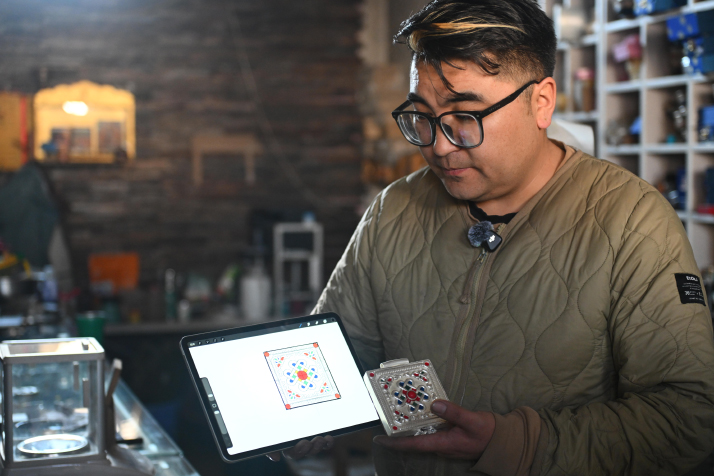
These proposed measures aim to foster a supportive environment for young returnees—a vision already coming to life through the paths of individuals like Wudemutu. For him, returning to his hometown in Subei Mongolian Autonomous County in Jiuquan, Gansu Province, after university was an instinctive choice.
Growing up as the son of a silversmith, he felt a deep connection to the craft, one that stayed with him even while pursuing his studies. In 2015, he opened a silverware shop to sell his own handcrafted jewelry and later formally established a silver product manufacturing company.
He works within the tradition of Subei Mongolian silverware, a treasured handicraft passed down through generations. The Mongolian ethnic group has long held silver ornaments in high esteem, with pieces coming in a rich variety of styles, shapes and types. Using techniques like casting, hammering, braiding, engraving and chiseling, artisans adorn silver with traditional motifs such as dragons and phoenixes.
As a Mongolian artisan born in the 1990s, Wudemutu drives innovation in this field by skillfully integrating modern design with these age-old techniques, developing a distinctive range of cultural jewelry and creative products. His efforts, alongside the craft’s inherent value, contributed to its inclusion in Gansu’s Representative List of Intangible Cultural Heritage in 2024, with Wu himself being recognized as an inheritor of the craft.
He recently designed and made a series of silver ornaments featuring horse motifs for the Chinese zodiac Year of the Horse. For him, this blend of timely themes and ancestral technique does more than ensure the craft’s contemporary relevance—it affirms his role as a crucial link in a living cultural chain and stands as a testament to how youthful innovation can both honor and advance heritage. –The Daily Mail-Beijing Review news exchange item