BEIJING: China on Thursday said it is “shocked” by the remarks by Israeli Defense Minister Israel Katz, who said Prime Minister Benjamin Netanyahu and he have authorized the Israel Defense Forces to kill any Iranian official without the need for additional authorization.
Katz’s remarks came as US-Israel strikes killed three high-ranking Iranian officials in the past three days, including Iranian Secretary of Supreme National Security Council Ali Larijani, commander of the internal Basij militia Gholamreza Soleimani and Iranian intelligence minister Esmaeil Khatib.
“The killing of Iranian leaders and attacks on civilian targets are by no means acceptable,” said Chinese Foreign Ministry spokesperson Lin Jian, adding that China is always against the use of force in international relations.
As the war entered its 20th day on Thursday, the conflict has rapidly evolved from strikes on military targets to a full-scale exchange of attacks on energy infrastructure. The conflict has also spilled over to energy facilities in neighboring Saudi Arabia, UAE and Qatar, sending shockwaves through global energy markets.
Escalating attacks on Persian Gulf oil-and-gas infrastructure are sending the US-Israeli war with Iran into a dangerous new phase that threatens to worsen the crisis over global energy supplies, the Wall Street Journal reported.
Israel on Wednesday struck Iran’s South Pars gas field, the world’s largest and the crown jewel of Iran’s energy industry. Hours later, Iran launched missiles against oil and gas facilities across Qatar, Saudi Arabia and the United Arab Emirates, hitting Qatar’s Ras Laffan Industrial City and setting off fires there, Al Jazeera reported Thursday.
The South Pars gas field, shared between Iran and Qatar (where the Qatari side is known as North Dome), contains an estimated 1,800 trillion cubic feet of usable gas – enough to supply the entire world’s needs for 13 years, according to media.
CNN said Iran’s production of gas from South Pars is the biggest source of its domestic energy supply. Iran has previously suffered power shortages because of disruptions to gas supplies, so any impact would affect its ability to produce electricity and heat homes.
After intercepting missiles fired from Iran, the UAE shut down its Habshan gas facility, according to the Arab Weekly.
For its part, Saudi Arabia stated that on Wednesday it intercepted and destroyed four ballistic missiles launched toward Riyadh, in addition to foiling an attempted drone attack on a gas facility in its east.
According to Al Jazeera, Saudi Arabia’s Foreign Minister Prince Faisal bin Farhan Al Saud warned Iran at a news conference on Thursday that tolerance of its attacks on his country and those of neighboring Gulf states is limited, calling on Tehran to immediately “recalculate” its strategy.
“So when this war eventually ends, in order for there to be any rebuilding of trust, it will take a long time. And I have to tell you, if Iran doesn’t stop … Immediately, I think there will be almost nothing that can re-establish that trust,” he added.
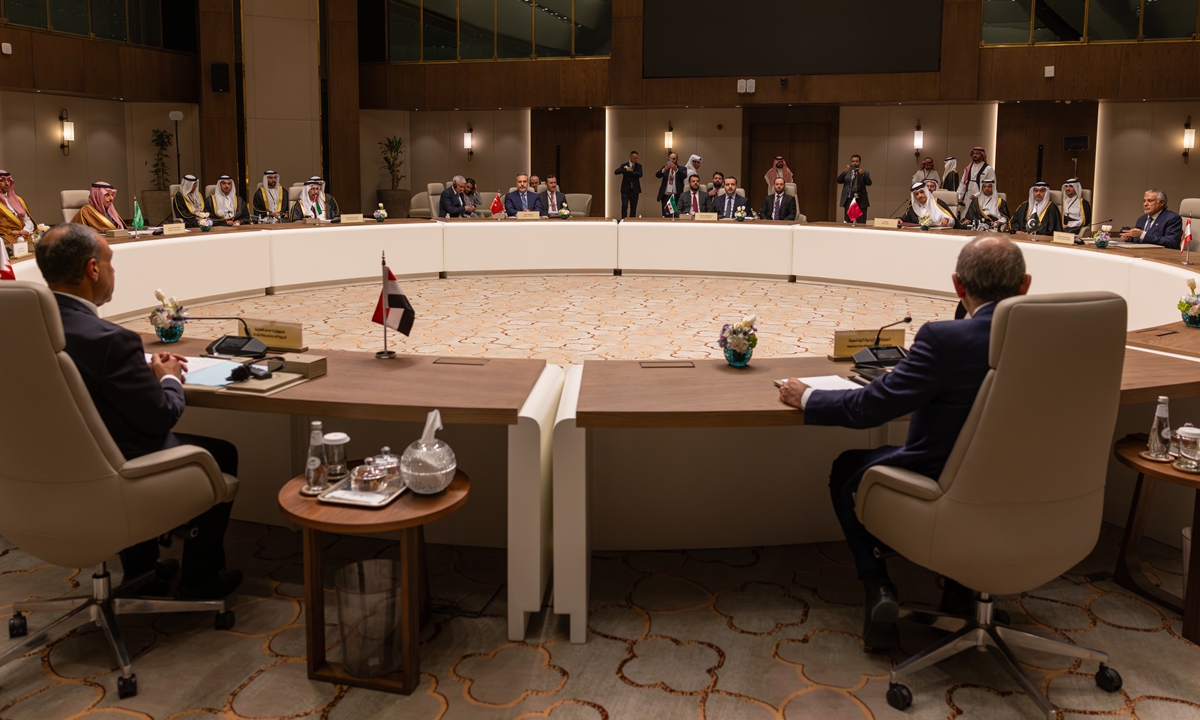
Prince Faisal’s warning followed a meeting of foreign ministers from Arab and Islamic countries in the Saudi capital earlier in the day to discuss the expanding war in the region. In a joint statement issued after the meeting, the ministers condemned what they described as deliberate Iranian attacks using ballistic missiles and drones targeting residential areas and civilian infrastructure, including oil facilities, desalination plants, airports, housing complexes and diplomatic premises, Reuters reported.
Liu Zhongmin, a professor at the Middle East Studies Institute of Shanghai International Studies University, told the Global Times on Thursday that the current conflict has entered a highly dangerous stage and is even undergoing a qualitative shift.
He noted that earlier exchanges of strikes between the US, Israel and Iran were largely aimed at military targets, with only limited spillover damage to civilian facilities and infrastructure. Now, however, the Middle East’s economic lifelines are becoming direct targets.
“While concerns previously focused on the security of shipping through the Strait of Hormuz, the situation now threatens not only transportation but also production. Strikes on gas fields and oil production facilities could put both energy production and transportation at risk simultaneously, with potentially immeasurable consequences for the global economy,” Liu added.
Notably, regarding Israel’s latest strike on the South Pars gas field, Trump wrote on Truth Social that the “US knew nothing about this particular attack,” while declaring that Israel would not carry out any further attacks on the “extremely important and valuable” South Pars gas field unless Iran “unwisely decides to attack a very innocent, in this case, Qatar.”
However, the Wall Street Journal and Axios reported that Trump knew of Israel’s plan to attack the South Pars in advance and supported it.
Liu said the escalation reflects the “overlapping actions of three parties.” The US had sought to pressure Iran to reopen the Strait of Hormuz, but Iran instead retaliated, while Israel continued strikes against Iranian leaders, pushing the conflict toward a more dangerous stage and expanding it into the oil and energy sectors.
“Before the death of Ali Larijani, Iran still appeared to leave some room for compromise and had signaled a desire to end the conflict soon. The Trump administration had also indicated willingness to end the war at an appropriate time, suggesting that both the US and Iran do not want the conflict to escalate into a full-scale war,” said the expert. –The Daily Mail-Global Times news exchange item