
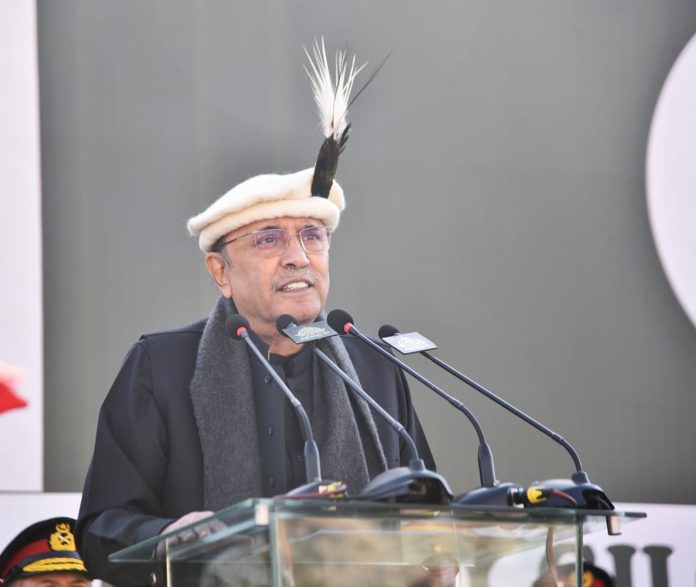
BEIJING: President Asif Ali Zardari has invited greater Chinese investment in Pakistan’s key sectors, including alternative energy, water treatment and EV battery systems.
The development came during Zardari’s meeting with Wang Jian, CEO of Hangzhou Jinjiang Group, read a press statement on Wednesday.
During the meeting, the premier encouraged the Chinese company to expand its footprint in Pakistan, particularly in the energy, industrial and agricultural sectors.
The President was briefed that the group is already engaged in multiple projects in Pakistan and ranks among the top 100 business groups in China, with operations spanning heavy industry, fertiliser, oil and gas, coal gasification, renewable energy, agriculture and irrigation.
President Zardari highlighted that Pakistan is actively encouraging foreign investment in various sectors, especially water treatment, electric vehicle battery systems and alternative energy. He emphasised that such partnerships could support sustainable growth and industrial development.
He further stated that the Government of Sindh would extend all possible facilitation to foreign companies seeking to invest in the province, particularly under public-private partnership frameworks.
Senator Saleem Mandviwalla, Sharjeel Inam Memon, Senior Provincial Minister, Sindh, Syed Qasim Naveed Qamar, Special Assistant to the Chief Minister of Sindh for Investment and Public-Private Partnership Projects and Chief Secretary, Sindh, attended the meeting.
A day ago, three MoUs were inked between Pakistan and China in the presence of President Asif Zardari in Changsha, China.
The agreement on making seawater usable was signed by Sindh Senior Minister Sharjeel Inam Memon and Chairman of Luxian Environmental Technology Group Yuhui.
The agreement on agricultural technology cooperation was signed by Sharjeel Inam Memon and the Chairman of Longpin High-Tech Information Company, Chen Zhishen.
The agreement related to the tea sector was signed by Senator Saleem Mandviwala on behalf of Pakistan, while Zhou Chongwang and Hao Jiaolong on behalf of Chinese companies.
These agreements aim to promote water, agriculture, trade and bilateral cooperation. –Agencies