

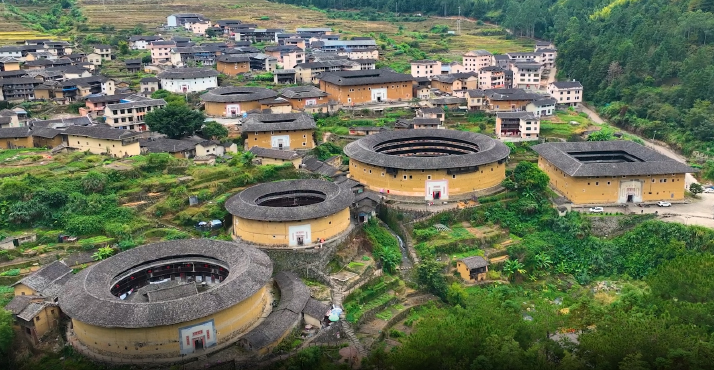
Encircled by lush hills and cut through by a clear stream, the village is home to 36 Hakka tulou, or earthen buildings. Known literally as “guest families” after their mass migration south from central China in ancient times, the Hakka people began building these multi-story, fortified, communal houses for defense against wild animals and local bandits as well as heat and humidity. From above, they appear like a constellation of massive rings, housing multi-generation families.
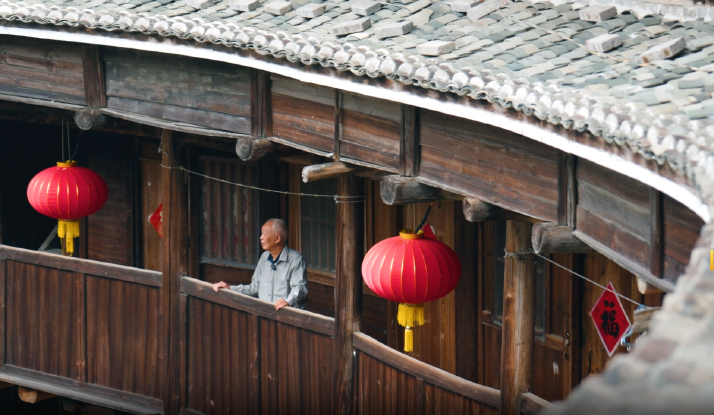
In August 1953, Xu Songsheng was born in a small room inside Yuqing Building (yuqing means abundant blessings), where he spent a joyful childhood. “I played hide-and-seek here with other children. We loved all kinds of games,” he recalled.
In those days, life inside the tulou was warm and close-knit. When parents were out working, neighbors looked after each other’s children, and doors were rarely locked. Meals were seldom confined to a single household—dishes were often brought out and shared among families.
“That was the best part of living here. Everyone helped each other,” he told Beijing Review.
Today, that child has grown up to become a national-level inheritor of Hakka tulou construction techniques, recognized as a from of intangible cultural heritage. For more than five decades, Xu has devoted himself to building and restoring these earthen structures, treating it not merely as a profession, but as a lifelong responsibility.
“Even though I am already 73, I still want to keep working on tulou,” he said.
From the ground up
Practical and resilient, tulou is cool in summer and warm in winter, with kitchens on the ground floor, grain stored above in drier conditions and living quarters higher up for better airflow and natural light.
Xu began learning the craft at the age of 14, following in his father’s mason footsteps. His father was highly skilled and had built tulou across the surrounding region. By the time the craft was passed on to Xu, it had already reached its fourth generation within his family.
He explained that different landscapes require different tulou designs. The first step is selecting a site according to fengshui principles, so as to harmonize human life with the natural environment to promote health, wealth and positive energy. The layout is then marked out by hand, even on steep slopes.
Once the layout is set, construction begins with the foundation. When his father first taught him this stage, he stressed that starting without a solid base is like building on sand.
Large stones are embedded underground, while smaller ones are arranged above to form a trapezoidal wall. All materials are sourced locally. Stones vary in size and shape, and the key is to find the right points of support so that each piece reinforces the others. Stones of different lengths are combined, with smaller pieces filling the gaps.
“This is a very delicate and demanding craft. We carefully fit together stones of different sizes, one by one,” Xu said.
Rammed-earth walls are then built, usually in the second half of the year when rainfall is lower. Each layer is compacted tightly, with wooden columns and beams added progressively.
At the top, the wooden frame is completed and roof tiles are laid. The main structure is then finished, followed by drainage systems. A four-story rammed-earth wall is typically about 1-meter thick and takes around a year to fully dry before interior work can begin.
Even with hands-on training, mastering the craft takes at least four years, even for those with strong aptitude. “For me, happiness is seeing a tulou completed and families moving in. We sit together, have tea and everyone feels joyful,” he said.
From collapse to restoration
At 22, Xu began leading his own construction team and went on to build more than 10 tulous. But from the 1980s onward, demand for new construction declined, and he gradually shifted toward restoration work.
Jiqing Building (jiqing means gathering blessings), built in 1419, is one of the oldest surviving tulou in Fujian. It is now open to the public as a Hakka folk museum. It is known for its all-wood structure built without nails, and its unique “one staircase per household” design.
By 2001, after years of neglect, it was on the verge of collapse. The scale and risk of restoration deterred everyone else. Xu was approached several times before he finally agreed.
The reality inside was worse than expected. Roof tiles had decayed, wooden beams were broken, walls were severely deformed, and more than 70 staircases were damaged. Hundreds of interior columns had tilted to varying degrees.
Xu explained that in circular tulou, wooden structures are intentionally built with a slight inward tilt, which increases stability. However, this also creates inward pressure, making deformation likely without regular maintenance. If even one column shifts, it can trigger a chain reaction across the structure. The key, therefore, was to identify the primary point of deformation.
He tapped wooden beams with a hammer, listening closely to the sound to judge whether the timber was hollow or decayed. A clear tone indicated sound wood. Eventually, he identified the root problem: a rotten beam joint that had destabilized the structure.
The team first reinforced the building with timber supports and ropes. They then carefully dismantled the damaged beam, sawing through it centimeter by centimeter over three days. Once removed, space was created to gradually correct the tilted columns and replace weakened structural components.
After six months of work, the building regained its stability and presence. “It was the most difficult, most dangerous and most complex restoration I have ever done,” he said. “During the process, I was deeply moved by how our ancestors were able to build something so strong and precise with such limited tools.”
In 2008, Jiqing Building, along with other Fujian tulou, was inscribed on the UNESCO World Heritage List.
Passing on the craft
In September 2020, Yongding was hit by several days of continuous heavy rain. Watching the rain outside his window, Xu wrote an article explaining in detail how to protect tulou against water.
Around the same time, he began to think more seriously about documenting his knowledge. “So that future generations can learn this craft from books, and the cultural legacy of the Hakka people will not be lost in history,” he said.
He later collaborated with a local Chinese language teacher and Hakka culture enthusiast in Yongding to complete a book on the construction techniques of Hakka tulou. Drawing on decades of experience in building and restoration, more than 3,000 copies of the book were printed and distributed free of charge to museums and schools, leaving an important written record of the craft.
“If someone wants to build a tulou in the future, they can refer to what I have written,” he said.
To this day, Xu continues to work on tulou restoration projects and still takes part in on-site work when necessary. Last October, he served as a project consultant at a tulou in Gaobei Village, Yongding. Once restored, it will be converted into a homestay.
“Today, the restoration of tulou adheres to the principle of ‘restoring the old to its original state,’ whereby traditional craftsmanship is employed to preserve the original style and timeless charm of these historic buildings,” he explained.
He remains concerned about the transmission of the craft. The last time he built a tulou was nearly 40 years ago. Today, most workers taking part in the project are already in their sixties, and very few young people have mastered these skills.
He proposed to local cultural heritage authorities the creation of a traditional-style tulou cluster that would showcase various building types, thereby ensuring that every stage of the craft is transmitted through the process of actual construction.
“I still hope to take on more apprentices to carry this skill forward,” he said. –The Daily Mail-Beijing Review News exchange item