
By Asad Cheema
ISLAMABAD: Senator Dr Afnan Ullah Khan, Member of Senate Standing Committee on IT and Telecommunications, has warned that Pakistan cannot afford to miss the emerging knowledge economy after historically missing earlier industrial revolutions, as digital infrastructure and related legislation are critical for the future competitiveness.
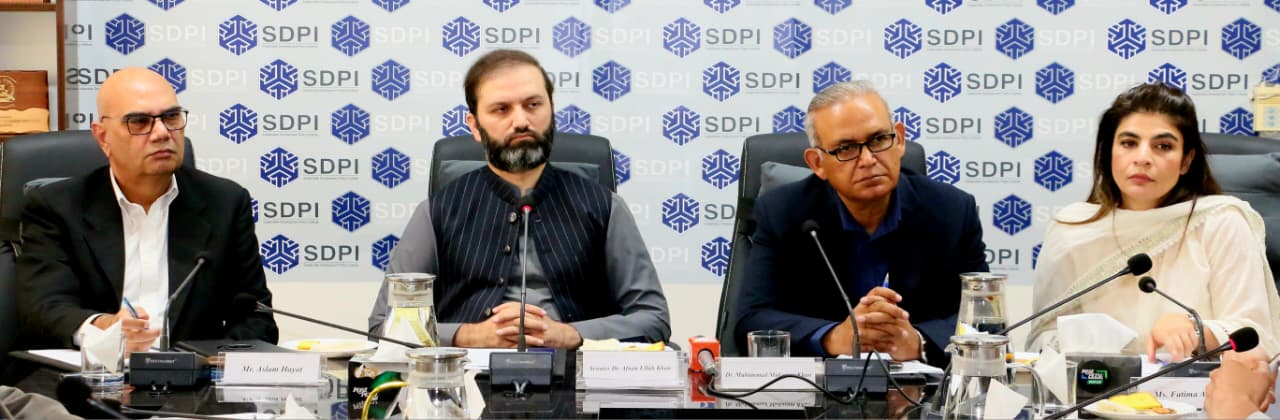
He was speaking at a Public Private Dialogue on “Building the 5G Economy: Industry 4.0, Enterprise Uptake, and Ecosystem Preparedness” organized by Sustainable Development Policy Institute (SDPI) under its Study Group on IT and Telecommunication here on Thursday.
The senator informed the participants that a Data Protection Bill had been tabled in the Senate to attract foreign investment in data centers. He further said international investors preferred countries with robust data protection laws, as only the legislation can unlock billions of dollars in foreign direct investment.
Cautioning against the emergence of a surveillance state, he emphasized the importance of data localization, digital rights and affordable internet access. He lauded the role of the government, PTA and industry for successfully conducting the 5G spectrum auction.
In his welcome remarks, Brigadier (R) Mohammad Yasin, Senior Advisor Emeritus at SDPI, said Pakistan had entered an era of digital transformation and the Fourth Industrial Revolution with the rollout of 5G technology. He emphasized that 5G was no longer merely a faster mobile broadband service but a catalyst for Industry 4.0, intelligent automation, real-time data exchange and interconnected systems.
He said 5G had the potential to transform healthcare, agriculture, education, manufacturing and transport sectors, while creating new opportunities for innovation and productivity growth. Brig. (R) Yasin stressed the need to create enterprise demand, strengthen workforce reskilling and foster partnerships between industries, universities, research institutions and policymakers. Pakistan’s research and development ecosystem lack effective coordination with industry needs, he said, and urged policymakers to align 5G with industrial and economic policies.
Dr. Muhammad Mukkaram Khan, Director-General Cyber Vigilance at Pakistan Telecommunication Authority (PTA), said the authority is working on alternative connectivity arrangements to reduce dependence on submarine cables vulnerable to regional conflicts.
He said PTA had directed telecom operators to develop satellite links and synchronize network time protocols with China to ensure uninterrupted services.
He acknowledged that Pakistan still relied heavily on international internet routing systems, resulting in significant foreign exchange outflows.
Dr. Sajid Amin Javed, Deputy Executive Director (Research) at SDPI, said the economic benefits of 5G would depend on how effectively Pakistan integrated the technology into local and regional value chains. He said conservative global estimates suggested that even a moderate 5G rollout could raise economic productivity by two to three per cent annually, translating into nearly $12 billion in additional economic output for Pakistan every year.
He added that a well-integrated rollout involving industry, academia, health and education sectors could potentially generate productivity gains of up to five per cent over the next few years, which is equivalent to around $ 20 billion annually for Pakistan’s economy. He warned that policymakers must ensure 5G does not widen the digital divide between urban and rural populations.
He called for affordable and comprehensive rollout strategies, particularly for small and medium enterprises (SMEs), which constitute over 80 per cent of Pakistan’s industrial landscape. He also urged policymakers to integrate 5G considerations into industrial, trade and financial policies rather than treating it as a standalone technology agenda.
Jahanzaib Raheem, Member of IT and Telecommunication Ministry, said Pakistan’s telecom sector is evolving into a digital connectivity infrastructure sector requiring large-scale capital investments. He said the government had adopted an umbrella policy approach covering mobile, terrestrial and optic fiber connectivity.
He said the government had abolished right-of-way charges at national and provincial levels to encourage infrastructure development, as such charges previously accounted for nearly 30 per cent of telecom investment costs.
The telecom sector has grown into a Rs1.7 trillion market contributing over Rs400 billion to the national exchequer through taxes, he said, adding that Pakistan’s recently approved space policy would further strengthen digital connectivity initiatives.
Muhammad Aslam Hayat, Senior Policy Fellow at LIRNEasia, said Pakistan’s 5G journey should move beyond spectrum auctions and focus on enterprise and industrial use cases. He urged the government to adopt demand-side policies, reduce taxes on devices and digital infrastructure, encourage infrastructure sharing and enable private industrial 5G networks.
He said Pakistan’s digital economy and AI potential could generate between $10 to 20 billion in economic gains if supported through coherent policies. He suggested prioritizing public-sector use cases, smart agriculture in the Punjab and Sindh, and logistics ecosystems in Gwadar. He also noted that recent regional conflicts had created opportunities for Pakistan to attract relocated data centers and strengthen its digital infrastructure ecosystem.
Fatima Akhtar, Head of Communication and ESG, Jazz Pakistan, said the company was testing 5G rollout at multiple locations and assessing enterprise-level impacts. Globally, the strongest 5G monetization story is no longer just about faster mobile internet.
She said excessive taxation remained a major challenge for operators, with nearly 40 to 45 per cent of revenues going into taxes. She called for fiscal discipline, affordable devices and broader ecosystem coordination to accelerate digitization. She observed that only five per cent of SMEs in Pakistan had so far been digitized and 5G is only one component of Enterprise 4.0, which also included AI and other advanced technologies.
Adnan Waheed, Group Director Product Management ICT & Connectivity, Pakistan Telecommunication Company Ltd (PTCL) said high taxation on fiber equipment and right-of-way payments remained major impediments to infrastructure expansion. He stressed that fiberization was the backbone of 5G-enabled digitization and called for easier device imports and incentives for localized device manufacturing to support Pakistan’s digital transformation agenda.
Dr. Shafqat Munir, Deputy Executive Director (Policy) at SDPI, in his concluding remarks, stressed that ecosystem preparedness was essential for successful 5G adoption. He warned that spectrum could remain underutilized unless institutional mindset is changed and infrastructure weaknesses addressed.
He highlighted the potential role of 5G in disaster risk reduction, telemetry systems and water distribution management, urging policymakers and industry stakeholders to work together to remove bottlenecks and strengthen cybersecurity protections.
Muhammad Zeeshan, IT expert from PTCL, said the core challenge in Pakistan’s telecom sector was not fiber availability but deployment and scale-up. He noted that fiberization of telecom sites often took months due to right-of-way bottlenecks. He suggested that telecom operators should be included in infrastructure planning and PC-1 approvals for highways and land routes to facilitate holistic connectivity expansion.
Earlier, Zainab Naeem, Associate Research Fellow and Head of Ecological Sustainability and Circular Economy at SDPI, said the dialogue is a continuation of discussions on the impact of 5G rollout and the measures required to promote the sector. She said the region was facing a technological onslaught and the consultation aimed at identifying systemic barriers, regulatory frameworks and fiscal policy requirements needed to support Pakistan’s emerging 5G economy.