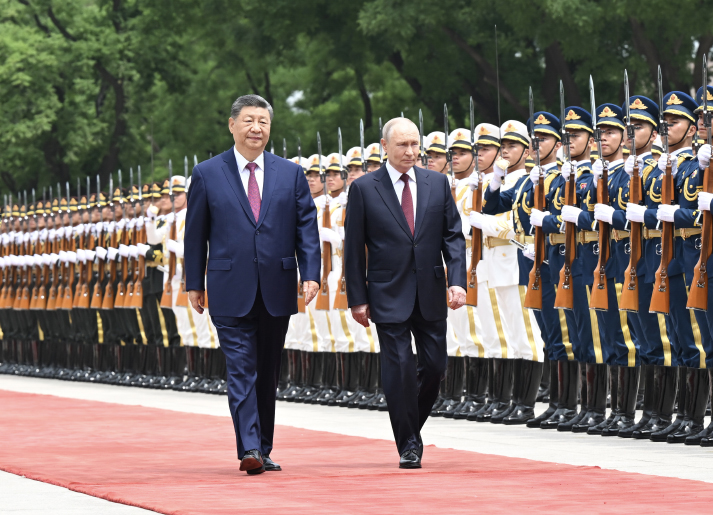
Before he boarded the plane for Beijing, Russian President Vladimir Putin did something he had never done in more than two decades in office. Instead of the customary op-ed in a state newspaper, the Kremlin released a short video on May 19—the target audience was the 1.4 billion people of China. Speaking directly to the camera, the Russian president bypassed the usual diplomatic filter, choosing to address Chinese citizens as neighbors.
That unscripted gesture, a shift from official to personal, set the tone for the 25th visit of his tenure. It was a signal that as Russia pivots decisively East, the relationship is no longer just about strategic calculus between governments, but about social gravity between nations.
Timed to coincide with three landmark diplomatic anniversaries, the 30th anniversary of the China-Russia strategic partnership of coordination, the 25th anniversary of the signing of the bilateral Treaty of Good-Neighborliness and Friendly Cooperation, and the 25th anniversary of the founding of the Shanghai Cooperation Organization (SCO), Putin’s visit carried both commemorative and strategic weight.
On May 20, Chinese President Xi Jinping and Putin hailed a “new stage” in bilateral ties as they agreed to further extend the Treaty of Good-Neighborliness and Friendly Cooperation and pledged to work together for a more just and equitable world order.
Amid a fluid and turbulent international landscape, the two countries have developed a comprehensive strategic partnership of coordination for a new era based on equality, mutual respect, good faith and win-win cooperation, Xi said, adding “the China-Russia relationship has entered a new stage of greater achievements and faster development.”
During the two-day visit, the two leaders held talks, chatted over tea, visited a photo exhibition, and witnessed the signing of a slew of cooperation documents.

Unshakable strategic trust
The treaty established by law the institutional foundation for long-term good-neighborliness, friendship and comprehensive strategic coordination between the two countries, according to Xi, adding since it was signed, bilateral relations have achieved leapfrog development. It has become increasingly relevant under current circumstances, Putin said.
The long-term development of bilateral relations requires sustained momentum and the continuous enhancement of political mutual trust. The extension of the treaty demonstrates again that the China-Russia relationship has a solid political and legal foundation, Li Ziguo, Director of the Department for European-Central Asian Studies at the China Institute of International Studies (CIIS), told China News Service.
Since 2013, the two leaders have met over 40 times, fostering rock-solid personal and political trust. Both nations adhere to the principles of non-alliance, non-confrontation and not targeting any third party, a framework that distinguishes their ties from Cold War-era alliances, Li Yongquan, a senior researcher with the Euro-Asian Social Development Research Institute of the Development Research Center of the State Council, told newspaper Global Times.
“The past 30 years have proven that China and Russia have found a viable model for major-country relations, one that rejects bloc politics and prioritizes equality and mutual respect,” he added.
China-Russia relations have come this far step by step precisely because the two countries have continuously deepened political mutual trust and strategic coordination with unyielding tenacity, expanded all-round cooperation with a drive to always scale new heights, and defended international justice and fairness and advanced the building of a community with a shared future for humanity with unflappable resolve, Xi said.
Chinese Ambassador to Russia Zhang Hanhui emphasized that deepening bilateral relationship is a long-term strategic choice, not a temporary alignment, with strong endogenous momentum and strategic resilience.
The year 2026 is a “critical juncture” to review past successes and chart a future path, Chen Yu, Deputy Director of the Eurasian Institute at the China Institutes of Contemporary International Relations (CICIR), told China Central Television. The world is now in a state of turbulence and transformation, with many conflicts and destabilizing factors present internationally. China and Russia have much room for discussion on a series of global strategic issues, he added.
Following the talks, Xi and Putin signed and issued a joint statement on further enhancing comprehensive strategic coordination and deepening good-neighborliness and friendly cooperation between the two countries.

Booming cooperation
On May 17-21, the 10th China-Russia Expo, covering a total exhibition area of 55,000 square meters and featuring over 1,500 enterprises from 46 countries and regions, was held in Harbin, Heilongjiang Province. Since 2014, under the guidance of the two heads of state, the expo has grown into the highest-level, largest-scale and most widely influential mechanism for economic and trade exchanges between the two countries.
Economic cooperation has become the engine of bilateral ties, delivering tangible benefits. China has remained Russia’s top trading partner for 16 consecutive years. According to the latest data released by China’s Ministry of Commerce, in the first four months of this year, trade between China and Russia amounted to $85.241 billion, a year-on-year increase of 19.7 percent. The trade structure continues to improve, with high-value-added goods, cross-border e-commerce, and tech products accounting for a growing share.
Energy cooperation remains a cornerstone. Russia supplies over 15 percent of China’s crude oil and 20 percent of its natural gas, with new pipelines and LNG projects under expansion. In the first quarter of 2026, China’s imports of Russian oil reached 31.86 million tons, a year-on-year increase of 31.06 percent. Beyond energy, cooperation spans advanced manufacturing, aerospace, AI and agriculture. The 2026-30 China-Russia Science and Technology Cooperation Roadmap, launched last year, guides joint innovation in cutting-edge fields.
In 2025, the mutual visa exemption policy between China and Russia came into full effect, facilitating people-to-people exchange and promoting practical cooperation across multiple fields. According to the Association of Tour Operators of Russia, over 150,000 Chinese tourists visited Russia in the first quarter of 2026, up 44.4 percent year on year, while Russian trips to China rose 33.6 percent in 2025.
On May 20, China announced it would extend the visa-free policy for Russian citizens to December 31, 2027, with the aim of continuing to facilitate personnel exchange.
Xi and Putin attended, on the same day, the opening ceremony marking the launch of the China-Russia Years of Education, the 10th national theme year of the two sides.
The two countries inked a total of 40 agreements, including 20 signed in the presence of the two leaders, covering such fields as the economy and trade, education, and science and technology.
Feng Shaolei, Director of the Center for Russian Studies at East China Normal University, identified three core priorities for future practical cooperation. According to him, both nations shall upgrade logistics infrastructure and tap the potential of new transport routes such as the Arctic shipping route, in response to current constraints on global commodity and energy circulation. They should also deepen coordination in trade, industry and finance to unlock bilateral economic potential and promote mutual market access. The two are well-positioned to expand cooperation in frontier sci-tech innovation leveraging established bilateral consensus and sound cooperative momentum, he added.
Scholars also warned that persistent challenges—such as payment system disruptions due to secondary sanctions, technology transfer disputes and the trade imbalance tilted toward Russian energy—will require continued attention.
Global stabilizers
In a volatile international landscape, Russia-China cooperation serves as an important stabilizing factor, Putin said.
Following their last year’s joint statement on global strategic stability, the two countries issued a joint statement this time on advocating a multipolar world and new type of international relations.
With a shared border, complementary economies, the two nations also hold similar views on many regional and global problems, Andrey Kortunov, a member and former Director General of the Russian International Affairs Council, told China Daily.
China and Russia have maintained cooperative dialogue within a range of international mechanisms, such as the United Nations, the SCO and BRICS, a group of Global South countries that cooperate to facilitate dialogue, consultation and the resolution of global issues, Chen of the CICIR said, adding “being major promoters of world multipolarity, they are working together to address global challenges.”
Both sides should deepen multilateral collaboration, further enhance coordination and cooperation under the frameworks such as the UN, the SCO, BRICS and APEC, Xi said.
He also underscored joint efforts to firmly safeguard the post-war international order and the authority of international law, unite the Global South, and guide the reform of the global governance system in the right direction.
Putin vowed to work with China to safeguard the authority of the UN, champion the diversity of civilizations, and promote a more just and equitable international order.
The frequent regional hotspots, especially the ongoing tensions in the Middle East, have affected the interests of regional countries and Global South nations, Li Ziguo of CIIS said, adding the coordination of positions between their leaders will play a positive role in de-escalating regional situations.
Instability and uncertainty have become the most defining features of the transition to a multipolar world. No country can remain immune to the threats and challenges facing the global community, Li Yongquan said. At the same time, emerging economies and the Global South are full of confidence in their participation in building a more just world order for the future. Under these circumstances, the China-Russia comprehensive strategic partnership of coordination for a new era has become an important force for building a multipolar world and safeguarding global peace, he added.
As Putin’s plane lifted off from Beijing, the video he recorded for China’s 1.4 billion people continued to circulate online. In a fractured world, the message was clear: The Russia-China relationship is no longer just about geopolitics—it is about staying power, neighbor to neighbor. –The Daily Mail-Beijing Review News exchange item