
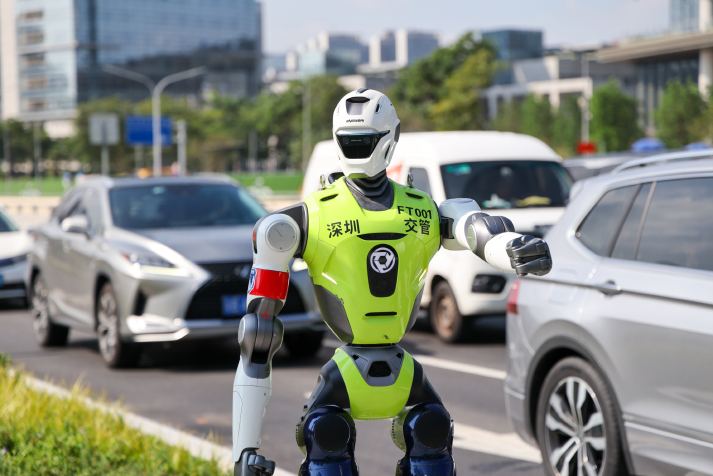
From predictive crime prevention and AI-assisted legal arbitration to intelligent disaster response, the Peaceful China Initiative has entered a new era: one enhanced with algorithms, autonomous systems and data-driven decision-making. This transition is more than just a series of technological upgrades; it is a fundamental shift in how a modern society manages risks, serves its citizens, and maintains social harmony.
The Peaceful China Initiative is China’s strategic goal for social advancement, focused on the coordinated pursuit of development and security to build a more robustly peaceful nation and uphold social stability and safety. The initiative aims to achieve greater national security, a more stable society, more effective governance and increased citizen satisfaction.

Robots on the beat
One of the most visible manifestations of AI empowerment is the deployment of intelligent robotics alongside human officers. In Wuxi, Jiangsu Province, the public security bureau, a police department responsible for maintaining order and security, has pioneered the Zhijia (Smart Armor) Squad, a specialized unit equipped with an array of intelligent robots, robotic dogs and autonomous delivery vehicles.
The team’s capabilities span multiple domains. Traffic management robots equipped with high-definition cameras and speakers patrol intersections to issue verbal warnings against helmet violations and passenger overloading, while optimizing flow in coordination with traffic signals. Administrative service robots, trained on vast datasets related to household registration, immigration and traffic management, can engage in nuanced, multi-turn conversations, providing instant, accurate responses to inquiries.
The unit’s robotic dogs are equally versatile, capable of handling tasks ranging from explosive ordnance disposal to public disinfection, crowd guidance and material transport. A dedicated delivery drone serves as a mobile hub, autonomously navigating to designated points where these robotic dogs begin work immediately upon arrival.
“We have pioneered the development of more than 20 specialized robotic dogs,” Hua Shuhui, head of the Big Data Division at the Wuxi Public Security Bureau, told Yangtse Evening Post newspaper. “These units operate alongside officers, providing logistical support or executing initial site assessments, allowing them to venture into high-risk areas in place of our police forces.”
Crucially, these robots are the product of robust police-industry collaboration. By partnering with eight local AI enterprises, the Wuxi police force has integrated cutting-edge manufacturing capabilities with frontline operational requirements, and plans to continue the expansion of the Zhijia Squad project. Utilizing pre-set path planning and autonomous navigation, these units will conduct independent patrols in residential communities. When an incident is detected, the squad reports directly to the Intelligence and Command Center. Through the use of augmented reality glasses, police officers can access the robots’ live perspective to coordinate precise, remote operations. This allows the police to remain on the front line at all times, even when they are not physically present.

AI against fraud
While AI empowers the guardians of public order, it also creates new challenges. As sophisticated generative tools become more accessible, bad actors are increasingly exploiting them for fraud, identity forgery, data theft and the propagation of online rumors. In response, China’s police forces have mobilized AI as a sophisticated counterweapon.
In the first half of 2026, Chinese police investigated over 170 cases involving online rumors generated by AI tools, dealing with more than 190 individuals, Jiang Guoli, Director of the Criminal Investigation Bureau at the Ministry of Public Security (MPS), announced on July 24.
To counter this, authorities have developed predictive risk assessment models. Using big data, these systems identify suspicious patterns such as frequent video calls from unknown accounts or repeated attempts to harvest facial biodata.
While warnings and case leads generated by the models can be sent to local police to help prevent potential victims from transferring money or disclosing personal information, the National Anti-Fraud Center app also offers an AI-content identification function, through which users can upload suspicious videos, audio recordings or images to check whether they contain signs of AI generation or manipulation, he added.
Furthermore, the MPS has worked with other authorities to issue rules requiring labels for AI-generated and synthetic content, he said. Regulators have also strengthened inspections of AI services and monitored potential security risks associated with large language models.
From January to June, authorities conducted more than 600 inspections of AI application services and took over 30 administrative enforcement actions, including issuing warnings, ordering corrections and shutting down services.
Safety in every pocket
Public safety extends beyond crime and into the realm of disaster mitigation. China’s public earthquake warning service now reaches more than 400 million users nationwide.
The architecture is multi-layered. For instance, television and radio broadcast coverage now extends across 13 provincial regions, including Yunnan, Sichuan and Xinjiang. However, the most transformative channel is the smartphone. More than 228 million mobile users now receive real-time, location-based warnings directly through their phone’s operating system.
Smartphone giants like Huawei, Xiaomi and Vivo have integrated this national earthquake warning network into their phone operating systems, requiring no app downloads or fees. An additional 60 million users have registered through the National Earthquake Early Warning Weixin mini-program. Mini-programs are small, lightweight tools like add-ons or plug-ins that run inside popular super apps such as Weixin (known internationally as WeChat). In the event of a tremor, this mini-program provides critical, high-priority alerts to users in the vicinity of the epicenter. In June, a 5.5-magnitude earthquake in Yibin, Sichuan Province, triggered warnings for over 2 million mobile users in the affected area, allowing precious seconds for individuals to seek cover.
“In over 100 earthquakes over the past two years, early warning systems have proven to be an effective means of reassuring the public and maintaining social order,” Hou Jianmin, a researcher at the China Earthquake Networks Center, told Xinhua News Agency. The center is responsible for earthquake monitoring, forecasting and early warning, as well as providing technical support for information systems and emergency response.
AI in dispute resolution
Beyond physical safety and digital fraud, AI is also transforming the way society handles interpersonal friction. Properly resolving disputes among people is integral to the Peaceful China Initiative. China’s Fengqiao Model, a governance philosophy emphasizing grassroots dispute resolution, is being enhanced by the very same AI-driven shift.
In Heilongjiang Province, the labor arbitration system has deployed Long Xiaozhong, a large language model-powered assistant that manages case filing, mediation, hearing preparation and even the generation of rulings. Long Xiaozhong is an intelligent mediator and arbitrator created by the Human Resources and Social Security Department of Heilongjiang as part of its ongoing digital transformation. As a smart assistant that deeply integrates modern information technology, it is revolutionizing the traditional case-handling model for labor and personnel dispute resolution, empowering services through digitization and intelligence.
To ensure Long Xiaozhong understands the nuances of law, the system is provided with precise legal precedents and logical frameworks, ensuring its reasoning is explainable and its conclusions are trustworthy. The system has processed nearly a decade of case data and utilized insights from over 200 senior arbitrators, and has rapidly evolved from a “novice” into a “proficient professional.”
The deployment of Long Xiaozhong has liberated arbitrators from repetitive, administrative tasks, leading to a leap in the quality and efficiency of dispute resolution.
Before a hearing, it assists in drafting outlines, helping to clarify key points. During the trial, it provides real-time, accurate transcription, executes voice commands from arbitrators and assists in identifying potential tampering with electronic evidence. These capabilities have improved trial efficiency by over 30 percent, greatly reducing the time cost for parties involved in safeguarding their rights.
What arbitrators find most helpful in terms of reducing their burden is the drafting of adjudication documents. What once took a week can now be completed in five minutes, drastically reducing the time costs for people seeking to safeguard their rights.
The strategic vision
China’s embrace of AI in advancing the Peaceful China Initiative is a carefully orchestrated national strategy. In August 2025, the State Council, the highest state administrative organ, issued the Opinions on Deepening the Implementation of the AI Plus Action, explicitly calling for the integration of AI into production safety supervision, disaster prevention and mitigation, public security early warning and social order management.
This policy direction builds on years of groundwork. In 2023, the Ministry of Public Security and the Ministry of Science and Technology jointly launched a three-year action plan for technology-driven policing, aiming to enhance the role of scientific and technological innovation in supporting the advancement of the Peaceful China Initiative.
Now, AI is proactively integrated into public safety governance. By leveraging big data to predict risks, utilizing robotics to assist officers, and deploying AI to streamline legal and disaster response, China is building a more resilient, efficient and responsive safety net to provide a stable, secure environment for its people. –The Daily Mail-Beijing Review news exchange item