
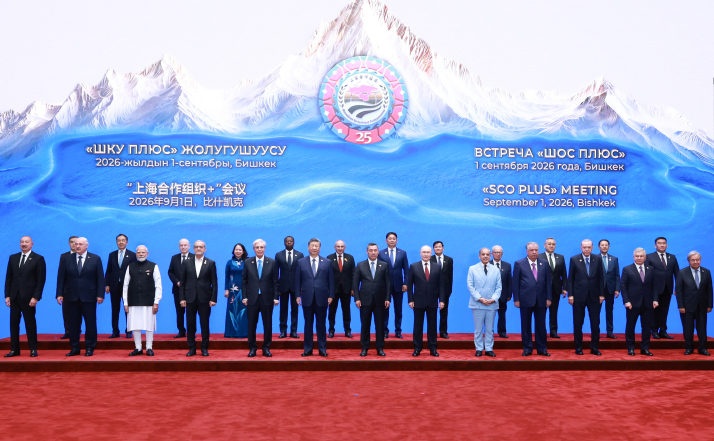
From August 30 to September 3, Chinese President Xi Jinping embarked on a landmark trip to Central Asia and Africa. He attended the Shanghai Cooperation Organization (SCO) Summit 2026 in Bishkek, Kyrgyzstan, and paid state visits to Kyrgyzstan and Egypt. This five-day tour linked multilateral cooperation with bilateral friendship.
The itinerary coincided with a cluster of milestones: The SCO celebrates its 25th anniversary; China and Egypt mark the 70th year of diplomatic ties; and China embarks on the first year of its 15th Five-Year Plan (2026-30). Dense yet substantive, the agenda featured strategic blueprints forged during presidential meetings, people-centered practical projects delivering tangible benefits, and warm exchanges among civilizations.
A 25-year journey
Over its 25 years, the SCO has grown from six founding members into a cooperation network covering 27 nations across Asia, Europe and Africa, with a combined population exceeding 3.4 billion. It has evolved into the world’s most extensive and populous regional organization.
“When purpose guides us, no path is too long; when resolve strengthens us, no barrier is too high,” Xi said at the 26th Meeting of the SCO Council of Heads of State, which was attended by leaders of member states, on September 1. He put forward a four-point proposal, calling on the SCO to stay committed to putting development and the people first, taking security as a key goal and promoting dialogue and consultation.
At the “SCO Plus” meeting on the same day, he called on the SCO countries to shoulder the responsibility of the times and work together to advance a more just and equitable global governance. “SCO Plus” is the cooperation framework under the SCO that brings together member states, observers and dialogue partners to advance joint initiatives on connectivity, green development, digital economy and security.
“Beyond simply growing larger, the deeper transformation lies in the SCO’s evolution from coordination on political consensus toward becoming an action-oriented community that builds institutions, delivers projects and supplies global public goods,” Yang Jin, Deputy Secretary General of the SCO Research Center at the Chinese Academy of Social Sciences, told China Economic Times newspaper. “Respecting each country’s chosen development path instead of exporting institutional templates, the SCO galvanizes cohesion through concrete gains from cooperation—the fundamental source of its enduring vitality,” he added.
Leaders of the member states signed and issued the Bishkek Declaration, approved the protocol on amendments and additions to the SCO Charter, the regulations on the SCO Universal Center for Countering Security Challenges and Threats and the regulations on the SCO Anti-drug Center, and adopted 28 outcome documents covering areas such as security, economic and people-to-people cooperation, and organizational development.
Turning 25 is not merely a milestone for commemoration; it marks a moment of transformation. The development strategy for the SCO in the 2026-35 period, endorsed at last year’s summit in China’s Tianjin, is gathering pace. For instance, a China-proposed initiative to jointly add 10-million-kilowatt photovoltaic and 10-million-kilowatt wind power capacity with fellow SCO countries over the next five years is nearly three-quarters completed.
The first 300-megawatt phase of the 500-megawatt Jizzakh photovoltaic project in Uzbekistan entered commercial operation on March 31. Upon full commissioning, it is expected to generate 1.1 billion kilowatt-hours of clean electricity annually, enough to power 400,000 local households.
Seven SCO application platforms covering green industry, digital economy and innovation are now fully operational, nurturing more than 160 joint projects across the grouping.
During this year’s summit, China announced plans to develop an international AI application cooperation center with fellow SCO countries and roll out 100 joint sci-tech projects in the next three years.
According to Alexey Mukhin, Director General of the Center for Political Information in Moscow, Russia, the outcomes of the SCO summit demonstrated that the SCO family is focusing on development and security priorities, and working together to address threats and challenges and promote long-term development through effective mechanisms within its framework.
This not only serves the common interests of all parties, but also contributes to improving regional and global governance, Mukhin told Xinhua News Agency.
The SCO adopts a flexible and diverse cooperation model that balances multilateral agendas and bilateral ties while consolidating cultural and public support, Sun Zhuangzhi, Director of the Institute of Russian, Eastern European and Central Asian Studies, Chinese Academy of Social Sciences, told China Newsweek magazine. “It provides much-needed certainty for the Eurasian continent and offers a multilateral model of ‘harmony without uniformity’ for reforming global governance,” he added.
No matter how the international landscape may change, SCO countries have consistently upheld mutual respect and trust, treated one another as equals, emphasized strategic coordination, and continuously strengthened coordination and cooperation in international and regional affairs, according to a think-tank report released by Xinhua.
“United in purpose and standing together through difficulties, member states have worked collectively to address risks and challenges and to promote development and prosperity,” it reads.

Chinese President Xi Jinping, accompanied by Kyrgyz President Sadyr Japarov, inspects the guard of honor during a welcome ceremony in Bishkek on August 31 (XINHUA)
Strong neighborly ties
China stands ready to work with Kyrgyzstan to strengthen the alignment of development strategies, deepen exchanges on governance experience, and make substantive progress in building a China-Kyrgyzstan community with a shared future, Xi said during talks with Kyrgyz President Sadyr Japarov in Bishkek on August 31.
Japarov said the ancient Silk Road has closely connected Kyrgyzstan and China, which share a border. In recent years, with the rapid development of the Kyrgyzstan-China comprehensive strategic partnership for a new era, bilateral relations have entered a golden period and reached an unprecedented level, he said.
Following talks, the two leaders signed a joint declaration on the high-quality development of the strategic partnership and a bilateral treaty on permanent good-neighborliness, friendship and cooperation. They also jointly witnessed the exchange of bilateral cooperation documents in the fields of investment, transportation, customs and sister-city relations.
Kyrgyzstan has a saying, “Drop by drop, a lake is formed.” Likewise, the Chinese often say, “Without small streams, there would be no great rivers.” Pragmatic cooperation has produced visible, tangible results with a human touch. According to official statistics, bilateral trade hit $27.2 billion in 2025, a year-on-year rise of 20 percent, reaching a new historical high.

The landmark China-Kyrgyzstan-Uzbekistan Railway is advancing steadily. This trans-Central Asian overland corridor will break logistics bottlenecks linking the three countries, as well as improve Eurasian land-based supply chains.
Launched at the end of 2024, the railway is a flagship project of the Belt and Road Initiative that was proposed by China to boost connectivity along and beyond the ancient Silk Road routes. The route, upon completion, will begin in Kashgar in Xinjiang Uygur Autonomous Region and pass through the mountainous terrain of Kyrgyzstan to reach Uzbekistan. It will shorten the overland distance from China to Europe and the Middle East by roughly 900 km and cut the transit time by seven to eight days.
Both sides are also modernizing border ports, nurturing new growth drivers via cross-border e-commerce and digital trade, expanding cooperation on renewable energy and the full green mineral industry chain, operating Belt and Road joint laboratories and launching collaborative innovation in AI, enabling technological advances to upgrade domestic industries.
At a time when traditional security threats compound non-traditional risks in energy, food and climate, Central Asian nations have growing aspirations for stability and development, Xu Tao, a researcher at the Institute of Eurasian Social Development, the Development Research Center of the State Council, told Guangming Daily newspaper.
“China-Kyrgyzstan cooperation goes beyond large-scale infrastructure, placing greater emphasis on green transition, scientific innovation and people-to-people exchanges. It converts geographic proximity into lasting development dividends and sets an exemplary template for deeper partnerships between China and Central Asian states,” Xu added.

Chinese President Xi Jinping arrives in Cairo for a state visit to Egypt at the invitation of Egyptian President Abdel Fattah El-Sisi on September 1 (XINHUA)
Civilizational resonance
According to an Egyptian proverb, “Once you drink from the Nile, you are destined to return.” A decade after his visit to the country in 2016, Xi embarked on his second state visit to Egypt on September 1.
Egypt was the first Arab and first African country to establish diplomatic ties with the People’s Republic of China in 1956. Over seven decades of shared trials and triumphs, the two sides have forged a comprehensive strategic partnership and become a prime example of solidarity among developing countries. As a Chinese saying goes, “A partnership forged with the right approach defies distance.”
China’s trade with Egypt reached 95.19 billion yuan ($14.16 billion) in the first seven months of 2026, up 18.7 percent year on year, Chinese official data show. Agricultural trade has been a particular growth area. Agricultural products accounted for 41.7 percent of China’s total imports from Egypt during the same period, with the volume rising 82.6 percent.
Egypt is China’s largest source of frozen strawberries and third largest source of flax, with the two products making up 96.7 percent and 7.7 percent of China’s respective imports.
On the industrial front, the two countries continue to broaden collaboration in new energy, biomedicine and digital sectors. Culturally, they have rolled out a series of events marking the 70th anniversary of diplomatic relations, with growing exchanges among media, youth and artistic circles bridging divides and fostering mutual understanding through civilizational dialogue.
Luban Workshops have become a benchmark for China-Egypt vocational education cooperation. The two Luban Workshops in Egypt, inaugurated in November 2020, offer five majors and have so far trained more than 3,000 local students. Launched in 2016, the Luban Workshop program aims to promote vocational education exchanges and cooperation between China and other countries and regions, committed to cultivating urgently needed technical talent.
Chinese automobile manufacturer Geely Auto’s Egypt plant was completed in December 2024. With two production lines, it boasts a designed annual capacity of 20,000 vehicles. Currently, over 45 percent of its auto parts are sourced locally. It has created more than 500 local jobs and fostered a pool of technical professionals in automobile manufacturing through hands-on production practices.
The China-Egypt TEDA Suez Economic and Trade Cooperation Zone, built from barren desert land on the northern coast of the Red Sea, now hosts over 200 companies with cumulative investment exceeding $4.7 billion. A newly inaugurated $116-million renewable-energy complex manufactures solar cells and photovoltaic modules, creating nearly 1,000 local jobs.
Suez’s geographical location and geological environment are very similar to TEDA—Tianjin Economic-Technological Development Area, situated about 150 km to the east of Beijing with the Bohai Sea to its east. Impressed by the blossoming of China’s development zones, Egypt solicited China’s assistance in establishing a development zone in Suez in the mid-1990s. In 1998, the Chinese Government assigned TEDA to undertake this project.

Chinese-invested projects are also helping strengthen Egypt’s power supply, with a solar park substation project providing about 16,000 gigawatt-hours of electricity since completion. Chinese companies have trained local engineers and workers, with some Egyptian employees moving into technical and management positions. At a joint venture between China’s power generation company XD Electric and Egyptian-owned EGEMAC, a leading company in the sector of power and electrical energy, local employees account for 97 percent of the workforce.
Other flagship joint achievements include Africa’s tallest skyscraper, built in Cairo’s New Administrative Capital Central Business District, and EgyptSat-2, the country’s first domestically assembled satellite, launched with Chinese support.
During his talks with Egyptian President Abdel Fattah El-Sisi, Xi called on China and Egypt to support each other, deepen cooperation, and continue advancing the building of a China-Egypt community with a shared future amid a turbulent international and regional landscape.
They issued a joint statement agreeing to deepen strategic coordination, safeguard the common interests of the Global South and enhance communication on regional hotspot issues.
As the unipolar order faces mounting challenges and the voice of the Global South grows louder, the significance of China-Egypt collaboration stretches far beyond bilateral boundaries, Yekaterina Zaklyazminskaya, head of the Center for World Politics and Strategic Analysis at the Institute of China and Contemporary Asia, Russian Academy of Sciences, said.
As a major Arab and African nation and the largest developing country, respectively, Egypt and China can rally more emerging markets to participate in reforms of global governance and build a fairer and more inclusive international system, she said. –The Daily Mail-Beijing Review News exchange item