For the Shanghai Cooperation Organization (SCO), 2026 is a special year. Twenty-five years ago, on June 15, 2001, in Shanghai, leaders of six states made a decision that reshaped the global political landscape and demonstrated a new model of cooperation among neighboring sovereign states with diverse cultural, historical and national traditions, as well as different political and economic systems.
The Shanghai Spirit—mutual trust, mutual benefit, equality, consultation, respect for diversity of civilizations and pursuit of common development—largely underpins the successful formation and evolution of the organization. Beyond that, the principles enshrined in the SCO’s mandate resonate across the world. These principles draw more and more countries into cooperation and partnership within the broad SCO family.
Throughout its short yet event -filled history, the SCO today comprises 10 member states, two observer states and 15 dialogue-partner countries. While expanding its membership roster is not a goal of the SCO, this growth clearly shows that the core ideas and principles upheld by the organization strike a chord with a large share of humanity.
At the “SCO Plus” meeting in Astana, Kazakhstan, in 2024, Chinese President
Xi Jinping noted that amid far-reaching global shifts, it is of critical importance that we possess wisdom, ability and courage. We must firmly establish and put into practice the vision of a community with a shared future, uphold the Shanghai Spirit, steadfastly follow development paths suited to national conditions and regional realities, and jointly build a common home for the SCO family where peoples of all our countries can live in peace, prosperity and friendship, he stressed.
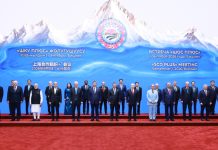
Kyrgyzstan’s chairmanship of the SCO concluded with the meeting of the Council of Heads of State, the SCO’s supreme body, in Bishkek on September 1. As is well known, the SCO’s core objectives include strengthening multifaceted interaction to sustain peace, security and stability in the region and advancing economic growth alongside social and cultural progress.
Over the SCO’s 25 years of existence, geopolitical shifts have exerted profound influence on the global order, a condition that might be more aptly described as “global disarray.”
Security and stability stood as central themes of the meeting of the Council of Heads of State in Bishkek. Two SCO member states are engaged in active armed confrontations with the so-called “Western world,” which pursues colonial style, predatory power politics against parties it disfavors: a proxy conflict in Europe and direct confrontation in the Middle East. In both cases, the hot phase fighting will likely drag on, and subsequent reconstruction and return to normal life will demand enormous efforts. These realities inevitably affect the SCO as a whole and its individual members, shaping both intra-organizational ties and external engagement, including bilateral relations with Western counterparts. Forging common understandings grounded in shared values in response to global challenges was a major task for the leaders’ gathering.
The motto of Kyrgyzstan’s chairmanship—25 Years of the SCO: Together for Sustainable Peace, Development and Prosperity—embodies the collective will and aspiration of the whole SCO family for stability and effective delivery of economic cooperation. That said, there remains a shortage of joint projects capable of driving regional states toward deeper cooperative ties beyond merely boosting mutual foreign trade volumes. Only qualitative transformation in the structure of economic cooperation can set in motion an efficient mechanism for shared development. Thus discussions on AI development and digital security were also hot topics at the event.
Naturally, given the scope of this article, it is impossible to cover the full breadth of the SCO’s modern-day agenda. To a large extent, it is the organization’s very uniqueness that enables it to set and address an extremely wide range of tasks, forge common ground and chart pathways to overcome the most urgent contemporary challenges. –The Daily Mail-Beijing Review News exchange item