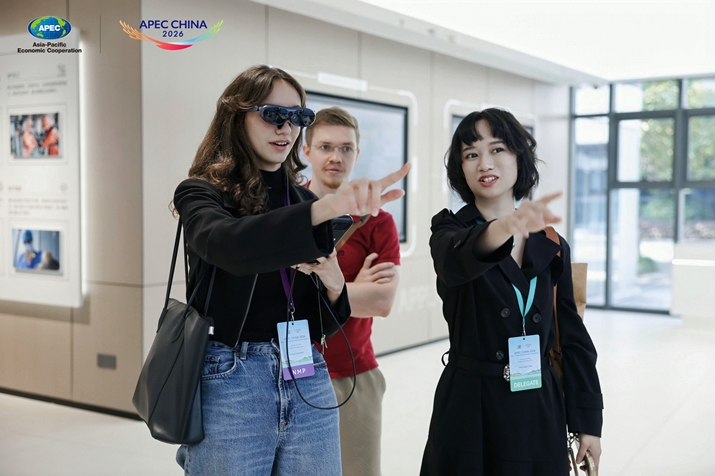
At Hangzhou–based technology company Rokid, Wang Byung–min from the Republic of Korea (ROK) pulled off the Rokid AI glasses and immediately turned to the staff with a question that had nothing to do with business models or market strategy, “How much are these? I want to buy a pair.”
The language student, studying at Yiwu Industrial and Commercial College in Yiwu, Zhejiang Province, had just experienced something his father desperately needed. For years, his father had been running claw machine shops in the ROK, traveling regularly to Yiwu to purchase small commodities. “My dad doesn’t speak Chinese, so every time he comes to Yiwu, I have to be his translator,” Wang said. The moment he put on the glasses, English subtitles materialized in front of his eyes, translating live conversation in real time. “If my father had these, I wouldn’t need to be his translator anymore.”
That moment, during the APEC Young Entrepreneurs Conference, captured something more immediate than any policy framework could.
The conference, a signature youth event of China’s 2026 APEC (Asia–Pacific Economic Cooperation) host year, took place in Hangzhou, Zhejiang Province and Guangzhou, Guangdong Province from September 15 to 20. It was co–hosted by the Chinese People’s Association for Friendship with Foreign Countries and the Zhejiang Provincial People’s Government. Organized by the Hangzhou Municipal People’s Government and the Zhejiang Provincial People’s Association for Friendship with Foreign Countries, the gathering brought together about 200 young entrepreneurs, investors and representatives from across APEC economies under the theme “Entrepreneurship Engine, Youth–Led Change: for a Prosperous Asia–Pacific for All.”
Its stated aim was to promote friendly exchange and practical cooperation among young people in the region, and to contribute youthful energy to building an Asia–Pacific community.
But what might distinguish this meeting from the usual round of speeches and handshakes was a tilt toward doing rather than discussing—a bet that in a region as economically diverse as the Asia–Pacific, which encompasses nearly 40 percent of the world’s population and over 60 percent of global GDP, the most valuable currency is not capital or policy, but the transfer of knowledge between people who have built things.
That bet carried risks. The Asia–Pacific spans economies at radically different stages of digital infrastructure, regulatory maturity and market scale. A workshop format that works in Hangzhou’s tech ecosystem may not translate to Jakarta, Santiago or Kuala Lumpur. And yet the urgency of connection was palpable among participants, who described the region not as a collection of separate markets, but as an interconnected landscape of shared challenges—aging populations, energy transitions and digital divides—that no single economy can solve alone.
AI’s unlikely leveler
Yau Ka Chun, Director of Business Strategy at Hong Kong-based technology company Motomics Limited, arrived at the event with a statistic that would have seemed implausible a decade ago. His core team consists of six people, and they serve approximately 2,000 elderly Hong Kong residents through AI–powered gait analysis for degenerative arthritis screening.
“What used to require a whole team can now be done by one person,” Yau said. The company originated from a university innovation project, and he hoped that APEC can catalyze more tech–transfer mechanisms, such as competitions and funds, that help deep–tech startups scale across borders.
The sentiment was echoed across the room by Khyruz Tasyriq Bin Abu Samah, Manager of the Strategic Communication Department at the National Institute of Entrepreneurship under Malaysia’s Ministry of Entrepreneur and Cooperatives Development. He said that market research, competitor analysis and multilingual content generation are tasks that once demanded a small team but now require only one person. For entrepreneurs in economies where labor costs are low but skilled labor is scarce, the calculus shifts. AI does not simply reduce costs; it redistributes capabilities.
But the enthusiasm was not unqualified. Saran Teawkitpaisarn, Vice President of Sales with Thai technology firm Kawna Tech International Co., Ltd., offered the counterpoint that several participants returned to during their stays in Hangzhou: AI can lower the barrier to entry, but it cannot guarantee that what you build will matter. “Business is not an arithmetic problem,” he told Beijing Review, adding “the emotional connection between people is still important.”

A panel discussion of the APEC Young Entrepreneurs Conference in Hangzhou, Zhejiang Province, on September 17 (COURTESY PHOTO)
Where ideas find footing
The event’s design reflected an understanding that startup ecosystems cannot be summoned into existence by policy pronouncement. They require density of talent, capital, failure and iteration. Their experience in Hangzhou offered both a laboratory and a showcase.
At Rokid, participants grappled with practical questions of how AI agents could serve local markets. Chilean entrepreneur Claudio Henriquez proposed a scenario. Chile’s mining sector is a pillar of its economy, yet technical experts are scarce on–site. Could a worker wearing smart glasses allow an expert 500 kilometers away to see equipment in real time and guide repairs? The expert can see the equipment’s condition in real time through the footage transmitted by the glasses and remotely instruct the operator on which component to check, he said, adding “the operator could also pull up equipment manuals directly in front of their eyes, check what each button does, and ask AI questions on the spot,” he told Beijing Review.
At an AI industrial park in Alibaba’s new global headquarters in Yuhang District of Hangzhou, teams explored lightweight business models for one–person companies. Light start–ups are a concept that has gained traction among young Chinese founders seeking lower–risk entry points. The 90-minute workshops produced no finished products, and that was the point. The goal is not to deliver a mature product but to explore collaborative creation and problem–solving, Lu Xiangdong, Vice President of the Chinese People’s Association for Friendship with Foreign Countries, said, adding “we hope to enable young people to transcend national borders, identify development trends, and explore new technologies, models and scenarios themselves.”
For international participants, the exposure was as much about observing ecosystem mechanics as absorbing technology. During a visit to an industrial Internet of Things (IoT) company in Guangzhou’s Nansha District, Henriquez saw an AI-powered energy-saving solution that struck him as directly relevant to Chile. And he began sketching a deployment strategy: negotiate a partnership with the company, train a local team and roll the system out in Chile. Since he is a computer scientist by training, he also volunteered himself for its localization—translating the entire system into Spanish himself. For Henriquez, the arrangement could amount to more than a technology transfer—“this could be a new business for me,” he said.
A bridge, not a stage
The event closed in late September, but for many participants the more consequential exchanges happened afterward—in visits to Hangzhou’s Future Sci–Tech City in Yuhang, and in Guangzhou’s Nansha, where biotech parks, cross–border e–commerce accelerators, and smart manufacturing firms opened their doors.
For Carlos Obando, Program Director of the APEC Senior Officials’ Meeting Steering Committee on Economic and Technical Cooperation, the value was cumulative. He had visited Guangzhou twice before, but this time he saw something different: a complete ecosystem in which each actor—government, incubator, established firm, university—played a defined role in supporting young entrepreneurs. “We call it an incubator of ideas,” he said. “Here, people can share ideas and experience freely.”
That framing as incubator rather than marketplace captures something essential about the conference’s ambition. APEC’s formal work program is dominated by trade facilitation, structural reform, and regulatory coherence. Those are necessary conditions for regional integration, but they are not sufficient to generate the kind of cross–border entrepreneurial activity that creates jobs and diffuses innovation.
The gaps between economies in language, business culture and access to networks are where young founders might stumble. A conference that puts an ROK student, a Chilean computer scientist, and a Chinese medtech strategist in the same ninety–minute sprint does not solve those structural gaps. But it makes them navigable. –The Daily Mail-Beijing Review news exchange item