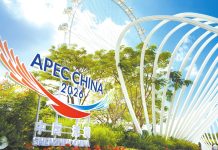


BEIJING: In Shenzhen, South China’s Guangdong Province – the host city of the upcoming 2026 Asia-Pacific Economic Cooperation (APEC) Economic Leaders’ Meeting – one of the most consequential urban landmarks is not a glass-curtained skyscraper, but a weather-beaten yellow wax stone. Standing on a coastal viewing platform in Qianhai Stone Park, where brisk sea breezes sweep off the bay across lush green lawns and tree-lined promenades, the rock measures about 2.8 meters high, 2.1 meters wide, and 0.65 meters thick. Boldly engraved with the two Chinese characters for “Qian Hai,” its natural silhouette resembles a ship setting full sail, framed against the sparkling waves of the Qianhai Bay on one side and a rising skyline of modern financial towers on the other.
Just blocks away from this stone, the Qianhai International Conference Center will serve as the venue for the 2026 APEC CEO Summit, which is scheduled to be held from Tuesday to Wednesday.
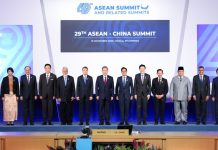
Chinese President Xi Jinping, along with leaders from APEC economies Australia, Canada, Chile, China’s Hong Kong, Indonesia, the Republic of Korea, Malaysia, Mexico, Russia, Thailand and Vietnam, will attend the summit and deliver speeches or remarks, or participate in panel discussions, the Xinhua News Agency reported on Sunday.
The 33rd APEC Economic Leaders’ Meeting will be held in Shenzhen from Wednesday to Thursday under the theme “Building an Asia-Pacific Community to Prosper Together.”
More than just a scenic marker, the Qianhai Stone stands as a defining symbol and witness of China’s high-standard opening-up.
Where barren coastal mudflats once lay just over a decade ago, a bustling metropolis teeming with global innovators and financial institutions now thrives. However, the most profound transformation this stone has witnessed is not the physical leap of Shenzhen from mudflats to a modern city, but Qianhai’s evolution into a premier strategic platform for China to pioneer institutional opening-up, deepen comprehensive reform, and engage deeply in international economic cooperation across the Asia-Pacific and beyond.
The stone’s iconic status is deeply rooted in key historical moments of China’s opening-up journey. In December 2012, standing beside the Qianhai Stone, President Xi issued a call to embark on a new journey of reform and opening-up. “No stop in reform, and no stop in opening up,” Xi said during his trip to Guangdong Province at that time, according to the Xinhua News Agency. –The Daily Mail-Global Times news exchange item