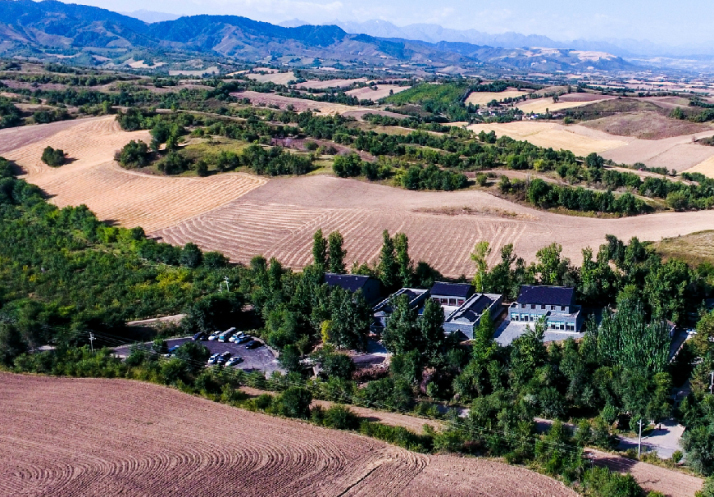
When morning light reaches Caizigou Village in Changji Hui Autonomous Prefecture, it spreads across fields dotted with apricot, apple and Russian olive trees. Their leaves and fruit shift with the seasons, making the landscape a natural mosaic of changing hues.
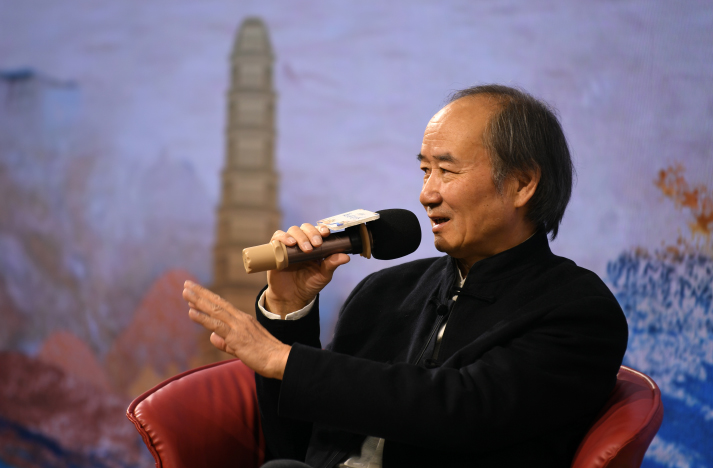
More than a decade ago, after years in Urumqi, Liu Liangcheng, a writer who grew up in Xinjiang, chose to settle in this village at the age of 50. It was a return to the rural life he had known in his youth.
According to Liu, at first glance, the village “felt like the end of time,” where people had lived in their homes quietly while they grew old slowly, and the homes, at the same time, had aged along with them. It was precisely this sense of worn history that drew him in.
He converted a deserted decades-old village school into a spacious courtyard, creating a home for his family and a place for writing. By day, the rhythms of village life unfold steadily around him; when his writing pauses, he returns to daily tasks, cutting wood, tending his garden or resting in the shade of a tree. By night, the courtyard remains unlit, leaving the open sky to fill with stars.
“I have allowed my novels to grow mature here,” Liu told ThePaper.cn, an online portal. He explained that if he lived in the city, his attention would be drawn to what is immediate, to what is around him. Living in the village, however, he finds himself looking farther afield toward the distant and the past.
Returning to memory
Liu was born in 1962 in Huangshaliang, a small village on the edge of China’s second-largest desert, the Gurbantunggut Desert.
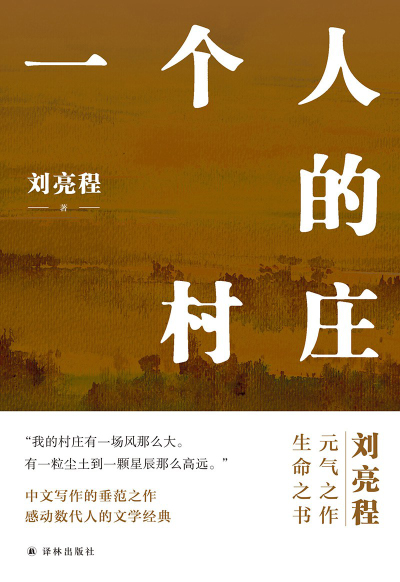
At 30, he left his job as a rural machinery administrator in Shawan County in Tacheng Prefecture and moved to Urumqi. There, he worked at a local newspaper while writing literary works in his spare time. It was during these years that he composed Yigeren de Cunzhuang (A Village of One), a collection of essays capturing the village of his childhood.
In a 2024 lecture at Xiamen University in Fujian Province, east China, Liu recalled the moment that sparked the essays. One afternoon, while hurrying through the city, he glanced at the setting sun and realized that its light was reaching his home village far away. In that instant, the village—its soil, its paths, the people and animals—awoke in his mind.
He began to write, not about the village as it existed then, but as it had lived in his memory.
“Writing is a strange and powerful act,” Liu said. “When I began to write about the village, it belonged to a single person. Through literature, I could bring it back, illuminate its days and nights, and let the greenery of familiar trees flourish once more.”
In this act, the writer becomes both witness and creator, holding the power to decide what occurs and what does not in the village of memory, he explained.
When the essays were published, they resonated widely. Mi Shu, an English teacher in Shanghai, is among those deeply moved by his writing. “What these essays convey goes beyond the quiet rhythms of rural life. They are also reflections on life itself, nostalgia for the past and a thoughtful meditation on human existence,” she told Xinjiang Today.
Although she grew up in the city, Mi visits her father’s hometown, a village in Jiangsu Province, twice a year. “Its landscape is different from Huangshaliang, yet the feeling it evokes is the same. These places restore energy and ground you, as if the land itself is calling you back,” she said.
Life and legacy
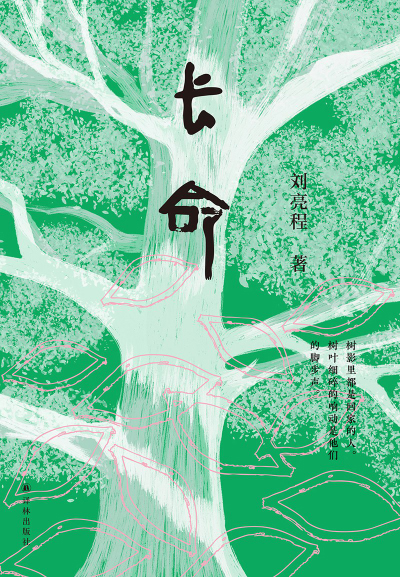
In the winter of 2025, Liu opened an account on Xiaohongshu (RedNote), a popular Chinese social media platform. One surprised commenter asked, “What? You are a living writer?” Liu, whose works have long been bestsellers, replied, “Not only am I alive, this year I published Changming (Longevity).”
The novel was inspired by the villagers in Caizigou. “I generally don’t interact much with the villagers, but my wife enjoys it. She often gathers with women of her age to make short videos for Douyin. Women love to tell stories, and when they speak, they share every detail of family life,” Liu said.
One such story particularly caught his attention. “She once told me that a family’s ancestral tomb had been destroyed by floodwaters, revealing a genealogy record. From it, they discovered that their original village had been wiped out over 130 years ago. Only a mother and her young son survived and fled to our area. Over the following century, their descendants grew into a new clan.”
Liu held the story in his mind, nurturing it slowly until it developed into a novel spanning several generations from 1873 to 2010. The book captures the complex realities of rural life in contemporary west China, exploring the tension between modernity and traditional rural civilization.
“The novel explores the theme of inherited life through family lineage, attitudes toward life and death, and rural culture,” Mi said. “It reminds us that no matter how times change, the continuation of life remains a driving force for humanity, and the rural homeland endures as a permanent spiritual home in our hearts.”
Changming follows the life of veterinarian Guo Changming and is told from two perspectives: Guo’s and that of the medium Wei Gu, who can perceive the spiritual world. Guo’s voice is grounded, detailed and warm, recounting the steady passage of days, years and generations. Wei speaks in ways others cannot understand, through ventriloquism or inner speech, sharing what she sees in a world that others do not believe exists.
Liu said he felt a thrill while writing her perspective. He explained that this way of speaking is one he particularly enjoys and that in telling her story, he discovered a part of himself.
“Every person carries thousands of such unspoken languages. The words we can speak are few, the words we choose to speak are even fewer, and the words that remain unsaid are the most numerous,” he said in an interview with China Reading Weekly.
Liu said that Changming was a book he had always wanted to write and one that he could only write at the age of 60. “At this age, you begin to understand what life truly is. You sense that certain things are drawing near. You may faintly hear the tolling of a bell, a kind of calling. This call comes from the depths of life, from our ancestors and from the culture we have built over hundreds of years,” he explained.

Daily rhythm
Today, Liu holds a string of prestigious titles and awards, including President of the Xinjiang Uygur Autonomous Region Writers Association and winner of China’s Mao Dun Literature Prize for his novel Benba. Yet he spends most of his time in quiet seclusion in his courtyard in Caizigou.
Like many rural villages, Caizigou has an aging population, where funerals outnumber celebrations. But Liu does not see growing old as something frightening. “When you see people in their 80s still working, you realize that life is full of hope,” he said.
Nowadays, he begins his creative writing in the morning when his energy is the highest. He eats lunch at two, takes a nap from three to five and then spends two hours doing farm work. His courtyard often hosts a few young volunteers, mostly college students or literature enthusiasts from other provinces. Together, they cultivate the land and immerse themselves in reading and writing.
“Although this village is far from where I was born, the trees and the birds are the same, and even the wind feels the same. That is what I love about this place,” he said.
In recent years, Liu has also devoted his energy to a major project: setting up the Tianshan Literature Prize. The award recognizes literary works about Xinjiang from around the world, regardless of genre, encouraging them to portray a true, rich and diverse Xinjiang. The first edition was held in 2024, and five works were awarded the prize.
Liu said he believes literature has the power to shape Xinjiang, a power that has long enriched the region through works such as The Classic of Mountains and Seas, the roots of which stretch back beyond the Qin Dynasty (221-206 B.C.), and The Great Tang Records on the Western Regions, which records the seventh-century journey of Buddhist monk Xuanzang through west China to India and back, as well as frontier poetry, novels and lyrics. –The Daily Mail-Beijing Review news exchange item