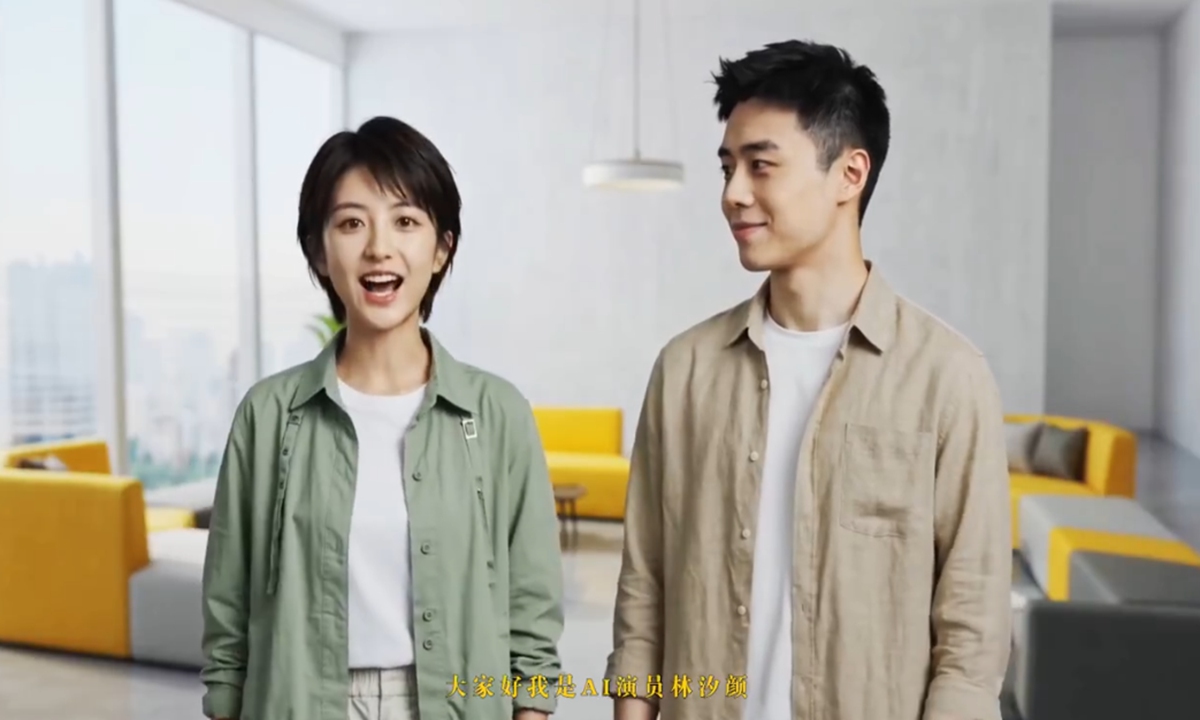
BEIJING: The debate over whether AI-generated dramas could replace traditional productions has recently intensified after television drama producer Youhug Media unveiled two AI-generated performers, sparking concerns over portrait rights, industry ethics, and employment security.
The official Weibo account of Youhug Media on Wednesday published a post introducing two AI-generated performers, Qin Lingyue, a male character, and Lin Xiyan, a female character, describing them as its first batch of signed AI digital stars. The two AI performers said in a video that they had opened social-media accounts and would appear in roles in the company’s AIGC-produced drama series.
On March 14, the founder of iQIYI, one of China’s major streaming platforms, also told media that a fully AI-generated commercial blockbuster could be produced as early as this summer or autumn, adding that this would not be limited to iQIYI, but would be an industry-wide development, The Paper reported.
Also, Lu Beike, director of the historical drama Swords into Plowshares, gave a detailed explanation for the first time of how AI technology is used in the production of the historical drama. Citing one of the scenes, he said that it would take five or six production steps and take several weeks to complete a visual-effects scene with traditional computer graphics, whereas with an AI-based approach, one person could finish the same work within a week, Beijing Youth Daily reported on Wednesday.
Although some of the advantages of using AI in the industry are being discussed, the move of introducing AI actors has also sparked widespread debate over portrait-right infringements, industry ethics, and the survival of human actors. Under the introduction video on Youhug Media’s Weibo account, some netizens commented that the two AI performers bear a strong resemblance to several real actors.
Whether generating characters or backgrounds, AI-based live-action dramas require “feeding” on real-world source material, making them prone to plagiarism controversies, Fengmian News reported, citing a technical director at a film company.
According to You Yunting, senior partner and intellectual property attorney at Shanghai Debund Law Offices, if the AI tool was trained without people’s consent, the question arises as to whether this constitutes fair use. Legally, this is still debated, as courts have yet to make rulings on similar cases, so it remains unclear whether AI service providers would be considered as an infringement.
The second issue is if the AI user inputs a person’s photo, resulting in the individual’s likeness appearing in the short drama. In this case, the AI user, namely the production team, would be infringing on portrait rights, You told the Global Times on Thursday. –The Daily Mail-Global Times news exchange item