By Ali Imran
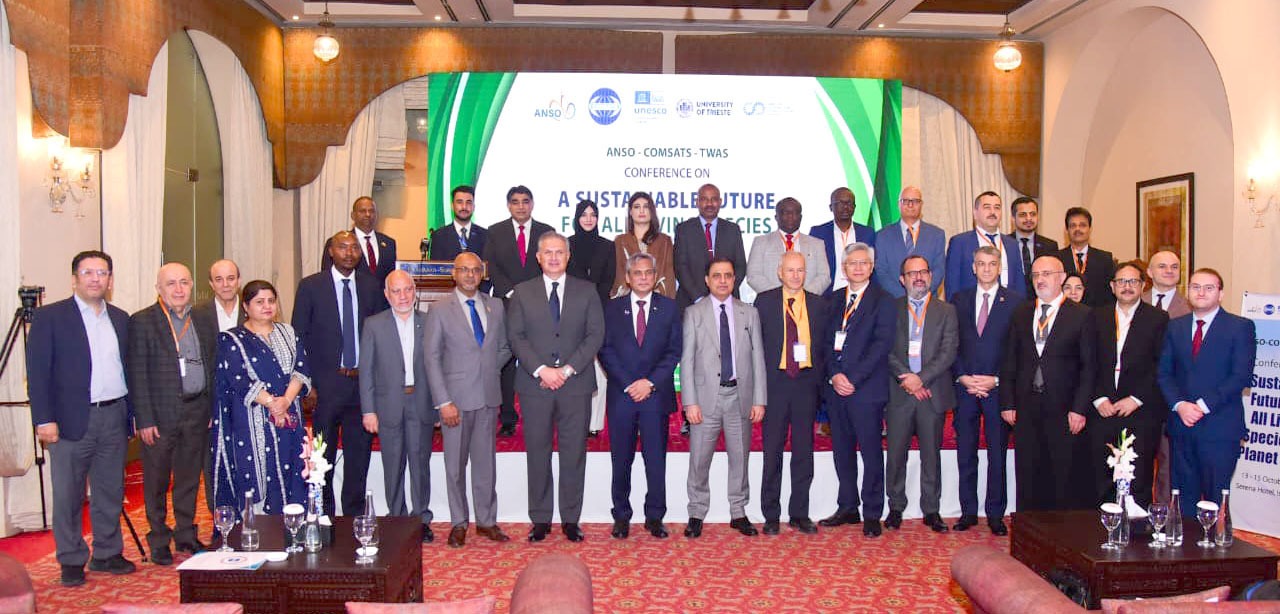
ISLAMABAD: Scientists, policymakers and young scholars from across the Global South and beyond gathered in Islamabad on Tuesday for the opening of the three-day ANSO-COMSATS-TWAS Conference, calling for science that works for every living species on Earth. The conference is aimed at turning research into practical action on sustainability, climate resilience and equitable access to knowledge.
The conference, titled “A Sustainable Future for All Living Species on Planet Earth,” is organised by COMSATS in collaboration with the Alliance of National and International Science Organizations for the Belt and Road Regions (ANSO) and The World Academy of Sciences (TWAS-UNESCO), with support from the University of Trieste.
It is an official activity of the UNESCO-led International Decade of Sciences for Sustainable Development (IDSSD) 2024-2033. Federal Secretary of the Ministry of Science and Technology, Mr. Shahid Baloch, was the chief guest. He stressed equitable access to scientific progress and the need to ensure that developing countries benefit from scientific knowledge, emerging technologies and research opportunities.
COMSATS Executive Director Ambassador Zakaria underscored the need for international scientific partnerships. He highlighted the potential of artificial intelligence, Earth observation, biotechnology and renewable energy to strengthen environmental resilience and turn scientific knowledge into practical solutions.
The conference is built around three themes: Sustainability Education and Planetary Health; the Water–Energy–Food–Ecosystems (WEFE) Nexus for Sustainability; and Science–Policy Dialogue for a Sustainable Future.
The inaugural ceremony was attended by the ambassadors of Jordan, Azerbaijan and Sri Lanka, and diplomats from Zimbabwe and Sudan. Also present were Prof. Jibin Sun, Chairman of the COMSATS Coordinating Council; Dr. Max Paoli, Coordinator of TWAS-UNESCO; Prof. Buratti of ICGEB; and eminent scientists and members of the COMSATS Technical Advisory Committee. Representatives of the Pakistan Science Foundation (PSF) and the Economic Cooperation Organization Science Foundation (ECOSF) also joined.
COMSATS scientists are participating as resource persons and speakers. Scholars from 16 countries, including Benin, China, Ghana, Iran, Italy, Kazakhstan, Morocco, Sri Lanka, Türkiye, Pakistan, Lesotho, Niger, Mali, Senegal, Bangladesh, Chad and Tanzania, will also share their expertise. Through expert dialogue and cross-border knowledge exchange, the conference aims to strengthen scientific networks, build research capacity and identify practical approaches to sustainability and resilience. It reaffirms the importance of inclusive scientific cooperation in ensuring that research, innovation and emerging technologies contribute to a more sustainable future for all living species.