
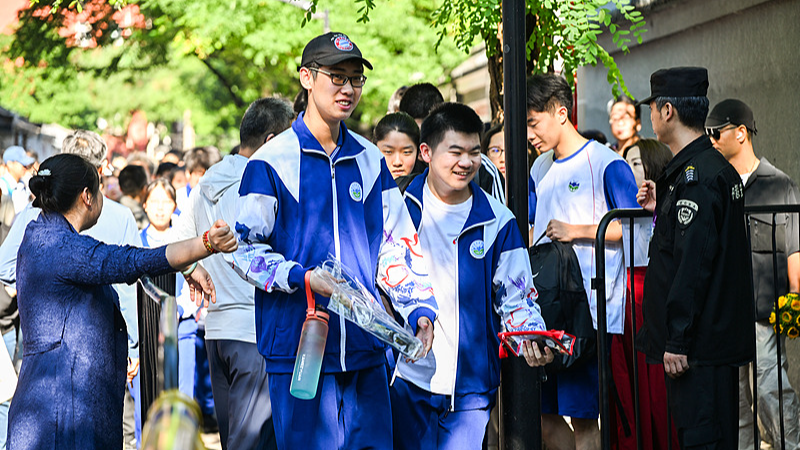
BEIJING: With China’s national college entrance exam, also known as the gaokao, kicking off on Sunday, around 12.9 million candidates will potentially have access to more academic options following the introduction of a raft of new majors.
Multiple Chinese universities have rolled out new undergraduate programs such as embodied intelligence, low-altitude economy and management, and marine intelligence and unmanned technologies, in a bid to meet the country’s emerging strategic and industrial needs, noted an updated catalog recently issued by the Ministry of Education (MOE).
The addition of these new majors underscores continued improvement in the structure of academic disciplines, said Zhang Nanxing, director of the Institute of Higher Education at the China National Academy of Educational Sciences.
The outline of China’s 15th Five-Year Plan (2026-2030) for economic and social development calls for an orderly expansion of enrollment in high-quality undergraduate and graduate education, with a focus on science, engineering, agriculture and medicine-related programs.
In an earlier interview with Xinhua, Education Minister Huai Jinpeng said China will establish a coordinated talent cultivation mechanism that aligns sci-tech innovation, industrial development and national strategic needs.
China will further adjust and optimize academic disciplines and majors and explore new models for nurturing top innovative talent in strategically critical fields like artificial intelligence and integrated circuits, Huai said.
In this year’s catalog, Sichuan University in southwest China was approved to launch a major in semiconductor process and equipment, the first program of its kind in the country.
Yang Yang, dean of the university’s School of Electronics and Information Engineering, said the new major is designed to provide a strong pipeline of talent to support self-reliance across the entire integrated circuit industrial chain. –The Daily Mail-CGTN news exchange item