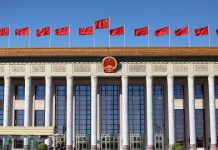

BEIJING: A new chapter in China-Tajikistan relations unfolded at the Great Hall of the People in Beijing on Tuesday as Chinese President Xi Jinping and Tajik President Emomali Rahmon signed a landmark treaty intended to define the two countries’ bilateral relationship for generations to come.
The China-Tajikistan Treaty on Permanent Good-Neighborliness, Friendship and Cooperation marks a significant elevation of ties, shifting the partnership into permanent strategic alignment.
President Xi hailed the treaty as a testament to high-level political mutual trust, noting it will provide a solid underpinning for China and Tajikistan’s everlasting friendship.
For his part, President Rahmon said the treaty marks a new historical stage in bilateral relations and opens up new prospects for long-term cooperation between the two sides.
Tuesday’s meeting continued years of close engagement between the two leaders, with head-of-state diplomacy serving as a key driver of China-Tajikistan relations.
Xi and Rahmon have met nearly 20 times in recent years, guiding bilateral ties through several upgrades – from the establishment of a strategic partnership in 2013 to the launch of a comprehensive strategic cooperative partnership in the new era in 2024. During Xi’s July 2024 visit to Dushanbe, he awarded Rahmon the Friendship Medal, China’s highest state honor for foreign nationals, reflecting the close political ties between the two countries.
President Xi noted that steadfast mutual support is the defining feature of China-Tajikistan relations. He said that no matter how the external environment evolves, China and Tajikistan will remain good neighbors looking out for each other, good friends sharing candor and mutual trust, and good partners pursuing joint development.
The strength of this partnership is built on mutual support for each other’s vital concerns. Xi stressed that China will always support Tajikistan in following a development path suited to its national conditions and in upholding national independence, sovereignty and security. Rahmon reaffirmed Tajikistan’s firm adherence to the one-China principle and its recognition that Taiwan is an inalienable part of China.
China is currently Tajikistan’s largest trading partner and biggest source of investment, with cooperation in connectivity, energy and infrastructure continuing to deepen. As the first country to sign a memorandum of understanding with China regarding the Silk Road Economic Belt in 2014, Tajikistan has long been a pioneer of the Belt and Road Initiative (BRI).
A series of landmark BRI projects, including the China-Tajikistan Danghara Agricultural and Textile Industrial Park and the second phase of the China-Tajikistan Highway, have made tangible progress. These initiatives not only improve local livelihoods but also effectively drive industrial upgrades and regional connectivity.
Building on that momentum, the focus is now expanding into new growth drivers.
Xi called on the two sides to focus on high-quality Belt and Road cooperation and thoroughly align their development strategies, namely China’s 15th Five-Year Plan and Tajikistan’s National Development Strategy for the period up to 2030, and work together to advance their respective development goals. He urged both countries to enhance the scale and quality of trade and investment, guarantee the implementation of major projects and expand cooperation on green energy, the digital economy, smart city and artificial intelligence (AI) to further boost sci-tech innovation.
Rahmon noted that cooperation in trade, investment, transportation and agriculture had already delivered tangible benefits for both peoples and expressed hope for stronger collaboration in critical minerals, AI and sci-tech innovation.
The two leaders also witnessed the signing of over 10 cooperation documents in areas such as party-to-party exchanges, economy, trade and investment, AI, green mining and media. –The Daily Mail-CGTN news exchange item