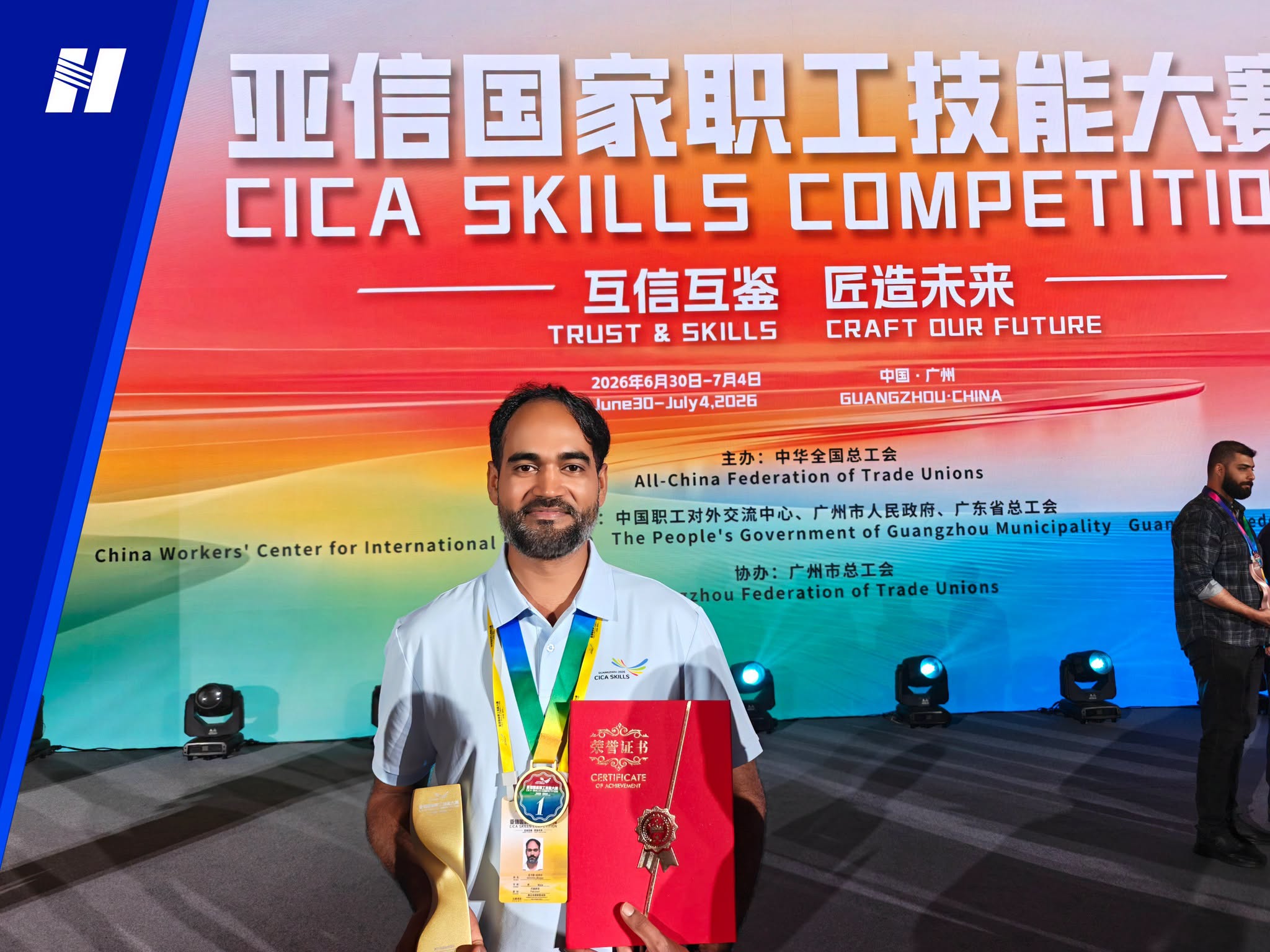
BEIJING: When Waqas Rasool stepped onto the winners’ podium at an international skills competition in Guangzhou last month, he wasn’t just accepting a trophy for himself. For the Pakistani engineer, the moment was a powerful validation of what the China-Pakistan Economic Corridor (CPEC) has always promised, genuine skills transfer that builds lasting local capacity.
Waqas Rasool, a deputy electrical maintenance engineer at the Huaneng Shandong Ruyi (Pakistan) Energy 1320 MW Sahiwal Coal-Fired Power Plant, earned first prize in the high-voltage cable intelligent operation and inspection category at the inaugural CICA Skills Competition.
The event brought together nearly 80 frontline workers from 23 countries. Yet for Rasool, the achievement is less about competition and more about the decade-long journey of professional growth that made it possible.
Since joining the Sahiwal plant in 2015, Waqas Rasool has accumulated years of hands-on experience across 500kV substations, generator protection and relay commissioning. The Sahiwal plant, one of the CPEC priority projects, has served not only as a critical power source for Pakistan’s national grid but also as a live classroom for hundreds of Pakistani engineers and technicians working alongside their Chinese counterparts.
For Waqas Rasool, the experience has reshaped his professional confidence. “Day-to-day plant work tests you against your own standards, but competing side-by-side with the best from more than 20 countries sharpened skills I already had and gave me real confidence that the training and experience I’ve built at Sahiwal stands up internationally.”
“Being part of a Chinese energy company has given me strong exposure to advanced technology and a great platform for continuous learning,” he said. “Huaneng invested heavily in preparing us, both technically and organizationally.”
The investment goes well beyond routine operations. Rasool credits his success to dedicated mentorship from his Chinese colleagues. He studied Chinese training materials directly to ensure adequate command of the standards involved, a process that deepened his understanding of the sophisticated systems now operating in Pakistan.
Beyond the technical arena, Waqas Rasool also values broader exchanges. He had the opportunity to share technical ideas with engineers from different countries and learn about their approach to cable testing and maintenance while also providing insights from Pakistan’s experience during the competition.
The interactions helped build professional relationships and international friendships, a reminder that CPEC’s impact extends beyond hardware to people-to-people connections, China Economic Net reported on Friday.
Looking ahead, Waqas Rasool is committed to continuing his professional development in electrical protection systems, high-voltage equipment and power plant maintenance, and plans to pursue advanced technical certifications. Equally important to him is giving back. “I would like to share my knowledge with younger Pakistani engineers, just as my mentors supported me during this competition. I hope to encourage them to keep learning and take part in international competitions.”
His success, Waqas Rasool believes, is a model for deeper cooperation. “Through joint training, technology sharing, and competitions like this, engineers can learn from each other and improve their technical capabilities. I hope to see more opportunities like this in the future because they benefit both countries and help develop highly skilled engineers.” –Agencies