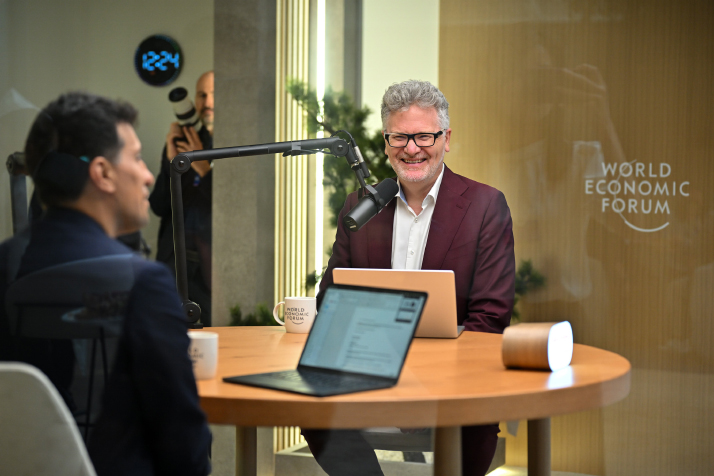
In an interview on June 24 with Beijing Review reporter Peng Jiawei on the sidelines of the 2026 Summer Davos, also known as the World Economic Forum’s 17th Annual Meeting of the New Champions, in Dalian, Liaoning Province, Adam Tooze, a professor of history and Director of the European Institute at Columbia University, discussed Western misconceptions about China’s economy, “polycrisis,” and the need for frank engagement across the global community. Edited excerpts of their conversation follow:
Beijing Review: What are the structural blind spots Western analysts frequently encounter when evaluating China’s economic trajectory?
Adam Tooze: I think the essential thing to understand about the Chinese economy—and this is not as well understood in the West as it should be—is that China is still a country undergoing development.
Western commentary often talks about China as if it were already a developed economy, where the big questions are small changes in GDP growth or unemployment. But that misses the point. Nor, on the other hand, is China a poor, low-income country.
China is in the middle of a transition, and nowhere is that more visible than in real estate. A trend I’ve noticed is that the country’s younger generations no longer see property as the obvious guarantee of security and wealth accumulation.
This, however, should not be interpreted as merely the end of a real estate boom; it is a fundamental gear shift. China is looking to new sectors. Obviously, I am a huge champion of new energy as a key growth driver. Another may be microelectronics.
Once that shift is accomplished, it will change consumer patterns, investment patterns and the course of the country’s future development. That is where I would look for new hope, and for new patterns of development.
In a sense, China both embodies development and bursts the category of development, because it is too big and too consequential. Once China develops, it changes the meaning of development itself, not only for China, but for the entire world.
You helped popularize the term “polycrisis,” the idea that today’s crises do not simply occur in parallel, but cascade into and amplify one another. Does that still seem like the right diagnosis of our current world?
That basic reading, that the world is facing a multiplicity of shocks from diverse origins, still seems to me highly relevant to our current moment.
I come from Europe, which is in the middle of an extraordinary heat wave. The presence of the climate crisis as a real and oppressive reality hardly needs exaggerating at this point.
The oil shock [the recent oil shock following the escalation of tensions in the Middle East] has exposed a different vulnerability: Asia’s dependence on imported energy. The region is now the main engine of global growth, but it is also a great energy importer, certainly of fuels other than coal.
One of the things we have seen is that China has played an incredibly cooperative role in managing that stress. In the face of the oil shock, China essentially halved its imports of oil and sat on its large holdings of reserves. It did not use its unparalleled purchasing power. After all, China is running a huge trade surplus, which means it can buy all the oil it needs. But it did not use that weight to further destabilize the global market.
Then there is fragmentation. The consequence of fragmentation is not the end of globalization, but the end of a simple, unified globalization.
On top of all this, AI is poised to transform—or displace—a vast number of jobs, making it one of the defining challenges of the next decade.
How should major economies like China, the U.S. and the EU manage their relationships in a world of “polycrisis?”
I think a story of multiplicity and increasing complexity is more relevant than a story of beginnings, middles and ends.
This is not a flat world. It is a world in which relationships have to be continuously managed through interaction.
In the case of China-U.S. relations, things are less bad than many of us thought they were going to be.
The question for many of us was whether Donald Trump’s desire to cut a deal would override his desire to gain the upper hand over China. It now seems quite clear that he remains fundamentally interested in deals.
Relations between China and the United States remain precarious, unbalanced and uncertain. But they have not descended into the open state of conflict that many of us feared.
What is needed, I think, is engagement. The other thing needed is honesty.
The reason Canadian Prime Minister Mark Carney’s speech at the World Economic Forum Annual Meeting in Davos, Switzerland, in January resonated so strongly was that it dispensed with a familiar hypocrisy. Its message was simple: stop pretending, and start facing reality.
China-Europe relations offer a case in point. Both sides need to have a moment of honesty and an adult conversation.
Europeans should admit that one of the reasons they are so fundamentally concerned with these issues is not just economics or World Trade Organization rules. The deeper anxiety is political. European governments are worried that if Chinese competition displaces industrial jobs in the region, voters will be more likely to support populist parties.
On the other hand, it is also very important for China to understand that, for Europe, the future of the automotive industry is an existential political question.
So to my mind, the answer is an open, honest conversation—one centered on bottom lines, and on the mutual recognition of where each other’s limits are. –The Daily Mail-Beijing Review News exchange item