

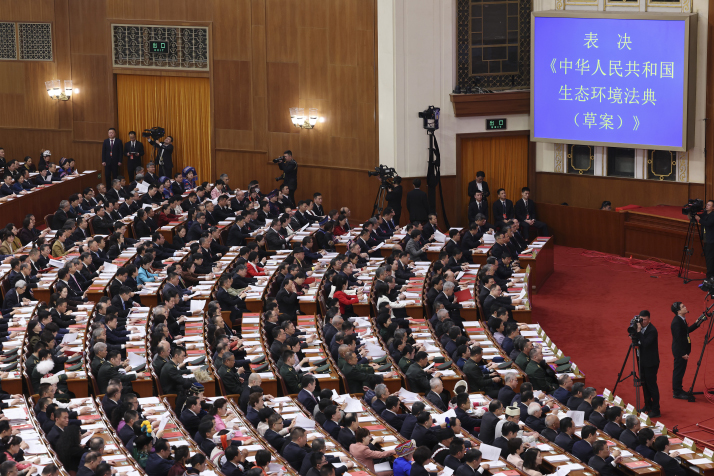
China’s second formal statutory code, the Ecological and Environmental Code, was adopted by lawmakers on March 12, a historic milestone in the nation’s pursuit of harmony between humanity and nature through the rule of law. Behind this achievement is the dedicated work of legal professionals who helped formulate this comprehensive legislation.
One of them is Qiu Jinghui, Deputy Director of the Public Interest Litigation Department of the Supreme People’s Procuratorate, China’s top public prosecutorial agency. Qiu’s team takes the Two Sessions as an opportunity for face-to-face meetings with lawmakers to learn about the legal needs of communities and gain feedback to improve their work.
This year’s Two Sessions—the annual meetings of the National People’s Congress (NPC) and the National Committee of the Chinese People’s Political Consultative Conference, were convened from March 4 to 12.
On March 6, after wrapping up a full day of work, Qiu finished his day with a visit to Xiawu Zhuoma, a deputy to the NPC representing Qinghai Province. The two have known each other since Zhuoma became an NPC deputy three years ago, and in addition to meeting during the annual Two Sessions thereafter, they have maintained regular contact on issues relating to public interest litigation in Zhuoma’s community.
Despite being a friendly, informal meeting, taking place in the lobby of the Qinghai delegation’s hotel, their discussion concerned serious issues: the habitats of snow leopards on the Qinghai-Xizang Plateau, the foraging routes of brown bears, and how the draft Ecological and Environmental Code, which was under discussion at the Two Sessions at that time, would contribute to the protection of the world’s highest ecosystem.
During the drafting of the Ecological and Environmental Code, the Supreme People’s Procuratorate participated extensively in legislative research and providing suggestions for its improvement.
In addition to being one of Qinghai’s elected NPC deputies, Zhuoma is an employee of Tongren City Water Supply Co. in Qinghai’s Huangnan Tibetan Autonomous Prefecture. Her home is at the headwaters of the Yangtze, Yellow and Lancang (Mekong) rivers, where environmental protection is not only key to the quality of her city’s water, but also a matter of national importance.
From the management of stray dogs in Yushu, Qinghai, to a wolf in Hoh Xil, also in Qinghai, that became famously plump after being overfed by tourists; from biodiversity conservation in the Sanjiangyuan (origin of three rivers) National Park to the problem of brown bears entering towns due to inadequate waste management—these seemingly scattered ecological issues are snapshots from the regular exchanges between Qiu and Zhuoma.
Many of Qiu’s past cases involved the protection of the Sanjiangyuan region, and Qiu and Zhuoma have both separately contributed to the drafting of the new Ecological and Environmental Code—Zhuoma, in her role as an NPC deputy, bringing suggestions and ideas from Qinghai, and Qiu participating in many seminars during the legislative process, sharing his enforcement experience in environmental protection and providing suggestions for the drafting of the code. The code includes provisions such as rational population management for biodiversity, ecological compensation mechanisms, and commercial insurance compensation systems, which, together offer a systematic framework for addressing human-wildlife conflicts on the plateau.
“The code emphasizes citizens’ environmental rights and public health rights,” Qiu said. “Under the broader goal of harmonious coexistence between humanity and nature, it provides a Chinese model of sound legislation and effective governance.”
One of the purposes of their meeting during this year’s Two Sessions was to explore together how the legal provisions in the code could be translated into concrete action on the plateau.
Democracy in judicial practice
The adoption of the new code, China’s first comprehensive environmental code, ushers in a new stage of systematic and codified environmental governance. For Qiu, the passage of the code represents the beginning of a new phase of work.
Public interest litigation—and Qiu’s team—will play a key role in defending China’s new Ecological and Environmental Code. “The code contains many innovative concepts, and they originate from the practical experience we have accumulated while tackling real-world challenges,” Qiu told Beijing Review.
As a prosecutor who has been involved in China’s public interest litigation pilot program since its launch in 2015, Qiu explained that public interest litigation differs from traditional prosecutorial work in two major respects: public participation and proactive responsibility.
“Procuratorial public interest litigation is perhaps the most vivid example of whole-process people’s democracy in the judicial field,” he explained.
Issues that concern ordinary citizens—polluted waterways near their homes, food safety at their dining tables, or the protection of the elderly and children—are all closely tied to the public interest. Yet these issues often stem from a “tragedy of the commons” in public governance: They affect everyone, but cannot be easily solved by any individual or entity.
“In such situations, procuratorial authorities must step forward as representatives of the public interest,” Qiu said.
When harm to public interests cannot be addressed effectively through criminal, civil, or administrative litigation, procuratorates can initiate public interest litigation procedures. In addition to handling individual cases, they can also establish standards for similar cases, thereby promoting higher-quality social governance.
“The public are not only discoverers of problems but also participants in governance,” Qiu noted. When public interests are harmed, citizens can provide evidence to prosecutors. Once a case is filed, they may also participate in hearings, expert consultations and on-site assessments, and testify in court. In doing so, they witness firsthand how public interests are protected through judicial mechanisms.
Behind a single earthworm
Though Qiu has prosecuted and supervised environmental cases all over China, even on the roof of the world, one of the cases that has left the deepest impression on him was one involving the protection of wild earthworms. It is also a story he often shares with prosecutors from other countries during international exchanges.
“Many people think of earthworms simply as fishing bait or creatures that appear on roads after rain,” Qiu said. “But in fact they are ‘guardians of the soil.’ They are an important biological indicator in systems used to assess farmland quality, especially in black soil regions.”
However, in some areas, wild earthworms have been illegally harvested using electric shock devices that force worms to the surface, and sold through black market chains. The worms are often turned into a traditional Chinese medicine ingredient known as dilong, but their removal causes lasting damage to soil ecosystems.
When procuratorial authorities intervened, they faced a challenge: Earthworms are not listed as nationally protected wildlife, so which law could be used to protect them?
“We changed our perspective and approached the issue from the angle of soil quality and food security,” Qiu explained.
Through public interest litigation, prosecutors urged e-commerce platforms to remove products related to the illegal practice, such as electric earthworm-capture devices. China’s procuratorates also perform investigative functions, and Qiu’s offline investigations targeted criminal groups involved in the illegal purchase and sale of dried earthworms.
The Supreme People’s Procuratorate subsequently launched a nationwide campaign referred to as the “Earthworm Protection Initiative.” Local procuratorates used both administrative and civil public interest litigation to establish clear judicial opposition to earthworm harvesting with electric devices, hold online platforms accountable for illegal sales, and seek compensation for ecological damage.
These cases are also valuable for improving related laws, including the Black Soil Protection Law and the Wildlife Protection Law, particularly regarding species with important ecological functions.
“China’s efforts to protect earthworms through legislation, judicial action, and law enforcement show that biodiversity protection has evolved,” Qiu said. “It has moved beyond focusing only on the number of species on protected lists toward a broader emphasis on protecting the ecological functions of all species.”
“Protecting earthworms means protecting farmland. Protecting farmland means protecting food security. And protecting food security means safeguarding the basic livelihood of the people and our quality of life,” he added.
“A tiny earthworm may seem insignificant, but behind it lies a major issue linking ecology and people’s livelihoods.”

From practice to code
“One of the key issues that civil environmental public interest litigation needed the code to resolve was the order of standing to file lawsuits,” Qiu said.
Before the introduction of the Ecological and Environmental Code, China’s Environmental Protection Law allowed qualified social organizations to initiate environmental civil public interest lawsuits. If a procuratorate intended to file the lawsuit, it had to first issue a public notice. Only after a one-month notice period had expired, and if no eligible organization claimed the right to sue during that period, could prosecutors then proceed with litigation.
“In practice, this arrangement proved inefficient,” Qiu explained. “It increased judicial costs, slowed governance, and did not align with the original intent of the public interest litigation system.”
The Ecological and Environmental Code changes this rule by establishing parallel standing between social organizations and procuratorial authorities. Prosecutors no longer need to wait for social organizations to waive their right to sue. Once they identify harm to public interests, gather evidence, and determine responsible parties, they can initiate litigation immediately.
“This is the most significant support and guarantee the code provides for the public interest litigation system,” Qiu said.
In addition, the code also addresses for the first time many practical issues raised in judicial practice, such as light pollution. Questions such as what constitutes light pollution, its potential harms, and how enforcement and rights protection should proceed are now addressed through specific legal provisions. “Clear legal rules fill a gap in social governance,” Qiu said.
Solutions before litigation
One distinctive feature of China’s public interest litigation system is the pre-litigation procedure, which takes a uniquely pragmatic approach.
“We prefer resolving public interest problems before resorting to litigation,” Qiu said. “If an issue can be addressed effectively through preliminary procedures, there is no need to take the case to court.”
Public interest litigation emphasizes achieving the best outcomes for public welfare with greater efficiency and lower costs. Before litigations, through consultations and prosecutorial recommendations, authorities can urge relevant parties to correct administrative inaction or misconduct.
“At present, 98.8 percent of our cases are resolved during the pre-litigation stage,” Qiu said. “Only a very small proportion proceeds to court.”
Every case must still meet the requirements for litigation, and when necessary corrections are not made through pre-litigation procedures, prosecutors will file lawsuits to uphold public interest.
From ecosystem governance at the Sanjiangyuan National Park to the protection of earthworms, public interest litigation in China is expanding its role in protecting the public good.
The Ecological and Environmental Code consolidates these practical experiences into a stable legal framework, providing stronger legal support for protecting China’s environment. It not only injects new momentum into ecological governance but also offers valuable reference for expanding public interest litigation into other areas of public governance. –The Daily Mail-Beijing Review news exchange item