
Staff Report
ISLAMABAD: Federal Minister for Information and Broadcasting Attaullah Tarar on Wednesday announced a series of measures to protect media workers, strengthen mainstream media and reform the government’s advertising policy, warning that media organisations resorting to layoffs, salary cuts or non-payment of wages could face suspension of official advertisements or a downward revision of their advertisement rates.
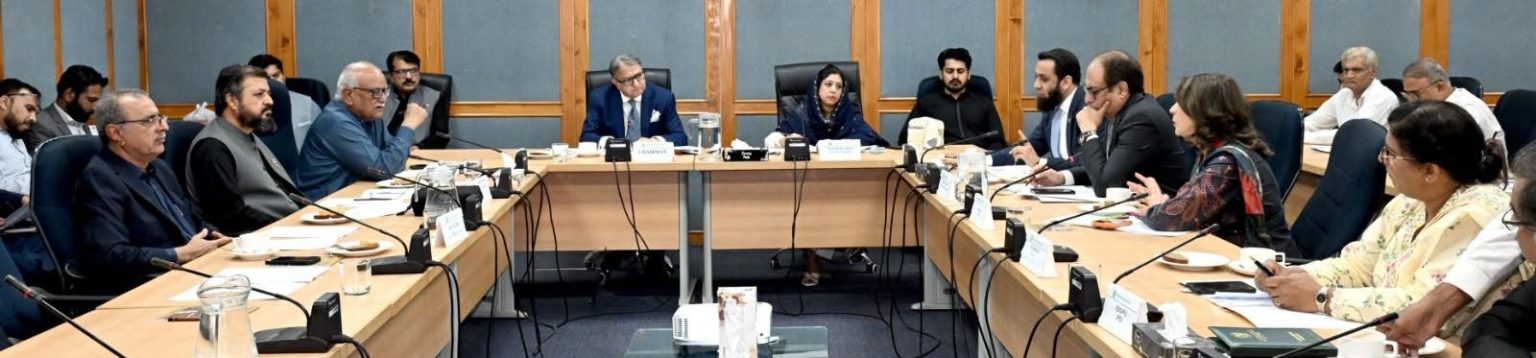
Responding to the Senate Standing Committee on Information and Broadcasting, chaired by Senator Sarmad Ali, the minister said the government’s foremost priority was the welfare of media employees and ensuring that public funds released to media organisations benefited journalists and other workers.
“We want government advertisement payments to translate into employees’ welfare,” he said, adding that the Ministry had already developed a mechanism with the Pakistan Broadcasters Association (PBA) under which media organisations were expected to clear employees’ outstanding salaries whenever the government released pending dues.
Citing an example, Tarar said the government had suspended advertisements to Suno News after it laid off employees, adding that several workers were reinstated following discussions with the channel’s management.
“If any newspaper or television channel lays off employees, cuts salaries or fails to pay wages, we have the authority to revise its advertisement rates downward and stop official advertisements in accordance with the law,” he said.
He said existing legal provisions already allowed employees to file complaints regarding non-payment of salaries, adding that such complaints were regularly received and processed.
The minister said the government’s digital advertising policy, originally introduced in 2021 and amended in 2022, had created a transparent framework for digital advertising and had subsequently been adopted by several provincial governments.
He said the policy incorporated Google Analytics, web traffic statistics, serving reports and an independent third-party verification mechanism to authenticate views and other digital performance indicators.
Tarar said digital media was a self-sustaining platform that generally did not require financial support and stressed that the government only purchased advertising according to its communication requirements.
At the same time, he cautioned against strengthening digital media at the expense of newspapers and television.
“Social media is ultimately fed by newspapers and television channels,” he said, observing that people of all age groups consumed social media content that largely originated from mainstream media.
He said newspapers should enjoy the first right over digital support and announced that under the Advertisement Policy 2024 the government would expand the inclusion of newspapers’ digital platforms.
“The digital media cannot be promoted at the cost of print and electronic media,” he said, reiterating that credible mainstream media remained indispensable in countering misinformation and fake news.
The minister announced that all issues relating to the appointment of the chairman of the Implementation Tribunal for Newspaper Employees (ITNE) had been resolved and the notification would be issued shortly after completion of a transparent, merit-based selection process.
He also proposed making registration of media employees with the Employees’ Old-Age Benefits Institution (EOBI) and provincial social security institutions mandatory.
Tarar further directed officials to prepare within one week a proposal for compulsory life insurance for employees of print and electronic media organisations, with the federal government contributing towards insurance premiums.
The committee was also briefed by the Information Secretary Ashdaq Ahmed Khalil on the role and functioning of the National Press Trust (NPT).
The minister directed officials to obtain complete details of the Trust’s assets, finances and audit reports while examining legal options for utilising its resources for the welfare of media workers.
Acknowledging concerns regarding regional newspapers, particularly those published from Balochistan and other provinces, Tarar directed the Press Information Department (PID) to constitute a subcommittee to identify genuine regional publications and submit a report on their circulation.
He also hinted that the government was considering to merge the Audit Bureau of Circulations (ABC) with the Office of the Press Registrar to establish a modern institution.
He said reforms had already been initiated through a dedicated committee to modernise the ABC system, enhance transparency and align it with contemporary media requirements.
Senator Sarmad Ali observed that the importance of print media could not be ignored and stressed the need to strengthen newspapers.
He also called for improvements in the government’s media list.
The committee also discussed certification of the recently released film “Buleha”.
Senator Pervaiz Rashid who participated via zoom said film depicting violence and criminality should not have been released under the name of the revered Sufi saint Bulleh Shah and called for determining why the title had been approved.
He said an inquiry should be conducted into how the Censor Board had certified a film carrying the name of such a historic and respected personality.
Highlighting reforms in Pakistan Television Corporation (PTV), Information Minister Attaullah Tarar said the state broadcaster had become financially stable for the first time.
He said PTV Sports was currently the only television channel in Pakistan broadcasting the FIFA World Cup, reflecting the organisation’s improved financial and professional capacity.
The minister informed the committee that approximately 216 employees were currently serving in PTV on contractual terms across different centres.
He said contractual recruitment was carried out strictly according to organisational requirements, while experienced anchors from private television channels had also been brought to PTV to improve programming quality.
Tarar said PTV’s Board of Directors was fully empowered and all major decisions were taken with its approval, adding that distinguished professionals from the private sector had also been included on the board.
He further stated that PTV had maintained timely payment of salaries throughout the past year and that no employee had faced delays in salary disbursement.
The Information Secretary Ashfaq Ahmed Khalil informed the committee that during the previous financial year neither salaries nor pensions at PTV had been delayed.
He said the corporation had reduced its expenditures to ensure timely payments to around 300 retired employees, particularly widows. The secretary also informed the committee that PTV planned to resume programme production during the current year and that measures were being taken to generate additional revenue from properties owned by PTV and Radio Pakistan.
The committee also sought reports on steps taken to resolve pension-related issues of employees of the Associated Press of Pakistan (APP) and Radio Pakistan, while noting that Pakistan Broadcasting Corporation had received the highest allocation for salaries and pensions during the previous financial year.
The meeting, among others was attended by Senators Abdul Shakoor Khan, Jan Mohammad and Waqar Mehdi, Chairperson of the Pakistan Electronic Media Regulatory Authority (PEMRA), Principal Information Officer (PIO), senior officials of the Ministry of Information and Broadcasting, the Capital Development Authority (CDA) and other departments concerned also attended the meeting.