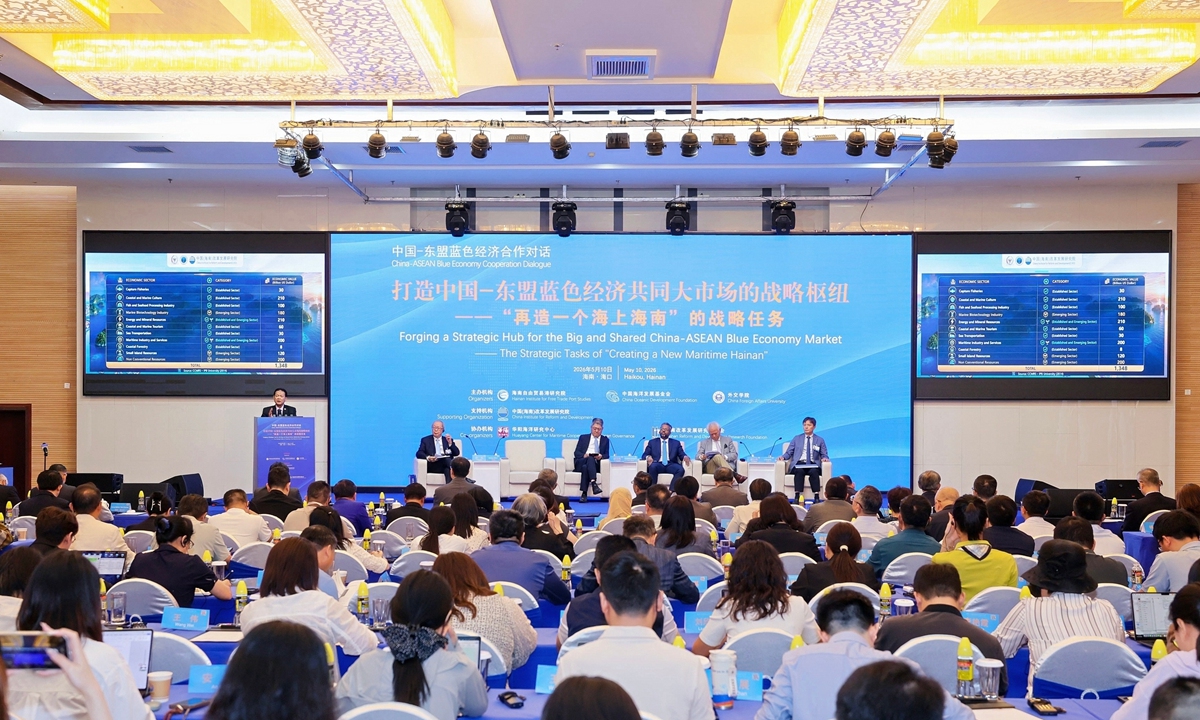
BEIJING: Officials, scholars, business leaders, representatives from 14 countries, including Thailand, Malaysia, the Philippines, and South Korea, as well as representatives of international organizations, highlighted the urgency of enhancing the cooperation of blue economy between China and ASEAN countries under the framework of RCEP during a forum held in Haikou, South China’s Hainan Province on Sunday.
The forum, titled “China-ASEAN Blue Economy Cooperation Dialogue: Forging a Strategic Hub for the Big and Shared China-ASEAN Blue Economy Market— The Strategic Task of ‘Creating a New Maritime Hainan’” was co-hosted by Hainan Institute for Free Trade Port Studies, China Oceanic Development Foundation and China Foreign Affairs University.
Amid a changing global landscape, how to overcome differences, enhance mutual trust, and achieve common development has become an urgent issue facing all Asian countries. China and ASEAN have already formed a closely interconnected relationship in which “our interests are deeply intertwined.” The key to breaking through current challenges lies in continuing to cultivate shared interests, with the blue economy serving as one of the largest areas of common interest, Gao Fei, president of China Foreign Affairs University, said at the forum.
Gao believes that Hainan has the conditions and capabilities to become a strategic hub for China’s longstanding principles of amity, sincerity, mutual benefit and inclusiveness in neighborhood diplomacy, as well as its commitment to fostering friendship and partnership with neighboring countries, to promote blue security cooperation, and to safeguard long-term peace and stability in the South China Sea region.
Chi Fulin, president of China Institute for Reform and Development, also president of Hainan Institute for Free Trade Port Studies, said at the forum that accelerating the establishment of a China-ASEAN common market for the blue economy is an important approach to responding to external shocks and safeguarding regional stability and development. It is also a major option for unlocking the cooperation potential between China and ASEAN and promoting deeper integration of industrial and supply chains.
One of the major missions of the Hainan Free Trade Port, which is strategically positioned as an “important gateway for opening-up,” is to advance the development of a China-ASEAN common market for the blue economy. The Hainan Free Trade Port has the conditions to become a strategic platform for building such a market.
The China-ASEAN partnership has become a strategic pillar for stability, growth, prosperity, and sustainable development in the Asia-Pacific region and across the world, Rokhmin Dahuri, former minister of Marine Affairs and Fisheries of Indonesia and chairman of Indonesian Aquaculture Association said at the forum.
Dahuri suggested strengthening cooperation between ASEAN and China in three areas: hard connectivity, soft connectivity, and economic and industrial connectivity.
He also called for prioritizing sustainable and data-driven fisheries and aquaculture management, low-carbon and climate-resilient marine industries, blue carbon ecosystems, marine science and technological innovation and technology transfer, as well as inclusive economic development that empowers coastal communities.
He believes that Hainan is more than just a geographic node; it is evolving into a marine economic platform that integrates production networks, logistics systems, and regional markets.
Against the backdrop of profound and complex changes in the international landscape, it is essential to strengthen regional cooperation in the blue economy and safeguard open, secure, and rules-based maritime routes. Closer blue economy cooperation between China and ASEAN can enhance regional resilience, stability, and the sustainable development of the blue economy, Li Mingjiang, associate dean (academic affairs), S. Rajaratnam School of International Studies, Nanyang Technology University in Singapore, said at the forum.
Li said that in the future, China and ASEAN will have enormous potential for cooperation in areas including sustainable fisheries management, marine environmental protection, scientific research and disaster response, renewable marine energy, maritime connectivity, port development, and digital shipping. The Hainan Free Trade Port is also expected to play an important role in these efforts.
“I believe blue economy is line with the agenda of the sustainable economic cooperation that China and ASEAN are trying to promote. By incorporating more sustainable elements into trade agreements, we can ensure that standards for various economic and trade activities are consistent with sustainability principles,” Yose Rizal Damuri, executive director from Center for Strategic and International Studies of Indonesia, told the Global Times.
Another important aspect is improving clean connectivity in the blue economy, particularly in logistics. Logistics is one of the sectors that produces significant emissions, and shipping is a major contributor. However, with appropriate arrangements, China and ASEAN countries can promote greener and cleaner logistics and transportation systems. This would greatly contribute to the development of the blue economy, making maritime transport more sustainable in the region, Damuri said. –The Daily Mail-Global Times news exchange item