
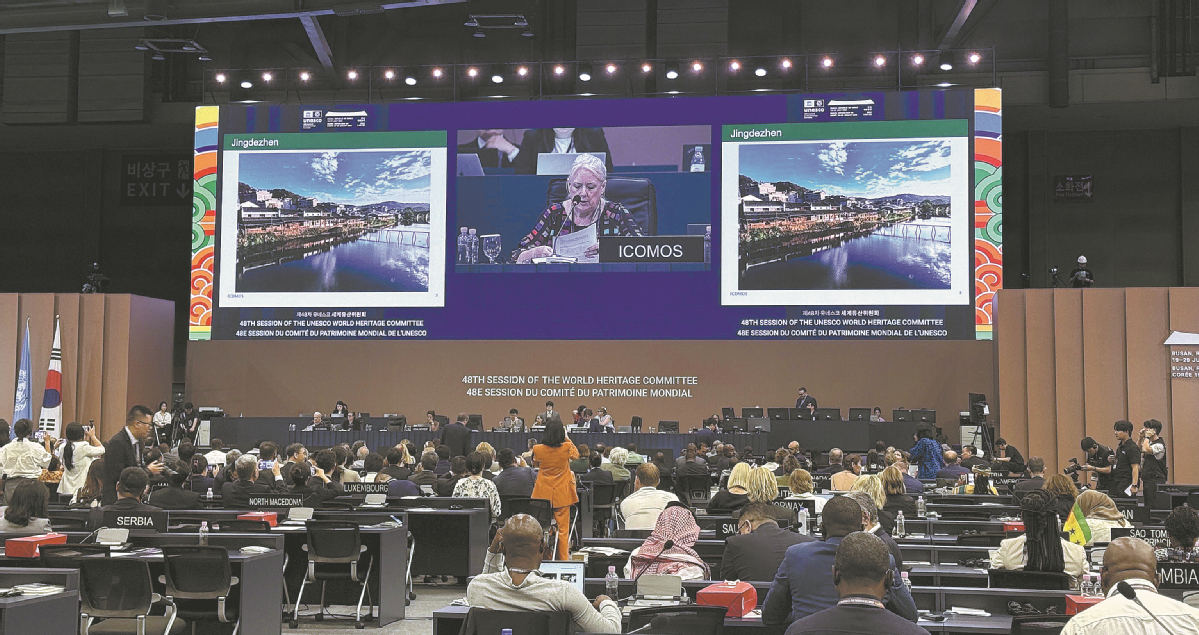
BEIJING: An ancient porcelain-making hub in East China that has been active for nearly a millennium has won global recognition for its outstanding universal value.
The Jingdezhen Handicraft Porcelain Industry Sites were inscribed on UNESCO’s World Heritage List on Saturday during the 48th Session of the World Heritage Committee in Busan, South Korea, bringing the total number of World Heritage sites in China to 61.
Located in the hilly landscape of Jingdezhen in Jiangxi province, the sites document the evolution of a complete porcelain production system that flourished between the 10th and 19th centuries. Rich deposits of porcelain stone and kaolin clay, together with an extensive water transport network, helped transform the city into the world’s foremost center of porcelain production.
The heritage premises comprise 45 component sites that cover an area of 1,979 hectares, ranging from porcelain workshops in the historical urban center to raw material extraction sites, transportation routes and traditional neighborhoods that together illustrate the industry’s full production chain.
Alessandro Balsamo, head of the Nominations Unit at the UNESCO World Heritage Centre, said that earlier, industry sites on the World Heritage List were represented more by locations known for mining or transportation. “The Jingdezhen sites highlight another important dimension that was not really represented before, concerning artisanal production,” he said. He added that the new inscription opens an important chapter in technological knowledge, skill and craftsmanship, and represents cultural exchanges over centuries.
According to Wei Qing, the author of the World Heritage nomination dossier, Jingdezhen represents an exceptional and unparalleled example of technological innovation, artistic achievement and industrial organization in porcelain production from the 13th to the 19th centuries.
From the bluish-white wares of the Song Dynasty (960-1279) to the blue-and-white ceramics of the Yuan Dynasty (1271-1368), the painted porcelain of the Ming Dynasty (1368-1644) and the famille rose and enamel wares of the Qing Dynasty (1644-1911), Jingdezhen continuously expanded the possibilities of porcelain craftsmanship.
Wei said Jingdezhen’s success was also built on cross-cultural exchange. The city combined ceramic traditions from northern and southern China, incorporated pigments introduced from the Middle East and Europe, and blended domestic and foreign decorative aesthetics.
Blue-and-white porcelain is one of the best examples. Produced by combining China’s porcelain-making techniques with Persian cobalt blue pigment, it became a defining influence on the “chinoiserie” style that flourished in European decorative arts throughout the 17th and 18th centuries. –The Daily Mail-China Daily news exchange item