
On July 13, Yao Lianbao, a lotus farmer in Guangchang County, Fuzhou City, Jiangxi Province, carefully placed a green lotus pod onto a digital scale before a panel of judges. Spectators pressed forward as the judges measured the pod with calipers and counted its seeds. Palm-sized, packed with 49 seeds and weighing 299.54 grams, the pod scored 98.4 points out of 100, ranking first and becoming the county’s “Lotus King.”
The county’s annual Lotus King competition was held inside the Lotus Culture Hall in Yaoxi Village, Yiqian Town. Lotus cultivation in Guangchang stretches back more than a thousand years and the county is known as the home of the white lotus in China.
Thirty-four teams from across the county brought 68 of their finest lotus pods, vying for a title that blends rural pride, scientific farming and centuries of culinary tradition into a single spectacle.
Holding the hefty green pod in his weathered hands, Yao spoke of the lotus variety that produced it less like a crop than a trusted companion. “The plants grow steadily, produce abundant pods, resist disease and collapse, and deliver stable high yields year after year,” he said after winning the title.
Space lotus
What makes Yao’s lotus pod stand out? The answer lies in space. In the 1990s, Guangchang’s white lotus industry faced a crisis. Aging varieties had become vulnerable to disease and yields stagnated at around 525 kg per hectare. For Guangchang, breaking through the production ceiling became an urgent challenge.
Since 1987, China has been sending seeds into space in order to increase the rate of genetic mutation within them and accelerate the creation of new and better plant varieties. In 1994, local researchers applied for county government funding to join the program, sending 442 lotus seeds from more than 10 varieties into space aboard a recoverable satellite. Exposed to cosmic radiation and zero gravity, these unlikely astronauts returned to Earth containing the key to restoring the county’s fortunes.
“Since 1994, we’ve sent lotus seeds into space six times. And we’ve been doing the selection work for more than 30 years,” Tang Jiping, a senior agronomist and Deputy Director of the Guangchang White Lotus Industry Development Center, told Beijing Review.
After years of selection, Space Lotus No.36 emerged as an outstanding variety, capable of producing fresh seeds weighing up to 5 grams each. Dried white lotus yields climbed to between 1.2 and 1.5 tons per hectare, with peak harvests reaching 1.8 tons.
Guangchang has become China’s largest supplier of space-bred lotus seedlings. “Space Lotus varieties are now grown on more than 1.33 million hectares of farmland, more than 80 percent of China’s land used to grow lotus for edible seeds. Thanks to their outstanding characteristics, they have also become key genetic stock for breeding new seed lotus cultivars,” Tang said.
Upgrading the industry
Years ago, fresh lotus seeds harvested in Guangchang blackened within days. Today, advanced preservation techniques keep them shelf-stable for more than two weeks and faster logistics networks now allow them to reach premium grocery chains across China within 48 hours.
“The lotus seeds are basically sleeping on their journey to supermarkets,” Liang Ning, Chairman of Jiangxi Yaolai Agricultural Products Co., told Beijing Review. What Liang calls “sleep” is a nitrogen-preservation process. Within an hour of harvest, lotus pods are pre-cooled in mobile cold-storage units parked beside sprawling lotus ponds and sealed in a low-oxygen environment that slows oxidation and dramatically extends freshness.
The technology has done more than extend shelf life. It has changed how farmers make money.
For decades, Guangchang farmers relied primarily on selling dried lotus seeds, a market vulnerable to price fluctuations. Fresh lotus products, by contrast, reliably command higher prices and stronger demand. Farmers who once earned roughly 90,000 yuan ($12,450) per hectare can now earn around 120,000 yuan ($17,700).
One of the county’s most significant breakthroughs came through its partnership with Freshippo, known in Chinese as Hemaxiansheng, the grocery store chain launched by retail and e-commerce giant Alibaba. In 2024, Guangchang became the first Freshippo Village in Fuzhou, with local farmers aligning their supply directly with the retailer’s demand. This model reduces waste while helping farmers access premium urban markets that would once have been unreachable, Liang said.

New frontiers
Guangchang’s ambitions extend far beyond selling fresh produce. The county has built an increasingly sophisticated lotus-processing industry that transforms nearly every part of the plant, including leaves, stamens and seeds, into commercial products.
Researchers from Nanchang University and other institutions are partnering with local firms to explore the plant’s nutritional and medicinal properties, while advancing preservation and extraction technologies.
At Jiangxi Luxiaolian Food Co. Ltd., lotus seeds are turned into crunchy snacks using low-temperature vacuum dehydration rather than deep frying. “The process preserves nutrients while keeping oil content very low,” Lai Haiping, an executive at the company, said.
Others target consumers’ increasing interest in traditional Chinese wellness concepts. At Jiangxi Guangxian Biotech Co. Ltd., lotus seeds are processed into instant powders marketed under the traditional belief that food and medicine come from the same source.
Engineers in Guangchang have also solved a challenge that long limited the commercialization of lotus beverages: preventing lotus juice from separating during production. A locally developed dual-enzyme process now allows companies to produce shelf-stable lotus drinks for both domestic and overseas markets.
Today, more than 30 lotus-related enterprises operate in Guangchang, forming an industrial chain that spans cultivation, storage, research, manufacturing, sales and tourism. The county’s lotus-processing sector now generates more than 2 billion yuan ($296.6 million) in annual output.
Additionally, mechanization has transformed what was once a highly labor-intensive business. Locally developed shelling, drying and seed-extraction equipment now enables fully automated production lines, reducing processing times from days to just hours.
Inside the workshop of Jiangxi Wanhe Machinery Manufacturing Co. Ltd., conveyor belts feed freshly harvested lotus pods into automated shelling and peeling machines. “The system can process 144 lotus seeds per minute,” Huang Junwen, the company’s general manager, told Beijing Review. “That is about 25 to 30 times more efficient than manual labor.”
Selling lotus online
Yet perhaps the most visible symbol of Guangchang’s transformation appears not in laboratories or factories, but on smartphone screens.
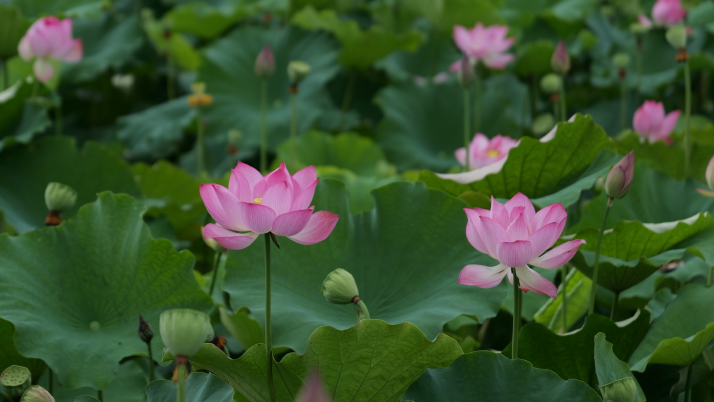
On the afternoon of June 17, local entrepreneur Rao Chunhong stood beside blooming lotus ponds, livestreaming to viewers across China. Online, she is better known as Lotus Sister. Holding a lotus flower toward the camera, she explained how every part of the plant, including its pollen, can be used in teas, soups or herbal products.
Rao once worked as a nutritionist in Guangzhou, Guangdong Province, before returning to her hometown to pursue opportunities in rural e-commerce in 2016. Last year, the sales volume of her company amounted to more than 10 million yuan ($1.48 million).
Live-commerce, the convergence of live streaming video and e-commerce, has become one of the defining features of China’s rural economy. Farmers, cooperatives and small companies now market directly to consumers through mainstream platforms such as Weixin, Douyin and Taobao Live, bypassing traditional distribution intermediaries.
The changes underway in Guangchang mirror the broader transformation of China’s countryside itself, from subsistence agriculture toward a technologically integrated rural economy in which even the smallest seed can generate an entire industrial chain. –The Daily Mail-Beijing Review news exchange item