
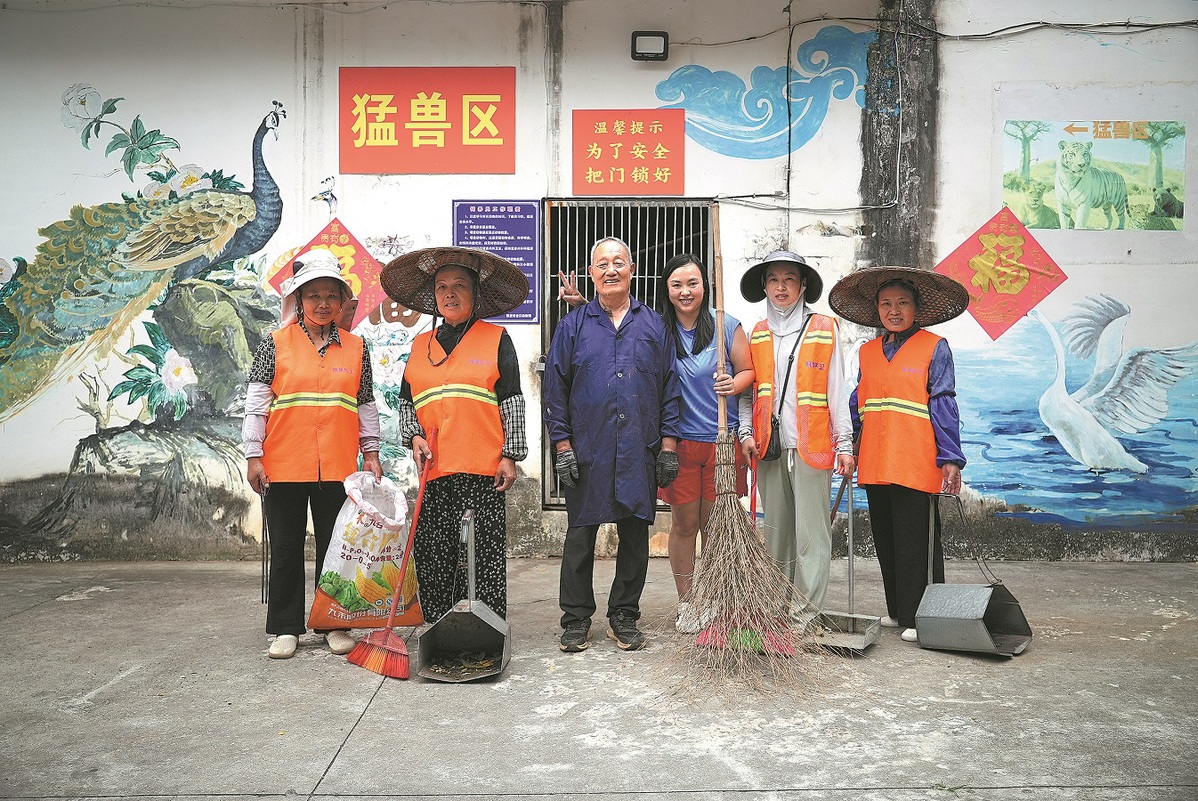
BEIJING: At 5 am, Feng Yuanyong was already making his rounds in the semi-darkness with a flashlight in hand, checking the animal enclosures one by one.
The 71-year-old spent decades as a school principal and education official. Now, his mornings begin with touching the noses of tigers at a privately-run mini zoo in Kaili, a city in southwest China’s Guizhou province.
After retirement, Feng became the facility’s zookeeper, repairman and even an unofficial “veterinarian”, devoting himself to caring for more than 20 species of animals.
The morning routine is a ritual Feng has repeated for the past decade. He touches the tigers’ noses to see whether they are moist — a simple method he developed after years of observing and caring for animals. He said small details like this one can reveal whether an animal is in good health. “People can tell you when they feel sick, animals can’t,” he said.
Time has left its marks on Feng’s face. His gaze is steady and focused, but whenever he talks about the animals, he breaks into his trademark warm smile.
Built on a hillside, a 10-minute drive from downtown Kaili, the Kaili Zoo covers about 0.35 hectares.
Unlike most other zoos, it has no sprawling grounds or a large number of staff. For years, visitors were few, and the revenue was barely enough to cover daily expenses, but he stayed on.
Feng never planned to become a zoo director, instead choosing a career in the education sector.
In 1977, the year China reinstated the gaokao national college entrance examination, Feng was admitted to a teachers’ college. After graduation, he started teaching in a rural area and later rose to the position of school principal before joining the education department as a physics education researcher.
In 2016, his younger brother asked him to help at Kaili Zoo, which was struggling financially and needed someone to manage it. What was meant to be a temporary arrangement became a permanent commitment. “Once I came, I never left,” Feng said. Many of the zoo animals were rescued or donated. Feng said he came to see each one as part of his family. “They are just like my own children,” he said, explaining every animal had its own story and refusing to say which one he loved the most. Before becoming a viral attraction, Kaili Zoo endured long periods of hardship. For years, it survived not because it was profitable, but because of Feng’s persistence.
The zoo originally operated alongside an amusement park. But when the park went into decline and closed, the zoo lost its main source of visitors. During the hardest period, nearby construction work cut off the road near the zoo, leaving visitors unable to reach it. At one stage, even feeding the animals became a challenge. Feng began growing vegetables to cut costs. “I thought about giving up. But what would happen to these animals?” he said.
Using a hoe, Feng cleared mountain paths and made directional signs to help visitors find their way. One read: “The zoo is 150 meters ahead along the mountain path. Brave children will receive a free portion of food to feed the animals.” Kaili Zoo began attracting wider attention almost by accident.
A visitor came to the zoo one day and saw Feng preparing food for the animals. She asked whether she could film him caring for them.
Feng agreed and told her that if she helped promote the zoo, she could feed the animals. Soon, more visitors began sharing their experiences online. One tourist from Shanghai suggested that Feng try promoting the zoo on Xiaohongshu, or RedNote, a popular Chinese lifestyle-sharing platform. Feng had never heard of the platform and thought it was the name of a book. –The Daily Mail-China Daily news exchange item