In one sentence, what do you do? What can you do that nobody else can? Do you have customers? Do you have revenue?” Those were some of the questions Silicon Valley investor and Startup World Cup co-founder Bill Reichert posed to entrepreneurs pitching their startups at the HICOOL 2026 Global Entrepreneur Summit, held in Beijing from August 26 to 29, offering a glimpse into how investors evaluate early-stage companies.
The summit brought together HICOOL Global Entrepreneurship Competition participants and showcased winning projects and innovations from around the world. This year’s competition, kicking off in January, attracted 10,209 entrepreneurial projects and 13,472 entrepreneurs from 141 countries and regions, with overseas projects accounting for 56 percent of the total, all the highest since its inception in 2020.
More significantly, the summit facilitated direct connections between entrepreneurs, investors and business leaders and served as a premier platform for sharing insights on global markets and innovation trends.
Increasingly, the annual HICOOL summit is evolving beyond a conventional entrepreneurship conference into a global gathering of entrepreneurs—a kind of “festival” of innovation. Understanding the reasons for its popularity this year requires considering a question that has more than one answer: Why are more and more entrepreneurs from around the world turning their attention to China?
Evolving startup ecosystem
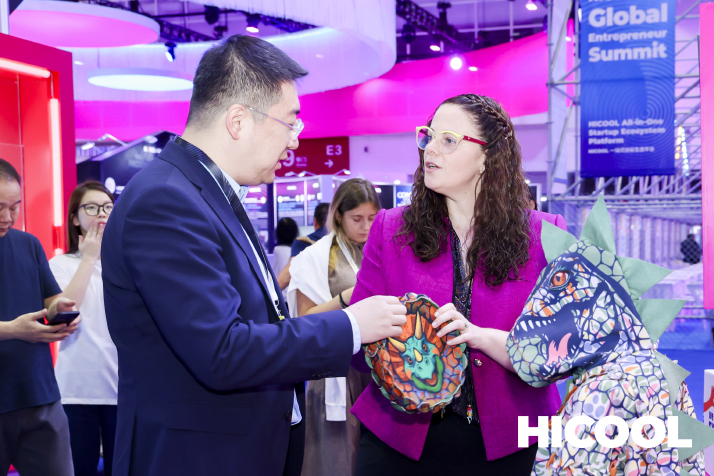
Maria Florencia Bordas, a Spanish entrepreneur and a winner of this year’s HICOOL competition, is the founder and product designer of Linkkit, a modular textile ecosystem. At her booth, a children’s outfit shaped like a green dinosaur immediately caught the eye.
Linkkit enables children to create clothing and accessories such as backpacks and storage bags using nothing more than their hands. “This is not a toy. It’s a creative experience. You make something with your own hands that you can actually wear and use,” Bordas explained to Beijing Review. “The products are made from recyclable materials, with each piece completed within 30 minutes to an hour.”
Drawing on more than 20 years of experience with Chinese suppliers, Bordas said integrating her startup into China’s well-developed manufacturing ecosystem was a natural decision. She plans to visit China again next January or February.
Claudia Danesi Carreras, Executive President for Technology Transfer, Innovation and Business at TecnoCampus, a scientific park in the Spanish city of Mataró, said Europe has strong scientific research and networks but needs closer ties with Chinese companies to transform research into real-world solutions.
“China has a huge concentration of talent. There is also a huge concentration of tech companies and public institutions to help them, to foster the development of projects and to turn them into applications that can have a real impact,” she told Beijing Review.
“What has impressed me is the speed at which research from universities and academic environments can be transferred into the commercial world here in China,” Walter Greenleaf, Director of Stanford University’s Virtual Human Interaction Lab and a behavioral neuroscientist specializing in virtual reality and digital health, told Beijing Review.
Sometimes, he said, the process can take a long time because different cultural environments and various barriers can stand in the way of commercialization. “But what I see here is that many teams have a very strong academic foundation, while also being very good at taking those results to market and developing them into real products. That makes me very excited.”
Reichert has observed a similar transformation from the investment side. Having visited China repeatedly over the years, he has witnessed the maturation of the country’s startup ecosystem.
“In the years that I’ve been coming here, I’ve seen the evolution of investment from everyday applications and businesses toward much deeper frontier technologies,” he told Beijing Review. He said this shift has encompassed AI, renewable energy, electric vehicles and autonomous driving.
He said China’s technology entrepreneurship ecosystem has become world-class and so now entrepreneurs here can compete with their counterparts anywhere in the world, including the Silicon Valley in the United States.
For Chinese entrepreneurs, Reichert stressed, a major advantage is the strong support from startup accelerators, government, investors and universities, coupled with another key asset: China’s vast market. Yet, he cautioned that in an increasingly globalized world, that vast domestic market can inadvertently serve as a comfort zone.
For global entrepreneurs, Reichert said, one of the hardest things is moving beyond their local market. “American entrepreneurs may have a slight edge over their Chinese counterparts when it comes to going global. Of course, many Chinese entrepreneurs have already succeeded internationally. But for many, figuring out how to truly globalize their businesses may remain one of their biggest challenges,” he added.
Innovation beyond borders
At the summit, Reichert urged entrepreneurs to define their “3Cs”: clear, compelling and credible—Who are you solving a problem for? How much better is your solution? And why should anyone believe you? Above all, he emphasized the importance of a compelling value proposition.
“Some investors say they invest in teams; others say they invest in technology; still others invest in markets. But if a company cannot offer its target market an attractive and compelling value proposition, none of that matters,” he said.
While Reichert focused on what makes a startup investable, Cambridge University Deputy Vice Chancellor Simon Woolley offered a different piece of advice: Entrepreneurs should look beyond technology and business, and consider the greater purpose behind innovation.
“The energy that I found in China and here at HICOOL in Beijing is unbelievable—the creativity, the ingenuity,” he told Beijing Review. “But I also want the young generation to better understand that all this ingenuity could be meaningless unless it has a greater purpose, a greater decency.”
“We need to establish a decency that understands that my challenge is your challenge; I want a better world and you should want the same,” he added.
Turning that shared vision into a reality requires innovation to move beyond national borders to leverage the distinct strengths of each country.
Greenleaf said he sees healthcare as a natural example. “Healthcare is borderless. A research result, a new product or a new way of addressing a healthcare problem, wherever it is developed, can ultimately be shared around the world,” he noted.
China has clear strengths in manufacturing, scaling and rapidly bringing innovation to market, according to Greenleaf. “If the U.S. and China can exchange ideas and learn from each other, both sides stand to benefit. That’s why I’m excited to be here,” he said.
For Danesi Carreras, trust is key to China-Europe cooperation. Cultural differences between Europe and China are real, but they can be addressed by finding the right partners and building relationships through concrete projects, clear cooperation agreements and sustained communication, she said.
She highlighted examples of an encouraging trend, in which European and Chinese participants actively negotiated potential partnerships during the summit, in areas including AI, digital technology and healthcare.
Looking beyond bilateral cooperation, Wendy You, Board Member of the Singapore Chinese Chamber of Commerce and Industry, suggested that Singapore, known for its connectivity, can serve as a bridge amid growing geopolitical tensions.
She said Chinese, British, European or U.S. companies can use Singapore as a platform for joint ventures and even three-way partnerships. For example, it can be one party from Latin America, one party from the Chinese side, plus a Singaporean company or even an international company in Singapore, to come together and collaborate. And that’s where they can scale better and bigger to different continents of the world.
For Reichert, the opportunities emerging from China’s entrepreneurial ecosystem are increasingly clear. “We have already invested in companies out of China. As you probably know, there are a lot of Chinese entrepreneurs in the Silicon Valley. Now we see tremendous opportunity in the entrepreneur ecosystem here in China, and so we are always looking for opportunities to participate in that ecosystem.”
His message echoes a broader theme running through successive HICOOL summits: Innovation becomes more meaningful when it creates connections rather than barriers.
At the events, entrepreneurs from different countries not only explore new markets or investment opportunities, they also look for partners with whom they can exchange ideas, build trust and, ultimately, go global together.
And for Chinese entrepreneurs, the next challenge is coming into sharp focus: Move from competing in China to competing globally. –The Daily Mail-Beijing Review News exchange item