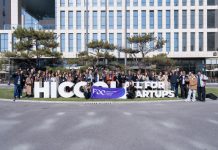


As Yangquan City in Shanxi Province celebrated the 20th anniversary of the publication of Chinese science fiction novel The Three-Body Problem by Liu Cixin, its honored hometown literary giant, a humanoid robot broke into a Michael Jackson-inspired dance at a science fiction exhibition. A group of children eagerly mimicked its moves, while Scottish writer and Beijing resident David Ferguson joined in the fun. For a moment, the future felt playful, noisy and shared.
That scene captured the spirit of the Fourth Liu Cixin Hometown Science Fiction Culture Week, which brought writers and science fiction enthusiasts from China and around the world to Liu’s hometown.
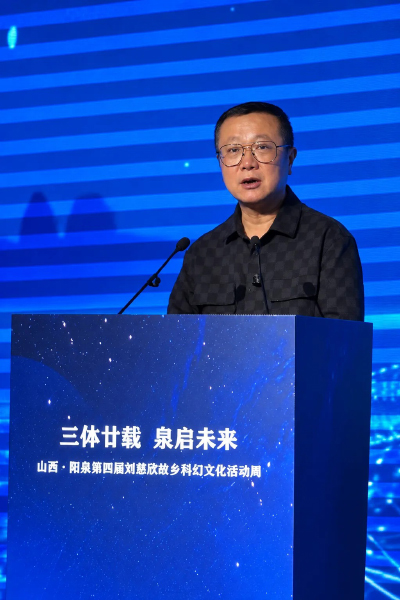
At the opening ceremony on September 8, Liu reflected on how dramatically Chinese science fiction had changed. Twenty years ago, he said, it was a minority interest, with few readers and writers. Today, it reaches far beyond publishing into film, television and other cultural industries.
The world has taken notice, too. Liu’s The Three-Body Problem, winner of the Hugo Award for Best Novel at the 2015 World Science Fiction Convention, the industry’s top honor, became an international phenomenon, helping introduce Chinese science fiction to a much wider English-language readership and opening doors for other translated works to find readers abroad.
A coal town enters the cosmos
“Yangquan is a home for my soul,” Liu said. He spoke of the city’s ambition to make imagination and creativity part of urban life, nurturing young people’s curiosity about science and the stars. But he also warned that Chinese science fiction still needs more high-quality original work. “Science fiction is not simply fantasy,” he said. “It is imagination grounded in science, and a clear-eyed reflection on humanity’s future and technological development.”
Writers, he argued, must record their own era while looking ahead.
Long associated with coal, power generation and heavy industry, Yangquan is where Liu worked as an engineer before becoming one of the world’s best-known science fiction writers. Its newly opened Liu Cixin Science Fiction Museum, the first in China dedicated to a science fiction author, places his work within a wider literary tradition. Walking through it, I thought of the lineage connecting writers in the genre across generations, from Mary Shelley and Isaac Asimov to William Gibson, Liu Cixin and my Canadian friend Robert J. Sawyer. As a working writer, I found myself somewhere along that same road. The children dancing with the robot were farther down it.
Creating connections
I first met Liu at the 2023 World Science Fiction Convention in Chengdu, capital of the southwestern Chinese province of Sichuan, where he and Sawyer were two of the headline guests. Sawyer and I hit it off, but Liu proved harder to catch; after our interview, he disappeared into the crowds.
Before traveling to Yangquan in September, I debated whether to carry my enormous, limited-edition Head of Zeus hardcover edition of The Three-Body Problem trilogy. Bought in Canada and already hauled to China, the Bible-sized volume seemed ridiculous to take from Chongqing, where I live, to a destination over a thousand kilometers away. Liu’s public signing was scheduled for September 8, but I was due to read at another venue. There was no guarantee of another chance. Sometimes, though, you have to take a long shot.
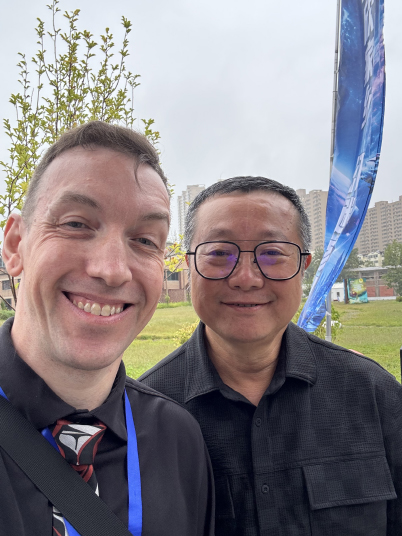
The gamble paid off. After the ceremony, I passed along Sawyer’s greetings. As we stepped out into the rain beneath our umbrellas, Liu asked about him, and we took a selfie to send our mutual friend. I later found myself in Liu’s car as he signed the colossal volume. He laughed, saying he had never seen that edition. I offered to give it to him—a curious proposition after carrying it across the world to have him sign it for me. We both laughed, a light-hearted and joyfully absurd moment.
Back inside the exhibition hall, I found several glimpses of technology moving from science fiction into practical applications. At one display, a woman demonstrated an independently operated robotic arm and its potential uses. Nearby, I spotted permeable concrete and found myself enthusiastically explaining China’s sponge city approach to Liu. As a writer with a particular interest in solarpunk, I was delighted to discuss urban ecology with him.
The principle is straightforward: Rather than simply channel rainwater away, cities can use permeable surfaces and green spaces to absorb, retain and manage it. Chongqing was among the original 30 cities selected for China’s national sponge city pilot program. I explained how the approach can reduce surface runoff and flood pressure in a densely built mountain city. Liu listened with a smile. I had traveled to hear about the future in his novels and found myself describing one already taking shape beneath our feet.
Tea with the OG
Later that day, and away from the public program, Liu joined our small group of international guests for tea and fruit at a private gathering arranged by the local government and newspaper Shanxi Daily. Liu also spoke candidly about the difficulty of finding an idea worthy of his next major work. He seemed in no hurry to produce another book simply because readers were waiting, and enjoyed morning runs around Yangquan.
When Ferguson asked how Liu dealt with the constant public attention, Liu admitted he receives hundreds of invitations each year and turns down most. Some writers might relish the spotlight; for him, he joked, it was “a disaster.” He rarely accepts invitations to major science fiction conventions around the world. This event was different: Held a few hundred meters from his home, it was an invitation he could hardly ignore. He joked that he “would have felt bad jogging past without attending.”
Prepare to adapt
At a multilingual reading hosted by Shanxi Daily, guests shared works in German, Spanish, Arabic, English and Chinese. I read from Amos the Amazing, my Chongqing-inspired science fiction and fantasy novel, and then gave my English and Chinese editions to several visiting children, who helped close the Shanxi Daily livestream with a song. Liu’s universe stretches across light-years; mine begins with the mountains, rivers and everyday contradictions of Chongqing, my home for the past 12 years. Both ask what kind of future we are making.
I asked Liu what advice he would offer young people preparing for a hi-tech future none of us can reliably predict. His answer was practical: Develop your imagination, consider the possibilities ahead and prepare to adapt.
As a teacher, I thought of my students, growing up with AI, rapid technological change and careers that may not yet exist. None can know what the world will look like when they are adults, but they can learn to remain curious, imaginative and adaptable.
Twenty years after The Three-Body Problem began its journey, Yangquan offered a fitting illustration of what science fiction can do. It can honor those who imagined before us, help us make sense of the technologies and choices shaping the present, and invite the next generation to take part. The robot danced. The children followed. Somewhere between the two, the future was already beginning. –The Daily Mail-Beijing Review News exchange item