

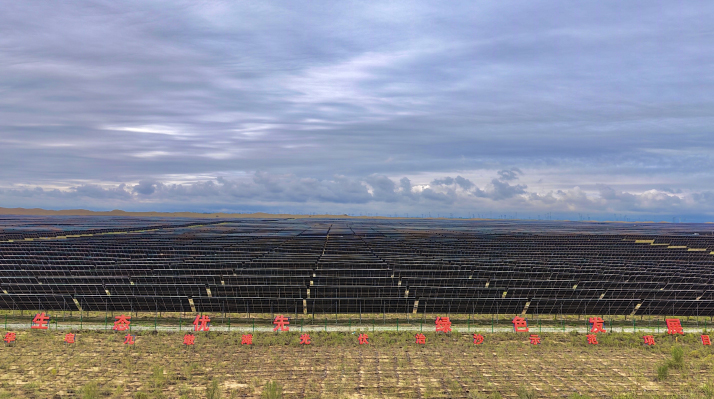
The collected water nourishes plants between and beneath the panels through precision irrigation. By forming sand-blocking and sand-fixing belts, these plants protect the station from the severe sand hazards that threaten operations—dust lowering power generation efficiency, abrasive particles wearing down equipment and dunes burying panels.
A chief designer of desert control and ecological restoration from PowerChina’s Beijing Engineering Corp. (BJEC), Ma noted that these small collectors are merely part of the pilot phase for a far larger rainwater harvesting system set to be launched next year.
The pilot was carried out in the Jiuduntan Photovoltaic Desert Control Demonstration Park in Wuwei, Gansu Province. Anchoring the southwestern edge of the Tengger Desert, China’s fourth largest desert, the park looks like a vast ocean of silicon panels set against undulating, golden dunes, converting this harsh wasteland’s solar potential into clean power.
Planned to span 300 square km, the park is still under construction, yet it already hosts several photovoltaic projects.
The research project that Ma took part in was launched in 2024 by BJEC. It is a systematic study on ecological restoration across mega-scale renewable bases in desert areas, including how to sustain desert plants between and beneath solar panels to stop sand from damaging the equipment.
To ensure solutions are adaptable rather than site-specific, the project distributed its field trials across three solar stations along the fringe of the Tengger Desert in Gansu, namely, Jiuduntan, Longyu and Minqin. Each represents one of the three most typical desert landforms in northwest China—shifting sand, saline soil and gravel desert. Across these sites, the project’s 20-person research team works to tailor ecological restoration methods to the unique demands of each landscape.
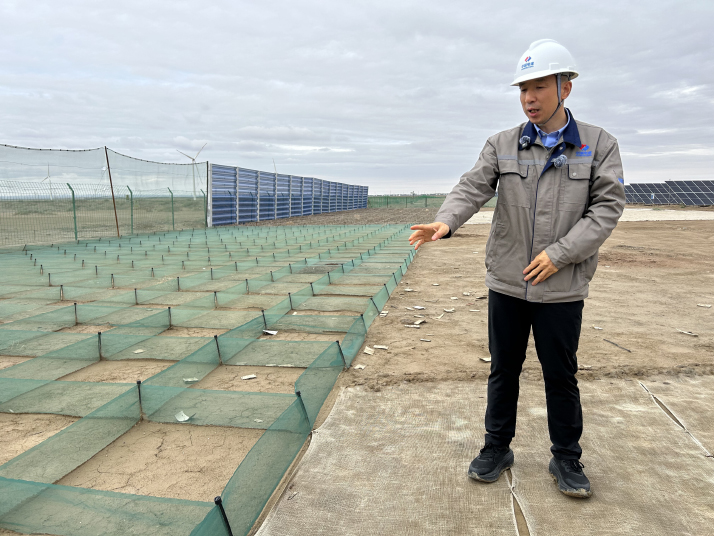
Engineer Ma Shijun presents the perimeter protection system to stop shifting sand from invading and burying the photovoltaic panels at the Longyu power station in Wuwei, Gansu, on September 8 (GE LIJUN)
A shifting landscape
Wuwei sits at the junction of three major plateaus, the Loess Plateau, the Qinghai-Xizang Plateau and the Mongolian Plateau, with desertified and sandy land accounting for 64.2 percent and 46.7 percent of its territory, respectively, making it one of the most severely desertified areas in China. Not long ago, its vegetation cover was well below 5 percent.
Left unchecked, the Tengger Desert threatened to merge with the Badain Jaran, China’s third largest desert. Had these two giant sand seas locked hands, they would have forged a colossal mega-desert, compounding the challenge of ecological restoration exponentially. To prevent that from happening, integrating solar power generation and desert control was made a national strategy.
Desert plants have long been used to fix and control sand, so why do they still need to be studied under such a project? Ma pointed out that installing solar panels transforms open dunes into far more intricate ecosystems. By casting shade, altering wind patterns and redirecting rainfall, the sloped arrays fundamentally reshape the light, air and moisture at the ground level.
Given these dynamic changes, ecological restoration within a solar farm involves countless variables that require multi-year, on-site testing. Wild desert plants rarely grow densely enough on their own to anchor the soil around heavy infrastructure, and Ma’s team is still determining which species can adapt to the microclimates created beneath and between the arrays. “On top of that,” Ma added, “because every patch of desert is unique, what works in one area cannot simply be copied and pasted to another.”
The largest site of the three, Jiuduntan, is surrounded by rolling dunes where fast-moving sand poses a constant risk of burying the infrastructure. To counter this, the team deployed a layered defense: Tall plastic fencing along the outer perimeter intercepts incoming windblown sand, while grid-patterned nets inside the facility bind the dunes, locking the surface in place until a natural crust can form.
At Longyu, the threat stems from salty, fragile ground where disturbing the topsoil can easily kick up corrosive salt dust. Research here focuses on preserving the natural ground cover and keeping soil disturbance to a minimum. Beneath the arrays, workers spray liquid binding agents to hold down dust and salt while weaving traditional reed checkerboards between the rows to keep the soil steady.
Further east in Minqin solar power station, named after the county in which it sits, the landscape shifts to a gravel desert. Loose sand is rare here, but wind-whipped pebbles act like flying sandpaper, scratching and damaging the solar panels. Researchers are testing new soil-stabilizing compounds directly beneath the arrays while intercropping hardy, native species like wild sand onion between the rows, pairing industrial protection with local ecological farming.
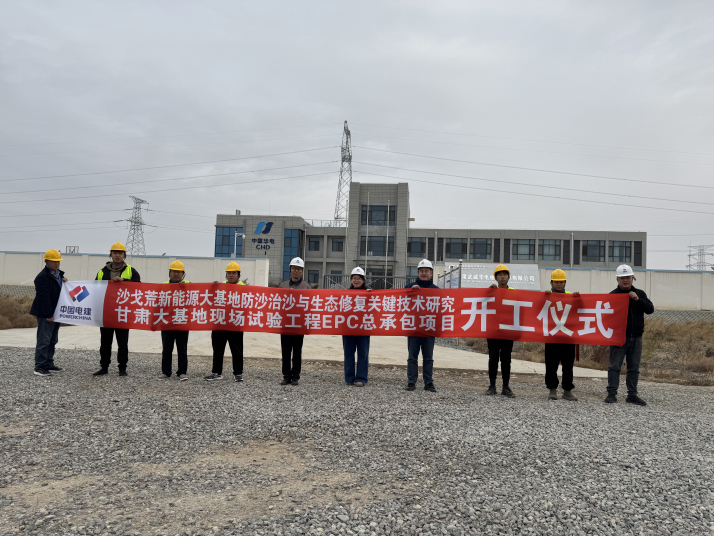
PowerChina hosts a kickoff ceremony for the research project on key technologies for desertification control and ecological restoration at the Jiuduntan Photovoltaic Desert Control Demonstration Park in Wuwei, Gansu, on October 25, 2024 (COURTESY PHOTO)
Taking root in the sand
Roughly 70 percent of the project’s researchers and engineers are under the age of 35. Among them is Zhao Lijun, a Minqin native who joined the team in 2024. “Growing up here, I remember every spring in Minqin as hazy and gray, punctuated by fierce sandstorms. One year, a catastrophic ‘black storm’ swallowed the entire horizon,” she told Beijing Review. “To see desert control elevated to a national priority and paired with solar energy generation is incredible. As a local, being able to do this for my hometown means everything to me.”
Yet turning theory into practice presented a steep learning curve. As national ecological restoration standards have risen sharply, the limits of textbook solutions quickly became clear.
“In school, the logic of desert control seemed straightforward: Assess the land, choose a plant, put it in the ground and hope it survives,” Zhao explained. “Real-world engineering demands systems thinking. We used to rely on single methods, like traditional straw checkerboards. Today, we layer multiple techniques—pairing tamarisk and straw fences with customized blends of shrubs and live grass seeds.”
This shift demands a much broader skill set. Beyond plant biology, the team must now navigate climatology, materials science, construction mechanics and cost management.
Among the three experimental sites, Zhao considers Minqin her most grueling test. Shifting dunes move, yet sand still behaves like soil—it can be enriched with organic matter and water-retaining compounds. A gravel desert, by contrast, has no real soil at all.
“Under natural conditions, it can take thousands of years for windblown dust to build just a single centimeter of fine soil over gravel,” Zhao said. “Because the gaps between pebbles are so large, water drains away before plant roots can ever reach it. Out of 10 liters of water, plants might absorb only two or three.”
To overcome this, the Minqin station focuses on creating a functional growing medium from scratch, importing soil and cultivating biological crusts, while deploying precision drip irrigation to make every drop count.
Finding the right species is a trial-and-error process. Unlike traditional desert-control work, planting inside a solar farm introduces a spatial challenge: Researchers must test how plants perform in the open spaces between panel rows versus directly underneath them. The panels cast heavy shade, blocking crucial sunlight and slowing plant growth.
Even wild plants that usually thrive in the desert can be challenging when cultivated by people. Getting seeds to sprout and helping young plants adjust to the wild require constant experimentation. Zhao explained that proving a species can truly survive in the sand is a long-term test that unfolds in three distinct stages. First, the plant must make it through an initial six-to-eight-month growing season. Next, it must prove its resilience across at least two consecutive years of freezing winters and scorching summers. Finally, over three to five years, researchers evaluate whether the species can reproduce on its own, survive without extra watering and live safely alongside the solar equipment.
Liu Ziyue, who joined the project straight out of graduate school, has spent her time turning coal ash into products for sand fixation and ecological restoration. “Nearby coal-fired power plants produce huge amounts of fly ash as industrial waste,” Liu told Beijing Review. “Repurposing it into eco-friendly materials turns a local pollutant into a useful resource while keeping costs down.”
The initial trials, however, hit immediate roadblocks: prototype panels cracked and test seeds failed to sprout. Liu needed to continuously refine her formula based on field observations. “You have to be on-site to spot the real-world flaws,” she reflected. “They often don’t show up in a lab environment.”
Parallel to their work with material formulas, the researchers are looking to upgrade other physical structures used to anchor the sand. Traditional straw checkerboards lose their effectiveness after three to five years, prompting the team to test nets made from natural plant fibers, polylactic acid (PLA), and high-density polyethylene (HDPE). While plant-fiber nets offer fully biodegradable, weather-resistant protection, the synthetic PLA and HDPE grids provide a service life of over 10 years while remaining quick and much easier to install.
When the desert answers
After more than two years of trial and observation, the desert is beginning to respond. Among dozens of species introduced across the stations, hardy sand-growing plants like nitre bushes, saxaul and Calligonum mongolicum are taking firm root. Matching plants directly to micro-lighting conditions—full sun, partial shade and deep shadow—the team has designed layered shelterbelts to catch windblown sand and stabilize the soil. At the same time, cultivation trials with cash crops like sand onion and black goji berry are laying the groundwork for a transition from costly sand control to a viable green economy.
As vegetation cover expands, the landscape is quietly coming back to life. Gazelles, hares and foxes now regularly range across the base.
To test these models at scale, the team is building a 53-hectare validation pilot to gather long-term field data. The findings have already helped BJEC draft China’s first technical guidelines for ecological restoration across mega-scale renewable bases in desert areas.
That local expertise has since reshaped national policy. In this June, the National Forestry and Grassland Administration issued the Technical Specification for Photovoltaic Desert Control (LY/T 3470-2026), an industry landmark drafted by BJEC. The standard governs the full lifecycle of solar-desert engineering, from initial site design to long-term operation.
In August, at the 17th session of the Conference of the Parties to the United Nations Convention to Combat Desertification in Ulaanbaatar, Mongolia, Ma presented BJEC’s integrated governance model at the China Pavilion, sharing lessons from Gansu’s sand frontier with an international audience.
Out on the dunes, where summer heat soars past 50 degrees Celsius and yellow dust sweeps the horizon, the work continues. What began as an engineering challenge has evolved into something deeper: an enduring search for coexistence between clean energy development and the natural world in some of Earth’s harshest places. –The Daily Mail-Beijing Review News exchange item