
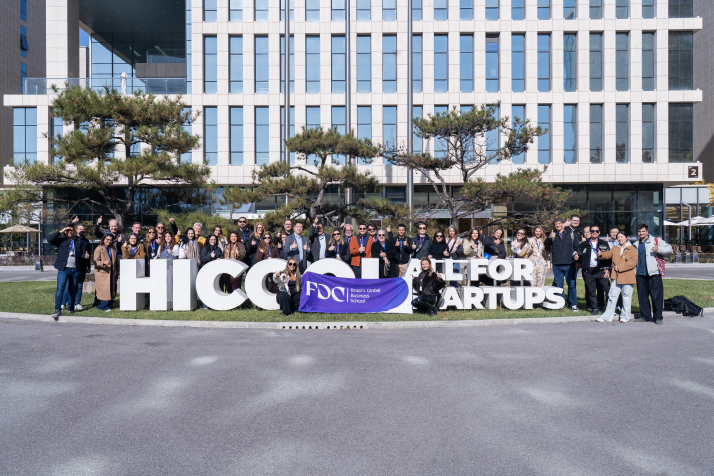
When more than 30 Brazilian business leaders visited Beijing’s HICOOL industrial park in Shunyi District on November 2, they were looking at a much bigger picture than one entrepreneurship platform.
Organized by Fundação Dom Cabral (FDC), one of Brazil’s leading business schools, the delegation brought together executives from over 20 companies and institutions across 15 sectors. The group was in China to gain a closer understanding of its business environment, explore investment and market opportunities, and assess the possibilities for future cooperation and local operations. Nearly half of its members were CEOs, board chairs or business owners. Their companies included Latin American car-rental leader Localiza, fashion retailer Riachuelo, property developer JHSF, mining and construction groups, as well as the Brazilian branch of global food and beverage giant PepsiCo.
A visit to HICOOL offered them a window into one part of that picture: China’s fast-evolving startup ecosystem, where entrepreneurs, investors and established industries come together to turn new ideas into businesses.
For Adriano Maluf Amui, an FDC professor who led the delegation, one word captured what he saw: “connection.” It was not simply about bringing people into the same room, but about creating ways for companies, capital, technology and markets to find one another.
“Platforms like HICOOL reduce the most expensive item in international business: the cost of finding the right partner and trusting them,” he told Beijing Review.
From competition to ecosystem
That idea is central to HICOOL’s development from a startup competition into a broader entrepreneurship platform.
Launched in 2020, HICOOL was established amid a growing global interest in entrepreneurship and innovation. Drawing inspiration from leading international startup events including Slush in Finland and VivaTech in France, it then evolved into a platform that would attract entrepreneurial talent from around the world to Beijing. From the beginning, HICOOL has embraced an entrepreneur-centered approach, with the aim of helping founders turn their ideas into businesses.
Wu Yi, Vice Chairman and Secretary General of the Beijing Overseas Talents Association and the head of the HICOOL platform, describes the platform’s approach as bringing resources directly to entrepreneurs. “Rather than simply providing space and leaving entrepreneurs to find resources on their own, we bring them capital, policies and industrial application scenarios,” she told Beijing Review.
The competition remains a major platform for drawing talented people. According to HICOOL, its 2026 edition attracted 10,209 projects and 13,472 entrepreneurial talents from 141 countries and regions. Its 12 industry tracks cover areas including AI and robotics, integrated circuits and quantum information, biotechnology and healthcare services, key new materials and advanced green energy, as well as intelligent equipment and aerospace technology.
The competition, however, is only the starting point. Today, HICOOL brings together business services, an entrepreneurship academy, investment funds, industrial parks and a digital platform. Its support ranges from company registration and tax consultation to talent services, financing connections and access to industrial partners.
The aim is to help promising projects move beyond the pitch stage. One example is METiS TechBio, an AI-driven drug delivery company working in a field where the technological barriers are high and the journey from research to commercial application can be long. When METiS TechBio entered the HICOOL competition in 2022, it was still a very small operation.
Through the visibility generated by the HICOOL competition, as well as the support that followed, METiS TechBio attracted considerable attention from the investment community and connected with several leading investment institutions.
In 2023 and 2024, the company successfully secured $100 million in Series C financing, a relatively late stage in traditional venture capital financing, providing a solid foundation for its further growth.
This May, METiS TechBio went public on the Hong Kong Stock Exchange, raising more than HK$2.1 billion ($270 million) as the world’s first publicly listed AI-driven drug delivery company.
METiS TechBio founder Lai Caida said HICOOL had “truly connected the entire chain, from the laboratory to the production line to the market.” Without that early push, he added, the company would probably not have grown so quickly—or steadily.
HICOOL has also sought to bring startups closer to the needs of established businesses. At the competition, it invites large companies to put forward technical problems and application scenarios for startups to address. A separate competition for one-person companies, or OPCs, reflects the opportunities created by AI-enabled entrepreneurship.
Finding common ground
For Amui, the real value of such an ecosystem lies in the relationships it can sustain beyond an annual competition.
Brazil has become an increasingly active part of HICOOL’s international network. According to the platform, 403 Brazilian projects have applied to enter its competition since 2022. This year, 302 valid applications came from Brazil, making it the largest source of overseas projects. Many were in AI and robotics, software and information technology services, as well as modern agriculture and food technology.
Brazil has considerable experience in tropical agriculture, soil management and biological inputs. China, meanwhile, has developed capabilities in AI, sensors, automation and agricultural machinery. Combining these strengths could open up opportunities in precision farming, agricultural technology and food innovation.
The potential extends beyond agriculture. Amui pointed to green industries, electric vehicles, renewable energy and mineral processing as areas where the two countries could work together. Brazil has abundant natural resources and a large domestic market, while Chinese companies bring manufacturing capacity and experience in scaling new technologies.
Yet he is careful not to describe the relationship as just a meeting of complementary strengths. “The complementarity is real. So is the asymmetry, and the next decade depends on how we deal with it,” he said.
Making cooperation work requires a clear understanding of each other’s markets. Brazilian companies need to understand China’s business environment, just as Chinese companies must navigate Brazil’s tax system, distribution networks and local conditions.
HICOOL has begun exploring some of these possibilities. In agriculture, it has introduced Chinese companies developing electric autonomous tractors and rapid biological testing products to Brazilian agricultural distributors. The platform has also worked with Brazilian organizations, including Invest RS and non-profit innovation hub the Caldeira Institute, on arrangements to help companies explore opportunities in Beijing and Porto Alegre.
These connections are still developing. Their value will ultimately depend on whether introductions lead to field trials, investment, local operations and lasting business relationships.
Amui also sees a role for startups in sustaining this process. Large companies can bring scale and stability, while smaller businesses often have the focus and flexibility to test new ideas. More structured channels are needed to help Chinese startups find Brazilian industrial partners, and Brazilian ventures in areas such as agricultural technology, biotechnology and financial technology find opportunities in China.
“Treaties open doors; founders who need each other keep them open,” he said. Looking five years ahead, Amui hopes to see China and Brazil move “from trading with each other to building together,” with businesses in both countries seeing the other not just as a market, but as a place to invest, innovate and grow. –The Daily Mail-Beijing Review News exchange item