

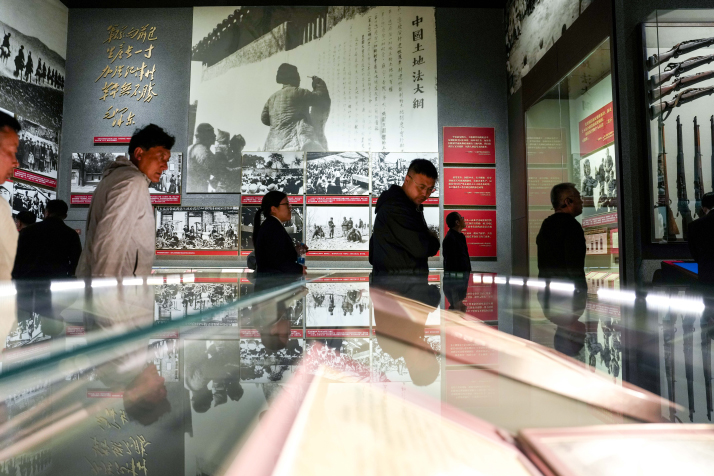
The Fifth Plenary Session of the 20th Central Committee of the Communist Party of China (CPC) was held in late October. It adopted a resolution on persevering with full and rigorous Party self-governance, offering a timely moment to revisit a persistent analytical problem. Too often, the CPC is assessed through categories developed to describe political parties that operate within the institutional and historical constraints of Western countries.
Those categories obscure more than they reveal. The CPC is not a political party that competes for office within a pre-existing constitutional order. It is an agent of historical change that first seized state power through revolution and now bears responsibility for governing a vast and complex society through a prolonged period of socialist construction and development. Recognizing this difference is essential if analysis is to move beyond surface comparisons and engage the Party’s actual role, structure and self-understanding.
Three differences, historical, organizational and democratic, are especially consequential, and each is routinely flattened by the standard comparative toolkit.
Back to basics
The first and most fundamental distinction is historical and functional. Western political parties, for all their variations, generally accept the existing framework of the state and contest power within it. Their purpose is to form governments, pass legislation and respond to electoral cycles. The CPC’s trajectory has been different. From its founding it understood itself as a revolutionary vanguard whose task was to transform the social and political order, not merely to administer it. After the founding of the People’s Republic of China in 1949, that revolutionary role evolved into the responsibilities of long-term governance.
The Party did not inherit a settled institutional architecture and then compete for control of it; it constructed the new state and has continuously adapted both the state and itself to the requirements of national development. Marxism-Leninism provided a powerful theory of revolution and class power, but it did not supply a complete theory of the socialist state in conditions of prolonged peace, industrialization and global integration.
The practical and theoretical work of defining what a governing Marxist party must be has therefore been continuous. The recent resolution on self-governance is one more step in that work: clarifying the organizational, political and ethical conditions under which the Party can continue to fulfill its role as the leading force of socialist modernization.
This historical identity has consequences for how the Party relates to society and the broader political landscape. It is not one voice among a plurality of equivalent parties. China has eight political parties besides the CPC; these are not opposition parties or out-of-power parties, but participating parties under socialism with Chinese characteristics in cooperation with the CPC. They accept CPC leadership and do not contest for governing authority.
It is the institutional center of a political system whose legitimacy rests on performance, continuity and the capacity to deliver long-term national goals rather than on periodic alternation in office. To treat it as if it were a conventional electoral party is to miss the logic of its formation and the nature of the responsibilities it has assumed.
A second distinguishing feature is scale and social penetration.
With membership exceeding 101 million, or roughly 7 percent of the population, the CPC combines a scale unmatched by any other ruling party with an organizational density that reaches into workplaces, villages, urban neighborhoods, universities and professional associations nationwide.
This penetration is not merely quantitative. It creates dense channels of information, mobilization and cadre recruitment that shape both policy implementation and intraparty political culture. The insistence on full and rigorous Party self-governance must be understood in this context. When an organization of this scale and reach weakens internally—through corruption, ideological drift or organizational laxity—the consequences for governance capacity are systemic. Conversely, when the Party strengthens its internal standards, the effects radiate outward through the same networks. The mass character of the Party is therefore both a source of strength and a continuous demand for disciplined self-management.
The third dimension concerns the development of socialist democracy and the problem of political proximity. One of the central challenges of any large-scale system of governance is the distance that tends to open between those who make and execute policy and those who live with its consequences. Nineteenth-century French social scientist Emile Durkheim, writing in his work Professional Ethics and Civic Morals, identified this distance as a core obstacle to effective democratic practice.
When the governed feel that decision-makers are remote, unaccountable or unresponsive, the moral and practical foundations of collective life erode.
A parallel concern runs through traditional Chinese political thought: The quality of governance depends on the ability of rulers and officials to remain attentive to the conditions of the people and to correct their own errors.
Narrowing the distance
The CPC’s promotion of whole-process people’s democracy can be read as a contemporary effort to narrow that distance through institutional means—consultative mechanisms, grassroots participation, inspection systems and the continuous circulation of information between the center and the periphery.
These initiatives do not replicate the competitive electoral model of Western countries. They pursue a different logic: embedding the Party more deeply in society while simultaneously subjecting it to stricter internal and public scrutiny.
These range from grassroots consultative bodies and outreach stations for people’s congress deputies to inspection and petition systems that channel local complaints upward.
The recent emphasis on self-governance, Party spirit, organizational integrity and the integrated fight against corruption is consistent with this approach. A political party that claims to lead must continuously reduce the gap between its formal authority and its practical responsiveness. Whole-process people’s democracy and rigorous Party self-governance are therefore not separate projects; they are complementary methods of maintaining the proximity that effective governance requires.
Taken together, these three dimensions—historical agency, mass organizational form and the deliberate cultivation of socialist democratic proximity—explain why the CPC cannot be adequately understood through the conceptual toolkit developed for Western political parties. It is not a competitor within a fixed constitutional game. It is the central actor in an unfinished process of national transformation that it both leads and is transformed by.
The resolution adopted at the Fifth Plenary Session of the 20th CPC Central Committee is best read in this light: not as routine internal housecleaning, but as part of the ongoing effort to ensure that the Party remains capable of the historical role it has assumed and to adapt to that role as the process continues. –The Daily Mail-Beijing Review News exchange item