
By Asad Cheema
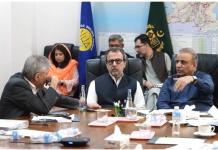
ISLAMABAD: Federal Minister for Finance and Revenue Senator Muhammad Aurangzeb and World Bank (WB) delegation, led by Vice President for Human Development ,Ms. Mamta Murthi here on Wednesday discussed strengthening cooperation in human capital development, focusing on skills enhancement, improved health outcomes, education, social protection and technology-driven public service delivery.
The delegation included Ms. Bolormaa Amgaabazar, Country Director for Pakistan; Ms. Keiko Inoue, Regional Director for Human Development; Ms. Sherin Varkey, Health Practice Manager; and Mr. Simon Andrews, IFC Director, according to press release issued by finance ministry.
On the occasion, Aurangzeb appreciated the World Bank Group’s continued partnership with Pakistan and acknowledged its support for the country’s development and reform priorities.
He noted that while Pakistan had made important progress in restoring macroeconomic stability, the government’s focus has been increasingly directed towards improving social and human development outcomes through targeted investments in health, education, skills development, and social protection.
He emphasized the importance of maintaining a strong focus on measurable outcomes and effective implementation under the World Bank’s long-term Country Partnership Framework with Pakistan.
The minister highlighted that Pakistan’s large and youthful population presents both a significant opportunity and an important policy priority.
He underscored the need to improve human capital indicators, strengthen workforce participation, and equip young people with skills aligned with evolving labour market requirements.
He further emphasized that sustained economic growth and competitiveness would require continued investments in people, alongside reforms aimed at improving productivity, service delivery, and employment generation.
Discussions focused extensively on Pakistan’s human development agenda, including maternal and child health, nutrition, immunization, early childhood development, education outcomes, and population-related challenges.
Aurangzeb emphasized the need to prepare Pakistan’s workforce for a rapidly evolving global economy, while the World Bank delegation shared international experiences relating to technology-driven service delivery, healthcare financing, and private sector participation.
He emphasized the importance of upskilling and reskilling Pakistan’s workforce to meet emerging economic needs and create pathways to higher-value employment opportunities. He noted that strengthening employability, particularly among young people, would remain central to the Government’s broader economic transformation agenda.
On the occasion, Ms. Mamta Murthi emphasized that long-term development outcomes would depend on sustained progress in key human capital indicators, particularly child nutrition, reduction in stunting, foundational learning, and access to quality healthcare and education services.
She noted that the World Bank’s engagement was focused on supporting measurable outcomes and strengthening service delivery systems to ensure that essential interventions reach mothers and children effectively across the country.
The meeting also covered opportunities to strengthen primary healthcare systems and expand access to essential services for mothers and children.
Participants exchanged views on the growing role of artificial intelligence and digital technologies in healthcare, education, and workforce development.
The meeting further explored opportunities for broader collaboration between the Government, the World Bank Group, and the private sector in support of Pakistan’s human capital objectives.
In this regard, Ms. Mamta Murthi invited Pakistan to participate in an upcoming global forum on Universal Health Coverage to be held in Japan later this year.
She noted that the forum is a collaborative initiative supported by the Government of Japan and jointly facilitated by the World Bank Group and WHO to advance progress towards Universal Health Coverage.