
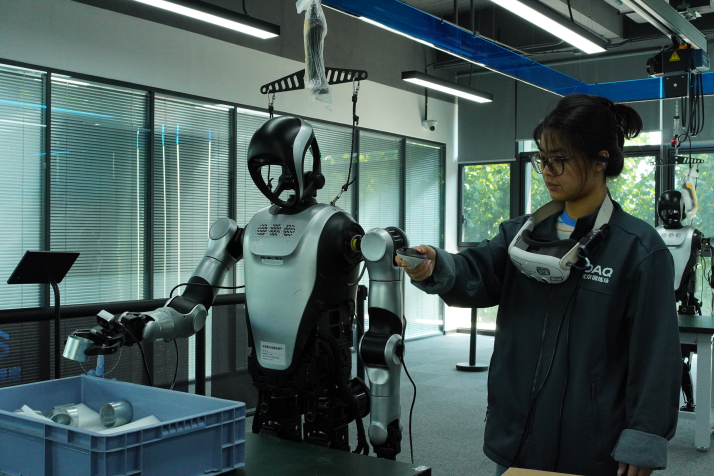
In a cavernous data-collection facility at China’s largest full-size bipedal humanoid robot training center in Beijing’s Shijingshan District, a robot dips a brush into ink, steadies its wrist and writes a Chinese character on paper. The demonstration is actually part of the center’s daily work: collecting data, refining algorithms and improving robotic skills.
The training center houses more than 100 robots operating within highly realistic simulation environments under the supervision of data collectors. They perform slow-motion tai chi movements, sort parcels, fold clothes and complete household tasks, demonstrating how embodied intelligence is moving into logistics, hospitality, manufacturing and other real-world settings.
Zhu Kai, General Manager of the training center, told Beijing Review that each robot completes more than 1,000 training interactions a day. Through motion-capture technology and environmental sensors, the machines continuously improve their ability to adapt to real-world service scenarios.
The center aims to build itself into an industrial platform that covers diverse application scenarios, captures multidimensional data, connects the entire technology chain and supports a coordinated ecosystem, Zhu added.
These “trainees” will soon be showcased at the 13th edition of China International Fair for Trade in Services (CIFTIS), scheduled to be held in Beijing from September 9 to 13. Shijingshan, the permanent host district of the annual trade fair, is betting on large-scale data-training infrastructure as a foundation for an embodied intelligence industrial park—one that connects research and development (R&D), scenario-based training, commercialization and global deployment.
The technology-driven upgrade of service industries is a highlight for this year’s event. According to the CIFTIS organizers, it will establish a dedicated smart services exhibition zone, highlighting advances in embodied intelligence and promoting international cooperation.
The CIFTIS 2026 will also for the first time set up a promotion and roadshow zone for overseas expansion services. More than 80 Chinese and multinational enterprises and institutions plan to release over 180 innovative achievements covering AI, healthcare, cultural exports and green development.
Bridging the lab-to-factory gap
As the humanoid robot industry is still in its early commercialization stage, CIFTIS serves as a vital platform for technology exchange, business matchmaking, application partnerships and global expansion, driving a shift from hardware exports toward integrated intelligent solutions.
Founded in 2025, Shijingshan-based Anyverse Dynamics is dedicated to core technological breakthroughs and global industrial applications in embodied intelligence. The company will make its debut at CIFTIS this year, leveraging the fair to expand international partnerships. Under the theme Going Global, its exhibition will feature live demonstrations that combine industrial automation with commercial service applications.
“We expect to showcase how embodied intelligence is moving from research laboratories into real-world deployment,” Xiao Jingwen, the company’s general manager for business development and ecosystem partnerships, told Beijing Review.
According to Anyverse Dynamics, its robots, including the second-generation K15, powered by a self-developed general-purpose brain model, have already made their way into overseas markets, notably battery manufacturing plants in France. To date, the company has secured global orders worth 700 million yuan ($103 million), including China’s first overseas embodied-manipulation order exceeding 100 million yuan ($14.8 million).
In overseas markets, Anyverse Dynamics also provides full-stack embodied intelligence solutions, including maintenance services, scenario customization and continuous data optimization. These offerings combine technology and data services and intelligent operations, creating new growth opportunities, the company said.

Bottlenecks remain
The year 2025 is widely considered China’s first year of humanoid robot mass production, with over 140 domestic manufacturers releasing more than 330 different models, according to the Ministry of Industry and Information Technology.
In the first six months of this year, China-developed quadruped robots accounted for nearly 70 percent of global sales, the ministry said.
The industry reached a historic milestone on August 19, with Unitree Robotics becoming the first humanoid robot maker to be listed on China’s yuan-denominated A-share market. Its shares ended the day up 460.34 percent on the Shanghai Stock Exchange’s sci-tech innovation board, or STAR Market.
Founded in 2016 and headquartered in Hangzhou, Zhejiang Province, Unitree Robotics specializes in the R&D of quadruped and humanoid robots. In 2025, its humanoid robot shipments surpassed 5,500 units, ranking first globally.
In March, China released its first national standard system covering the full industrial chain and lifecycle of humanoid robots and embodied intelligence, laying a regulatory foundation for the sector’s development.
Yet as the industry accelerates, new bottlenecks are emerging. Zhu said at a CIFTIS news briefing held in early August that the industry’s biggest challenge has shifted from hardware production to the shortage of high-quality, multimodal, real-world robot data.
In the first half of 2026, China shipped 23,000 humanoid robots, but fewer than 5 percent were operating stably on factory production lines. Globally, industrial-grade multimodal datasets available for training remain far below industry demand, with major gaps in force-tactile sensing, fine manipulation and complex unstructured environments, Zhu said.
This shortage of real-world data is one reason why many robots remain confined to exhibitions rather than widespread commercial deployment, he added.
Zeng Hui, Senior Vice President of Beijing-based robot company Galaxy General Robotics, said at the same briefing that achieving general-purpose intelligence faces four key barriers: insufficient high-quality data, weak cross-scenario and cross-task adaptability, the persistent separation between robotic cognition and motion control, and the lack of a unified, continuously learning model architecture.
According to Zhu, these challenges cannot be tackled by individual companies alone and demand coordinated efforts across the wider industrial ecosystem.
A frontier
The training center in Shijingshan, a public-private partnership project covering over 10,000 square meters, is therefore built to empower robot brains.
It is also developing a compliant cross-border data-flow platform to support overseas deployment and help Chinese robotics companies navigate regulatory challenges.
“Cooperation between the Shijingshan District Government and private enterprises on building the training center has alleviated the financial burden on companies to build and maintain shared infrastructure,” Zhu said.
According to the news briefing, government support for China’s humanoid robot sector has evolved from individual policy incentives toward ecosystem building. The approach now encompasses strategic planning, long-term investment, open application scenarios, data resources, computing infrastructure, pilot production lines and talent development. –The Daily Mail-Beijing Review news exchange item