
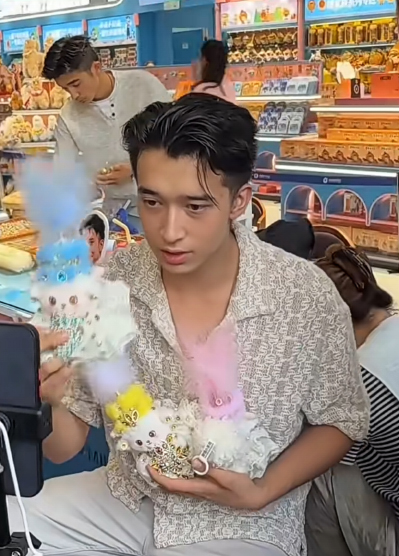
The toy is small enough to fit into a backpack. With curly white wool, bright Atlas silk patterned clothing, a traditional Uygur-style embroidered cap, and glittering faux gemstones stitched by hand, it was jokingly called the “Xinjiang Labubu” on Chinese social media.
Abudula’s daily work often continues until after 8 p.m. “Every morning, upon opening my eyes and washing my face, I start making lambs,” Abudula said. He is now known online as “Xinjiang Lamb Brother.”
Usually, Abudula makes 200 toy lambs every day. A more intricately designed lamb takes about six minutes to make, while simpler versions can be finished in three. During peak tourist season, his family all pitch in. Together, they produce more than 600 toy lambs a day. Despite the speedy production of the toys, during peak demand, visitors reportedly waited up to four hours to purchase them.

A tailored souvenir
Consumers adore the lambs not just for their cuteness, but also for the chance to take part in their making. Customers first select a plain “naked lamb,” then choose fabrics, hats, feathers and accessories before watching the toy be assembled by hand in front of them. Within minutes, a personalized souvenir emerges. Many visitors describe the experience less as shopping than as adoption.
“No two Xinjiang Lambs in the world are exactly alike, just as no two memories of Xinjiang are the same,” Sun Yu, a tourist from Shanghai, told China Tourism News. After waiting in line for several hours, Sun finally received her own lamb. “What I bought wasn’t just a doll, but a personalized impression of Xinjiang. Even though it only takes a few minutes to finish, the sense of co-creation—having watched it become mine—constantly reminds me of the streets I wandered through and the fruit I tasted at the Grand Bazaar.”
Min Jie, Vice Chairman of the Shanghai Modern Culture and Tourism Promotion Center, told China Tourism News that on-site handmade DIY process ensures every lamb has unique, non-replicable details, perfectly aligning with younger consumers’ growing preference for personalized experiences.
For years, tourism campaigns in China focused heavily on scenery: mountains, deserts, historical landmarks… But younger travelers increasingly prioritize interactive and emotionally specific experiences. Souvenirs are expected to tell stories. Trips are designed around shareable participation as much as destinations themselves.
The Xinjiang Lamb fits neatly into that economy. It is affordable, visually distinctive, easy to photograph and deeply customizable. More importantly, it transforms purchasing into performance. Customers do not simply buy the toy; they document the process of watching it become theirs.
That imbalance—hours of anticipation for a handmade object assembled in public view—is central to the appeal. In a consumer economy dominated by mass production, visible labor itself has become a form of luxury.
That emotional attachment has helped fuel a secondary online culture around the lamb. On social media platforms such as Xiaohongshu (RedNote) and Douyin, users regularly post requests asking strangers in Xinjiang to purchase one on their behalf. Many local residents volunteer to help. The exchanges carry a tone that feels unusually personal for Internet commerce.
Chen Bin, Secretary General of the Tourism Commodities and Equipment Branch of the China Tourism Association, said as tourism consumption shifts from simple sightseeing to emotional and experiential engagement, a cultural product capable of telling stories and carrying memories gains significance far beyond that of an ordinary souvenir.
More than a viral sensation
China’s online economy produces viral sensations frequently. Most disappear within weeks or months. But the rise of the Xinjiang Lamb became something larger: a case study in how local culture, emotional consumption and social media storytelling are reshaping tourism in Xinjiang.
For years, Xinjiang has occupied a particular place in China’s travel imagination: distant, vast and cinematic. Its deserts, mountains and grasslands have long drawn visitors seeking spectacle. But spectacle can feel abstract. Travelers leave with photographs and refrigerator magnets, while the emotional texture of a place often disappears once the trip ends.
The lamb has changed that equation by allowing young visitors to carry some of that emotional texture home with them. Its details are intensely local. Atlas silk patterns reference a traditional textile associated with Uygur craftsmanship. The embroidered caps echo styles commonly seen in southern Xinjiang bazaars. The sheep itself is a symbol of the region’s pastoral culture.
“I didn’t make the Xinjiang Lamb popular,” Abudula said in one interview that later circulated widely online. “These local traditions deserved to be seen.”
The city’s response became part of the story itself. The crowds soon overwhelmed the small underground stall where Abudula originally worked. Videos of long lines and cramped waiting areas began circulating online.
Urumqi’s local authorities moved quickly to address the issues. Officials relocated the stall to a larger storefront near the bazaar. Rest stations, water dispensers and shaded waiting areas appeared nearby. A reservation system was introduced to manage crowds. Tourism authorities even launched a free Lamb Tour bus route connecting visitors to local attractions while they waited for pickup times.
On July 10, the young vendor was officially appointed as Urumqi’s cultural tourism ambassador after videos of his workshop-style stall spread across Chinese social media. Social media users praised what they described as a willingness to listen to online feedback in real time. Vendors near the bazaar extended business hours. Restaurants offered snacks to tourists standing in line late into the evening.
The result was that a single viral product began generating economic spillover far beyond one souvenir stall.
In Hetian (Hotan), sales of Atlas silk products reportedly surged. In Kashi (Kashgar), tourists began showing renewed interest in felt handicrafts, engraved knives and traditional artisan workshops. Nearby cafés and snack shops developed lamb-themed merchandise and collaborative products designed for social media sharing.
The phenomenon reflects a broader shift in China’s domestic tourism industry, where local governments are increasingly trying to transform short-term Internet attention into long-term cultural branding.
Internet trends rarely last long in China. But for one summer in Urumqi, a handmade toy lamb has managed to make the distant region feel closer to netizens around the country.
Challenges
As the popularity of the Xinjiang Lamb continues to grow, new challenges have emerged, including limited handmade production capacity leading to longer waiting times, counterfeit products, and scalpers hoarding goods for resale at inflated prices. Converting short-term online popularity into long-term value has become a pressing issue for all parties involved.
Regarding the long-term development of viral cultural intellectual properties, Min proposed a systematic operational strategy for the industry. On the intellectual property and production side, he suggested completing comprehensive trademark and design patent registrations as soon as possible, adding exclusive anti-counterfeit labels to authentic products, and maintaining regular enforcement against online infringement. He also recommended adopting a semi-handmade production model and supporting more local artisans to join the supply chain. On the branding side, he called for expanding product categories, establishing a unified visual identity system, and launching official online sales channels. –The Daily Mail-Beijing Review news exchange item